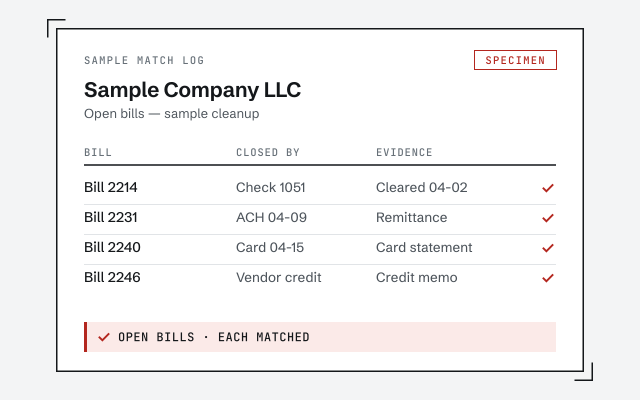
Four situations decide how an A/P cleanup actually runs, and each has a boundary we hold rather than a judgment we make for you.
Bills that will never be paid
A bill that is genuinely not owed — a duplicate entry, a cancelled order, an amount the vendor wrote off — is cleared with a vendor credit applied against it, so the aging drops without pretending money changed hands. You see the list and the supporting evidence before anything is applied, and nothing is cleared on a guess.
Bills dated inside a closed period
QuickBooks does not provide a way to clear bills dated on or before a closing date without affecting closed books. Those bills are separated out, listed with dates, vendors and amounts, and handed to you and your accountant. What happens to a filed year is their call and we do not make it quietly.
Duplicate vendor records
When one supplier exists under two spellings, their bills and payments split between the two names and neither balance is right. Merging them brings the history together so the combined balance comes out correct — done carefully, because a merge cannot be undone and the wrong merge is worse than the duplicate.
Bills that carry inventory
A bill that received inventory is not just a payable; clearing it carelessly moves inventory quantities and cost of goods with it. Those are flagged before anything is touched, because a correction that fixes the aging and breaks the inventory valuation has not made the file better.