Most "results" pages ask you to trust a wall of quotes and numbers. This one does the opposite. The only result that matters is the state your own QuickBooks file is left in — so here is exactly what that looks like, and how you can confirm it without taking our word for anything.
What "results" mean here
A result here is a verifiable state of your file, not a testimonial about someone else's: your accounts are reconciled, your chart of accounts is clean, your reports tie, and you hold a written record of every change that got you there.
We deliberately do not define results the way a lot of firms do — with quotes, star ratings, logos, or a percentage that sounds impressive and cannot be checked. Those are claims about other people's files that say nothing certain about yours. What we can stand behind is the condition we leave your books in, because that is something sitting in front of you that you can open, test, and question. Everything below describes that finished condition in plain terms, and the section after it shows you how to prove each part for yourself. Whether the job was a one-time QuickBooks cleanup or the first month of ongoing work, the shape of a good result is the same; only the size of it changes.
Reconciled books that tie to the statement
The first result is that every bank and credit-card account reconciles — its ending balance in QuickBooks matches the statement, with no unexplained difference and no pile of stale uncleared items.
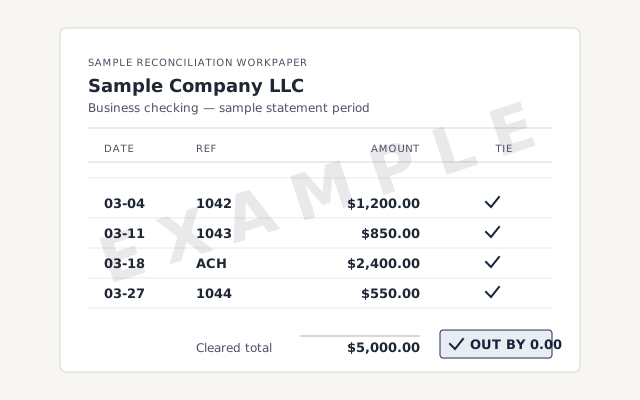
Reconciliation is the load-bearing result because everything else depends on it. When an account ties to its statement, you know every transaction that should be there is there, nothing is duplicated, and nothing was invented. That is what turns a profit and loss from a guess into a report you can act on. A finished file has each account reconciled through the agreed period, the uncleared list explained rather than ignored, and any opening-balance oddity resolved instead of buried. You do not have to take that on faith: a reconciliation is the one result you can re-run yourself, statement in hand, and confirm to the penny.
A documented change log you keep
The second result is a written change log: a plain record of every correction made to your file — what changed, why, and where its history went — that stays with you after the engagement ends.
This is the artifact we care most about handing over, because it is what makes the work auditable long after we are gone. A number you cannot explain is a liability; a number with a documented reason behind it is an asset, and the change log is where those reasons live. It lists each account and entry that moved, the decision behind the move, and the trail back to the original state, so nothing about the finished file is a black box. If, six months later, you or your accountant wonder why a category was split or a duplicate was removed, the answer is written down rather than locked in someone's memory. That log is also the practical result of how we work — every change mapped and approved before it is made, as the methodology spells out.
Reports that tie, before and after
The third result is that your reports still tie: the profit and loss and balance sheet read correctly now, and the prior periods you had already filed on still match, because we compared before-and-after snapshots on every change.
A cleanup that fixes the present by quietly breaking the past is not a result — it is a new problem wearing a tidy coat. So a proper finished file comes with the evidence that this did not happen: a set of "before" report snapshots taken at the start, and the matching "after" reports that show current numbers corrected while historical totals hold. If a filed period had been about to shift, that comparison would have caught it during the work. The finished state is one where your current books are right and your history is undisturbed — and both halves of that are things you can lay side by side and check.
An audit-ready trail for your CPA or a lender
The fourth result is that the whole file is audit-ready: an outside reviewer — your CPA at tax time, a lender doing diligence — can trace any figure back to its reason without needing us to explain it.
This is really the sum of the first three. Reconciled accounts, a documented change log, and tying reports together mean that any number in your books has a visible path behind it. When your accountant asks why an account looks the way it does, the answer is in the log; when a lender wants comfort that the statements are real, the reconciliations are the proof. A file that can survive that kind of outside look without a scramble is the strongest result we can point to, precisely because it does not depend on us being in the room. You can hand it to a stranger and it holds up.
What you keep
How you'll know it worked
You will know it worked by checking it, not by reading a review — reconcile an account against its statement, compare your report snapshots, and trace any number you doubt through the change log.
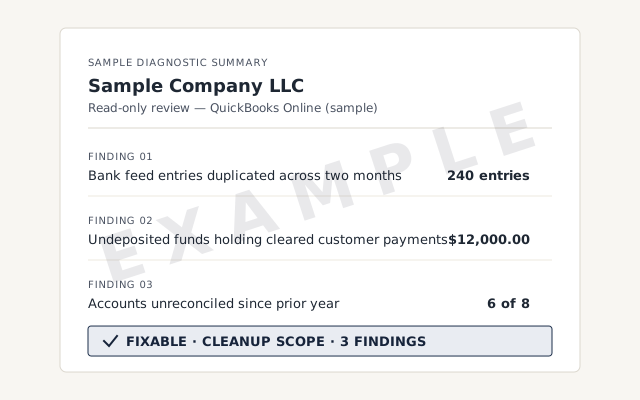
Below are the specimen frames for the records a finished engagement produces. They are honestly labeled examples — the layouts you will receive, shown without any invented client data — because we will not paste a fabricated screenshot or a manufactured quote in their place. Each one names a check you can perform yourself: the review write-up you keep, the reconciliation you can re-run, and the response you can hold us to. That is the whole idea of results here. The proof is not a story you are asked to believe; it is a set of things you can independently confirm.
The verification loop