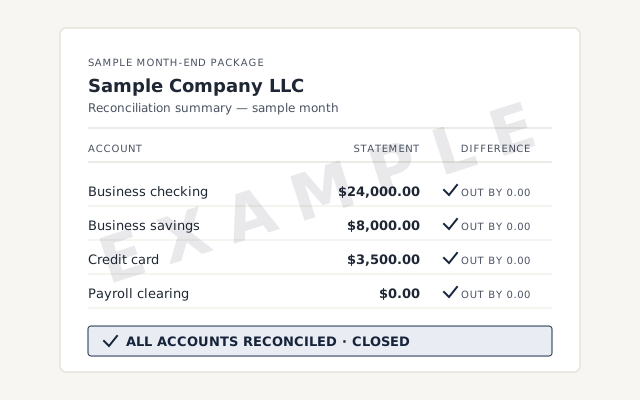
 Sample workflow — not a specific client’s data
See a sample month-end package
The exact reconciliation reports and statements you receive at each month's close.
Monthly bookkeeping
Monthly bookkeeping keeps your QuickBooks current every month: every bank and card account reconciled, every transaction categorized, the results reviewed, and a closed month-end package delivered. One firm — never a rotating pool — owns your file, remote, on a fixed monthly fee, so your numbers are true whenever you need them.
Monthly bookkeeping is the recurring service that keeps your QuickBooks current: every bank and card account reconciled to its statement, every transaction categorized, and each month formally closed so your reports are true at any point in the year.
It is the ongoing counterpart to a one-time cleanup. Where cleanup and catch-up are projects with an end date, the monthly service is a standing cadence — the same disciplined pass over your file, period after period, so the numbers never drift out of date. The output is not just a tidy ledger; it is a set of reconciled, closed financials you can hand to a lender, a CPA, or a decision without a scramble first.
You need monthly bookkeeping once your business runs enough activity that the books drift when no one tends them — typically past a few dozen transactions a month, or as soon as you add payroll, inventory, or a line of credit.
The trigger is rarely revenue; it is complexity and volume. A consultant with one bank account and ten transactions a month does not need a monthly service. A contractor with a card, a loan, payroll, and job costing does, because every untended week compounds into a reconciliation problem. If you find yourself reconstructing months at tax time, or you can't answer "how did we do last month" without a day of work, you have already outgrown doing it yourself.
Every month of the service covers the same fixed scope, so nothing quietly falls out of your books. We reconcile each account to its statement, categorize the month's transactions, review the results against the prior period, and deliver a closed month-end package. Concretely, a standard month includes:
The scope is the same whether the month was quiet or busy — you are paying for a closed, reconciled month, not a variable pile of hours.
The monthly service runs entirely remote: one firm — never a rotating pool — owns your file, reconciles and closes each month, and uses QuickBooks' accountant access to make and log every correction — never your bank logins.
We pull each month's activity from your bank and card feeds, then reconcile and close it. Nothing moves off your systems: the work happens inside your QuickBooks under accountant access, where every change is logged, and the statements you provide are what the file is tied to. You can watch any close over screen-share, and every month is documented in writing, so you are never asked to take the result on faith. Because the same hands handle your file each month, context carries forward — we already know your vendors and categories, so questions get fewer over time rather than starting from zero.
The monthly cycle is the same loop every period: reconcile each account to its statement, categorize the month's transactions, review the P&L and balance sheet for anything out of pattern, then deliver the verified month-end package.
The loop repeats the next month, and the order matters. Reconciliation comes first because it proves the raw data is complete before anything is categorized or reviewed; a P&L built on an unreconciled account is a guess. Only once every account ties to its statement do we code and review, so the financials you receive rest on verified cash. The cycle is deliberately boring, and that is the point: a predictable, repeatable close is what keeps a healthy file healthy.
The monthly cycle
The month-end package delivered every month contains a reconciliation report for each account, a profit-and-loss statement, a balance sheet, and a short written note on anything unusual.
This is the same deliverable a formal month-end close produces, and it is the record a lender, a tax preparer, or a future you can actually rely on. Nothing is left implicit. If an account didn't reconcile cleanly, the note says why and what we did; if a number moved sharply from last month, it's flagged. The package is built to be picked up cold by your CPA at year-end without a single follow-up question. If you'd rather run the close yourself, the same sequence is public: our month-end close process guide documents each step, the month-end close checklist is the printable working list, and the month-end close template gives you the workpaper to fill in.
Because the monthly service is remote, your location never limits access: we keep Mon–Sat · 8am–6pm CT, which overlaps standard business hours in every U.S. time zone, from a Pacific morning to an Eastern early-evening.
Our desk is reachable during your working day whether you run in Los Angeles or New York. Remote does not mean absent: you get a written reply within one business day, and screen-share is available whenever you want to watch a close or walk through a number. You can see exactly where we work and how coverage lands across the map.
Time-zone coverage
Monthly bookkeeping adapts to the harder cases: accrual books where a lender or CPA requires them, multiple entities kept on separate files, and a catch-up first when your file arrives behind.
Most small businesses keep books on a cash basis; we run accrual where a lender, investor, or CPA requires it, or where accrual reflects your operations more honestly than cash. Multiple entities stay on separate files, closed independently, with inter-company items handled deliberately rather than blended by accident. When you come to us behind, we don't start the monthly cycle on a broken file — we catch up the missing months first, as a fixed-scope engagement, and repair anything a cleanup would fix before the recurring close begins. And for seasonal businesses, the fixed monthly fee smooths the work: quiet months cost the same as busy ones, so you are never penalized for a strong season or forgotten in a slow one.
QBSpecialist's monthly service differs in three verifiable ways: the same hands do the work start to finish, every account is reconciled before a month is called closed, and the fee is fixed rather than billed by the hour.
You are not handed to a junior each quarter or nickel-and-dimed for questions. If the alternative you're weighing is Intuit's built-in service, our side-by-side of QuickBooks Live vs. an independent bookkeeper is an honest look at where each fits. Our method is the same one we publish openly — every account tied to its statement, the reconciliation is the proof — so you can read exactly how we work before you hire us.
Every account is reconciled before we call a month closed — that is the standing commitment on every monthly engagement, and the reconciliation reports are yours to inspect at any time.
Don't hire a monthly bookkeeping service — including ours — if your books are genuinely simple: a single checking account, a handful of transactions a month, no payroll, no inventory.
At that size, QuickBooks' own bank feed and an hour of your own time each month will keep you current for less than any service costs. The honest test is whether tending the books yourself costs you real time or real accuracy. If a month takes you fifteen minutes and always ties out, keep doing it — our bookkeeping workflow guide lays out the weekly and monthly routine that keeps a simple file current on your own. If it eats an afternoon, or if you're not sure it ties out at all, that's when a service earns its fee. Not sure which side you're on? Our bookkeeping health score will tell you where your file actually stands.
Which cadence fits
An honest comparison — a slower cadence is cheaper, and truly simple books need no service at all.
| Monthly | Quarterly | DIY | |
|---|---|---|---|
| Books current at any moment | — | It depends | |
| Every account reconciled monthly | — | It depends | |
| Errors caught while still small | It depends | — | |
| Lender- or tax-ready on demand | It depends | — | |
| Demand on your time | Minimal | Some | Ongoing |
| Best fit | Volume, payroll, or inventory | Low, stable volume | Very simple books |
| Verdict | Current and hands-off | Cheaper but laggier | Free, if truly simple |
The monthly cycle
Days 1–3
Your bank and card statements close and the feeds finish importing the month's activity.
Days 3–6
Every account is tied back to its statement until the difference is zero.
Days 6–8
Every transaction is coded, then the P&L and balance sheet are reviewed against last month.
Days 8–10
Your closed month-end package arrives, with a written note on anything worth your attention.
What it costs
Real ranges are set after a free review. The floors shown are published starting points, not a quote for your file. For a rough number first, the monthly bookkeeping cost calculator turns your account count and transaction volume into an estimated range, and what actually drives the fee is broken down on our bookkeeping cost page.
| Engagement | Typical range | Timeline | What's included |
|---|---|---|---|
| Essential monthly | From $400/mo | Ongoing | Up to two accounts, cash basis, core reconciliation and categorization. |
| Standard monthly | Custom fixed quote | Ongoing | Several accounts, AR/AP review, and a full monthly P&L and balance-sheet package. |
| Complex / multi-entity | Custom fixed quote | Ongoing | Accrual, multiple entities, payroll, inventory, or class and job tracking. |
| Get your exact quote | |||
Essential monthly
Standard monthly
Complex / multi-entity
Sample workflow — not a specific client’s data
The exact reconciliation reports and statements you receive at each month's close.
Every account tied to its statement before a month is closed. Read exactly how.
Read the full methodQuickBooks' accountant access makes and logs every correction — never your bank logins — no data moves off your systems, and every month is documented in writing.
Remote-first, nationwide
Mon–Sat · 8am–6pm CT
We work entirely remote across every U.S. time zone — view-only access for the free review, QuickBooks' accountant access for the monthly work, screen-share whenever you want to watch a close, and a written record of every month.
A monthly engagement keeps a current file current, month after month. Catch-up enters months that were never recorded; cleanup corrects months recorded wrong.
If your books are simple — one account, a few transactions, no payroll — QuickBooks' bank feed and an hour a month will keep you current, and you don't need us. Volume, payroll, inventory, or lender reporting are what make a monthly service worth it.
Yes, but we catch you up first. We reconcile and close the missing months as a fixed-scope catch-up, then roll straight into the recurring monthly cycle so the file never falls behind again.
Whichever your business needs. Most small companies run cash basis; we run accrual when a lender, investor, or CPA requires it, or when accrual reflects your operations more honestly than cash. We confirm the basis before the first close.
Both. In QuickBooks Online the monthly work runs on QuickBooks' accountant access, which logs every change we make; Desktop runs by screen-share or a hosted file. Fully remote either way, nothing moves off your systems, and you can watch any close over screen-share.
Each month we reconcile every bank, card, and loan account to its statement, categorize every transaction, review receivables, payables, and the P&L and balance sheet against the prior month, then deliver a closed month-end package with a short written note on anything unusual. The scope is the same whether the month was quiet or busy.
Very little once set up: QuickBooks' accountant access so every correction we make is logged in your file — never your bank logins — your monthly bank and card statements, and a quick answer when a transaction needs context we can't infer. Most months need only a few minutes of your time.
From $400 a month. The fee is fixed after a free review — based on how many accounts you have, your transaction volume, and whether you need accrual, payroll, or multiple entities — and a quiet month costs the same as a busy one.
Typically within the first ten days of the new month. Once your bank and card statements post, we reconcile, categorize, and review — the closed month-end package usually arrives between day eight and day ten.
No. We keep the books your tax preparer or CPA files from — reconciled, closed, and ready to be picked up cold at year-end. We don't file returns or give tax advice.
We keep Mon–Sat, 8am–6pm Central, which overlaps standard business hours in every U.S. time zone from Pacific to Eastern. You get a written reply within one business day.
Yes. Each entity is kept on its own file and closed separately, with inter-company items handled deliberately. Multi-entity work is scoped into the monthly fee so nothing is double-counted or blended by accident.
Related work: month-end close, QuickBooks cleanup, and catch-up bookkeeping — all part of our full range of QuickBooks services — or get your free review to scope the monthly fit.