 Sample workflow — not a specific client’s data
A real catch-up summary
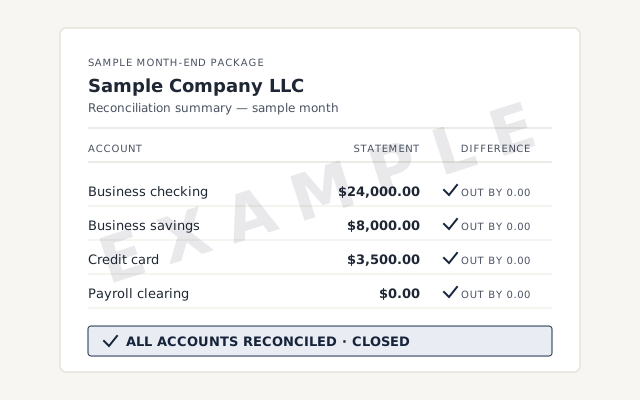
The year-by-year, month-by-month reconciliation summary you receive when the look-back is complete.
Answer
There's no fixed limit — books can be caught up as many years back as your records support, whether that's a few months or a decade. QuickBooks imposes no cap. What governs how far you go is three things: whether the source records still exist, what your tax filing obligation requires, and whether reconstructing an older year is worth the cost.
There is no rule that caps how far back books can be caught up — people expect one, three years or seven, but neither the software nor the bookkeeping trade draws that line. QuickBooks will happily hold a decade of history, and catch-up bookkeeping is the same task at year ten that it is at month two: enter each period's transactions and reconcile them to the statement. The work scales up; it doesn't hit a wall.
So the honest answer to “how many years back can books be caught up?” is: as far back as you have the records to support. The limit isn't a number in a manual — it's whether the evidence still exists, and whether going that far serves a real purpose.
Three gates decide how far back your books can practically go. The one that closes first is the one that binds — not the software, and not an arbitrary cutoff.
Records availability. This is the real ceiling. A month can only be reconstructed from what documents it: bank and credit-card statements, prior tax returns, payroll reports, invoices, and receipts. Most banks keep statements available online for a stretch and can produce older ones on request, so records usually reach further back than people assume. Where a record is genuinely gone, that period can't be reconstructed to the statement — and we say so rather than guess.
Your obligation. How far back you need to go is usually set by something concrete: an unfiled year, a return you want to amend, a lender or buyer asking for clean historical books. Your tax preparer, lender, or attorney names that target. We don't invent a reason to reach further than your situation calls for.
Cost. Every additional year is more months, more accounts, and more transactions to enter and tie out — so more scope. Older years can absolutely be caught up; the question becomes whether the value of having them justifies the work. That's a decision we lay out plainly so you make it with the numbers in front of you.
What sets the reach
The further back you go, the more likely the look-back is two jobs, not one. Catch-up bookkeeping enters the months your books never recorded. Cleanup corrects the months that were recorded, but recorded wrong — miscategorized transactions, unreconciled accounts, a drifted opening balance. A short gap is usually pure catch-up. A multi-year gap almost always mixes in some cleanup, because whatever partial records exist for those years tend to need correcting too.
That distinction matters for scope. We separate the two so nothing is counted twice, and so you can see exactly what each year is going to take. If you're carrying a long backlog right now, the fuller picture lives on behind on bookkeeping, and the fix itself is catch-up bookkeeping.
We work oldest-forward, one reconciled period at a time. We start by inventorying what records exist for the span you need, so we know the real reach before we quote. Then each month is entered, categorized, and reconciled to its statement, and every reconstructed year is brought to a filable state — with a written summary you could hand a preparer without a caveat.
Access stays view-only until you approve a scope, and we change nothing in your file without telling you first. Where a record is missing, we flag the gap in writing rather than paper over it. The full sequence — how we scope, reconstruct, and verify each period — is documented on our methodology page.
Which applies to you?
The right scope depends on how much history you need and how complete the records are. Here's how the common cases sort out.
Start here
How far back do your books need to reach?
Straightforward catch-up
Enter and reconcile the missing months and you're current — usually the smaller scope.
See catch-up bookkeepingMulti-year catch-up
Fully doable oldest-forward; the number of years drives scope and timeline, not whether it's possible.
See what being behind involvesReconstruct what's available
We rebuild from whatever records survive, reconcile what we can, and document any gap honestly — no invented transactions.
Start with a free reviewStraight talk
Just because a year can be caught up doesn't mean it should be. If a year is past any filing or amendment purpose, isn't needed for a loan or sale, and no one is going to read those numbers, reconstructing it is effort spent on history no one will use. We'll tell you when that's the case instead of quoting you for it.
The years worth catching up are the ones that do a job: an unfiled or amendable return, books a lender or buyer will examine, or a clean starting point you'll carry forward. Reach exactly that far — no less, and no further for its own sake. If you're not sure where that line falls, the free review sorts it out, and if the answer is “you don't need that year,” we'll say so. And if you'd rather keep reading first, our free guides, calculators, and answers cover the rest of the catch-up picture.
Sample workflow — not a specific client’s data
The year-by-year, month-by-month reconciliation summary you receive when the look-back is complete.
Each period reconstructed oldest-forward and reconciled to the statement. Read the method.
Read our methodologyA written reply within one business day.
Remote-first, nationwide
Mon–Sat · 8am–6pm CT
We work entirely remote — view-only access for the free review, QuickBooks' accountant access for the reconstruction itself, a screen-share whenever you want to watch, and every reconstructed period documented in writing.
Records set the ceiling — and it's usually higher than people assume, because most banks can produce older statements on request. We reconstruct each period from whatever survives: bank and card statements, prior returns, payroll reports, invoices. Where a gap truly can't be closed, we flag it in writing rather than invent transactions to fill it.
Only as far as a concrete purpose requires — an unfiled year, a return to amend, a loan application, a buyer's due diligence. Your tax preparer, lender, or attorney names that target. We catch up to it and stop; we won't quote you for history no one will use.
Yes. Cost tracks the work, and every added year is more months, more accounts, and more transactions to enter and tie out. We quote a fixed scope only after a free, view-only review shows how much history is actually there.
They're two different jobs that often travel together. Catch-up fills in months that were never entered at all; cleanup fixes months that exist but are wrong. A long look-back usually needs some of each, so we scope the two separately and nothing gets counted twice.
Yes. Each reconstructed year is entered, reconciled to its statements, and brought to a filable state, with a written summary you can hand your preparer without a caveat. The age of the year changes the scope, not whether it can be filed.