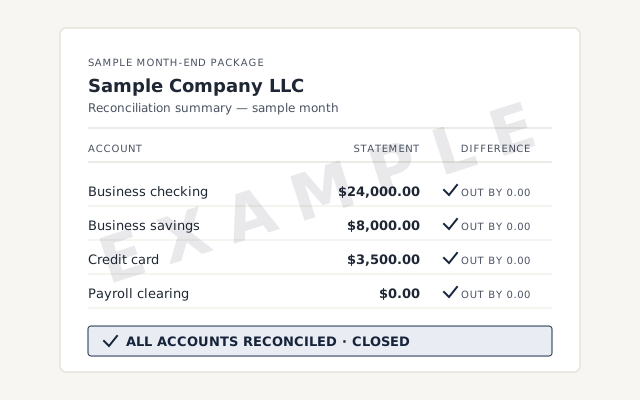
 Sample workflow — not a specific client’s data
A real repair record
The before-and-after file report you receive when a rescue closes.
QuickBooks rescue
The file gets repaired before anyone bookkeeps.
QuickBooks rescue diagnoses and repairs a company file that won't open, won't balance, or has gone corrupt — recovering your data and rebuilding the file before any cleanup or catch-up begins. We diagnose on a copy of your file first, tell you honestly what is recoverable, and quote a fixed repair before touching your books.
QuickBooks rescue is the diagnosis and repair of a company file that won't open, won't balance, or has gone corrupt — recovering the data, rebuilding the file, and verifying it holds before any bookkeeping begins.
It is a repair job, not a bookkeeping one — a rescue makes the file sound, but it does not make the numbers right. Once the file opens and holds, we tell you honestly whether it also needs a QuickBooks cleanup or catch-up bookkeeping, and scope that separately. Many files need a rescue first and bookkeeping after — priced as separate stages, never bundled to pad a bill. And if you're wondering whether the file is even worth saving, the short answer to whether QuickBooks can be fixed without starting over is almost always yes — a fresh file is rarely the right call. When the break has landed at the worst possible moment — payroll due, a filing deadline in sight — urgent QuickBooks help is where we cover the emergency version of this work.
The rescue path
You need a rescue when the file itself is broken — it won't open at all, throws a fatal error the moment it loads, or reports internal data damage that QuickBooks' own Verify and Rebuild utilities can't clear.
Most of what looks like a broken file is not. A great many QuickBooks error codes are network, permissions, or hosting problems rather than corruption: error H202 is a multi-user connection failure, and many 6000-series messages are simply the program unable to reach the file. Those are usually a quick fix — often one you can do yourself — and they are covered on our file-repair walkthrough.
A rescue runs in four stages — diagnose, recover, rebuild, verify. We open a copy of the file to see what is damaged, recover every record we can, rebuild the file structure, then verify it opens, holds, and balances.
On security: we diagnose and repair on copies, never on your original file — if a repair path fails, the original is untouched and we try another. Where a Desktop repair needs admin-level access to the file, it runs over a screen-share or a hosted copy you control. Every step is documented, and we never touch your bank logins.
You get a sound company file that opens and holds, a written record of exactly what was repaired and what — if anything — could not be recovered, and a plain plan for whatever bookkeeping the file still needs.
Where a file breaks depends on where its data lives. QuickBooks Desktop keeps a company file on your machine or server, so damage sits in that file and its indexes; QuickBooks Online keeps data on Intuit's servers, so a "rescue" there is a different job.
Desktop vs Online
Three things: the same firm does both the diagnosis and the repair — one set of hands, not a support queue; we scope and quote the repair before touching the file; and we tell you plainly when you don't need us at all.
Plainly: if your file still opens and your only problem is an error code or a wrong number, you probably don't need a paid rescue. Many QuickBooks errors are network issues, and minor file damage clears on its own.
QuickBooks ships its own repair tools — Verify Data and Rebuild Data — plus the free QuickBooks File Doctor, and between them they clear a lot of minor damage with nobody hired. If the file opens but a report is wrong, that's a cleanup, not a rescue. If you're staring at an H202 or a 6000-series error in multi-user mode, start with our error-code guide and file-repair walkthrough — you may fix it in minutes for nothing.
Come to us when the DIY path runs out: the file won't open, Rebuild won't clear the damage, or you can't afford to guess with data you can't lose. Not sure? Run the bookkeeping health score or send the file over for a free, view-only review — we'll say honestly whether it's a five-minute fix or a real rescue.
Timeline
A rescue moves through four stages, and the timeline is fixed before it starts. Most files are diagnosed within a day or two of the free review; the repair is scoped and quoted before it begins, never left open-ended.
Day 0
View-only look at the file; we confirm whether it opens and what the damage is.
Scoped first
We identify corruption, data loss, and what is recoverable, then quote the repair.
Once approved
Rebuild the file, recover what can be recovered, and verify it opens and holds.
On completion
A sound file, a written record of what was repaired, and a plan for cleanup or catch-up if the books need it.
Which do you need?
These three solve different problems. Rescue is the only one that repairs a broken file; cleanup corrects books that are wrong; catch-up enters months never recorded. Many files need one now and another next — in sequence, scoped apart.
| Rescue | Cleanup | Catch-up | |
|---|---|---|---|
| Repairs a broken file | — | — | |
| Corrects existing errors | It depends | — | |
| Enters missing periods | — | It depends | |
| Typical timeline | Scoped first | 2–4 weeks | 1–3 weeks |
| Best when | File won't open or is corrupt | Books exist but wrong | Months are missing |
| Verdict | File is broken | Wrong, not behind | Behind, not wrong |
What it costs
The diagnosis is quoted first; the repair itself starts from a floor set only after we've seen the file. Figures below are starting floors until the diagnosis on a copy of your file fixes a real, fixed quote — there is no hourly meter.
| Engagement | Typical range | Timeline | What's included |
|---|---|---|---|
| Diagnosis | Quoted | Scoped first | Diagnosis on a copy of the file: what is damaged, what is recoverable, and a fixed repair quote. |
| File repair | From $1,500 | Once scoped | Rebuild and data recovery until the file opens, holds, and balances. |
| Rescue + cleanup | Custom fixed quote | Scoped first | Repair the file, then reconcile and correct the books so you can file. |
| Estimate your cost with the calculator | |||
Diagnosis
File repair
Rescue + cleanup
Sample workflow — not a specific client’s data
The before-and-after file report you receive when a rescue closes.
A written reply within one business day.
Remote-first, nationwide
Mon–Sat · 8am–6pm CT
We work entirely remote — a view-only free review first, then repair on copies over screen-share or a hosted file, with admin-level Desktop access only where the repair itself requires it, and every step documented in writing.
Usually, yes. A file that won't open is the most common reason people come to us for a rescue. We start on a copy of the file, confirm whether it can be opened at all, and tell you honestly what state the data is in before proposing any repair.
Error codes point to where the file is unhappy — a damaged record, a network path, or a corrupted index — but the code alone rarely tells the whole story. We diagnose the underlying cause rather than guessing from the number, and we explain what we find before repairing anything.
Usually how the file was handled, not QuickBooks itself: a connection dropped mid-save, a forced shutdown, two people working in single-user mode, or a large file strained over a network. The diagnosis names the cause as well as the damage — a repaired file breaks again if the cause stays.
Often a great deal of it is, but honesty matters here: we can't promise full recovery until we have looked. The diagnosis step exists precisely to answer this. We tell you what is recoverable, what is not, and what a repair would involve before you decide to proceed.
The goal of a rescue is to preserve as much history as the file allows. Where records are damaged beyond repair, we document exactly what was affected rather than quietly dropping it, so you always know what the recovered file does and does not contain.
No. Desktop stores a company file on your machine or server, so corruption usually lives in that file and its indexes. Online keeps data on Intuit's servers, so a rescue there is more about untangling bad data and access than repairing a file. We work with both.
A rescue makes the file sound; it does not, by itself, make the books correct. Once the file opens and holds, we tell you whether it also needs cleanup or catch-up, scope that separately, and let you decide. Many files need a rescue first and bookkeeping after.
The diagnosis is quoted first. Repairs start from $1,500 — a floor, not a final price — and the exact fixed quote is set after the diagnosis on a copy of your file, once we know what is recoverable. There is no hourly meter, and nothing is charged before you approve the quote.
Most files are diagnosed within a day or two of the free review, and the repair carries a fixed timeline set before it begins. A file that won't open is not an open-ended project — you know the schedule before you approve it.
Sometimes, but honestly it depends on your backups. We can rebuild from a damaged or partial file and from QuickBooks' automatic transaction logs, but no one can recover data that was never saved anywhere. We tell you what is recoverable before you pay to try.
Often, yes. QuickBooks' built-in Verify Data and Rebuild Data, and the free File Doctor, clear a lot of minor damage — and if they fix it, you don't need us. Come to us when they can't, or when the file won't open at all.
If you have a recent backup and can accept losing everything entered since, restoring is often the fastest and cheapest path — and we will say so. A rescue earns its keep when the backup is old, missing, or damaged too, or when the gap holds work you can't afford to re-enter.
Before assuming corruption, check the specific code: error H202, error 6123, and error 6000 77 are usually network or permission issues you can fix yourself.