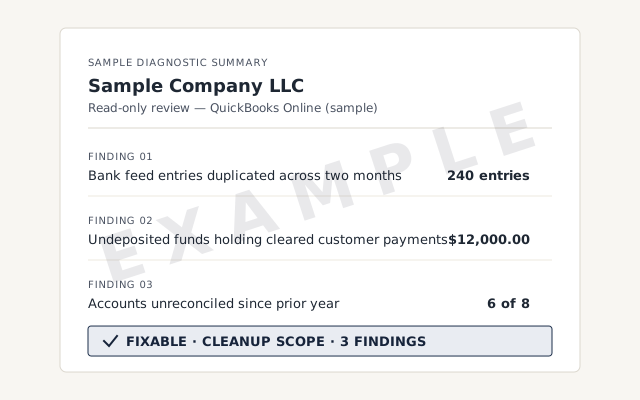
 Sample workflow — not a specific client’s data
A real before-and-after
The corrected balance sheet and the entry we traced, so you can see exactly what broke and what fixed it.
QuickBooks balance sheet out of balance
Assets don't equal liabilities plus equity? Here's the fix.
A QuickBooks balance sheet out of balance means total assets no longer equal liabilities plus equity — from a cash-vs-accrual view, a damaged transaction, a multi-currency gap, or a one-sided journal entry. A view issue you can fix yourself in a click; data damage or many bad entries need a cleanup, and a file that keeps breaking needs a rescue.
A balance sheet out of balance means total assets no longer equal total liabilities plus equity. That identity is supposed to hold on every date, automatically — so when QuickBooks shows a difference between the two totals, it's telling you something posted to one side without its matching half.
It matters because the balance sheet is the report every other number leans on. If it doesn't balance, your equity is wrong, your retained earnings are wrong, and any lender, buyer, or preparer who opens the file sees it immediately. The good news is that the difference is a precise clue: whatever the report is out by, that's the size of the entry you're hunting.
A QuickBooks balance sheet goes out of balance for one of four reasons: a cash-versus-accrual view that can't split certain transactions, a damaged transaction the file can no longer read, a multi-currency rounding gap, or a one-sided entry from a journal or an import.
The view issue is the friendliest — a cash-basis balance sheet often looks out of balance because inventory, unapplied payments, or transactions spanning two dates don't map cleanly onto a cash view, even though the accrual view is perfect. The other three are real: in QuickBooks Desktop, a true imbalance usually signals data damage; in either product, a one-sided journal entry or a sloppy import can post to assets without touching liabilities or equity. Multi-currency revaluation leaves the occasional residual. Each has a different fix, so naming the cause comes first.
The accounting identity, broken
A balance sheet that is out of balance becomes our kind of problem when the imbalance is real rather than a view — a damaged transaction, a multi-currency residual, or several one-sided entries — and it won't come out with a single correction. That's a cleanup, and a file that keeps breaking is a rescue.
The way to know is to find the exact date the balance sheet went out. You run it across a wide range, then keep halving the window — year, quarter, month, day — until one date remains. On that date sits the entry, or the damage, that broke the identity. When it's one clean entry, we correct it; when it's damage, or many entries across periods, it's a structured cleanup; and when the file breaks again after every repair, it needs a rescue before anything else.
Find the date it went out
We start by separating a view issue from a real one — switching the report basis and checking whether accrual balances — then, if it's real, we bisect the dates to find the day it broke and open the transactions on that day to see what posted one-sided or came back damaged.
From there the fix follows the cause: correct a bad journal entry, re-post a mangled import, resolve a currency residual, or repair genuine data damage and confirm it holds. The free review runs on view-only access; if you hire us, the fix uses QuickBooks' accountant access to make and log every correction — never your bank logins — and you're welcome to screen-share the diagnosis. If a rebuild clears it once but it breaks again, we tell you plainly that you're looking at a rescue rather than another patch.
Fixing an out-of-balance file is quoted as a fixed scope after a free, view-only review — never by the hour, and never before we've found what's actually wrong. A single one-sided entry is a small correction; recurring data damage across periods is a different scope entirely.
Because the cause changes the work so completely — a view issue is minutes, a damaged file is days — we don't put a number on it until the review tells us which one you have. What you get up front is a plain answer: view, entry, damage, or rescue, and the fixed scope that matches it.
One firm diagnoses the imbalance start to finish — never a rotating pool, and no guessing — and we find the exact date and entry that broke it rather than posting a plug to make the report look right.
That last part matters here more than anywhere. It is genuinely easy to “fix” an out-of-balance sheet by burying the difference in Opening Balance Equity or a journal entry, and plenty of files arrive that way. We do the opposite: locate the real cause, correct it, and leave you a balance sheet that balances because the underlying entries are right — not because a plug is holding it together.
Which do you need?
A cash-versus-accrual view or one obvious bad entry is a do-it-yourself fix. Data damage, multi-currency residuals, or a file that keeps breaking is where a specialist keeps a patch from becoming a bigger mess.
| Do it yourself | Specialist | |
|---|---|---|
| Out only in the cash-basis view | — | |
| One obvious one-sided entry | It depends | |
| Bisect the dates to find the break | It depends | |
| Damaged transactions to repair | — | |
| Multi-currency residual to resolve | — | |
| File keeps breaking after a rebuild | — | |
| Verdict | A view or single entry | Damage or many entries |
Honest answer
Not every out-of-balance balance sheet is a crisis. If it balances on the accrual basis and only looks wrong on the cash-basis report, most owners can resolve it themselves, because the file is fundamentally sound and the cash view is the quirk.
The businesses that need a specialist are the ones where accrual is out too — where a transaction is damaged, a journal entry posted to one side, or the file balances one week and breaks the next. Multi-entity and multi-currency files raise the odds, and so does a long history of “just make it balance” adjustments. If you can't tell whether it's a view or the real thing, that distinction is the first thing our free review settles.
Do-it-yourself
For a view issue or a single bad entry, the do-it-yourself fix is three moves: switch the report to accrual, run the “find the date it went out” bisection, and correct the entry on that date — or, for minor damage, rebuild the data.
First, change the balance sheet basis from cash to accrual. If it balances on accrual, you've found your answer: the imbalance is a cash-basis display quirk tied to specific transactions, not a broken file, and you can leave it or clean up the underlying entries at your leisure. If accrual is also out, run the bisection — set the report to a wide date range, then halve it again and again (year, then quarter, then month, then day) until you land on the single date it went out.
On that date, open a transaction detail report and look for the entry that posted to one side only, or one that won't open cleanly. Correct the one-sided entry, and you're done. If the culprit is damage rather than a mistake, run Verify Data and then Rebuild Data in QuickBooks Desktop. Where it stops being a do-it-yourself job is when the rebuild doesn't hold, the damage spans many transactions, or Opening Balance Equity has been used to force past balances — that's a cleanup, and a file that keeps breaking is a rescue.
Straight talk
Don't hire us if your balance sheet is perfect on accrual and only looks off on the cash-basis report — that's a known QuickBooks quirk, not damage, and you can switch the basis or leave it without harm.
Don't hire us for a single, obvious, one-sided journal entry you can already see and reverse yourself, and don't pay for a rescue when a one-time Verify and Rebuild quietly fixes it. We earn our fee when accrual is genuinely out, when the damage recurs, when multi-currency or multi-entity is involved, or when past “make it balance” adjustments have to be unwound. If a free review shows it's the simple kind, we'll tell you how to handle it and send you on your way.
Sample workflow — not a specific client’s data
The corrected balance sheet and the entry we traced, so you can see exactly what broke and what fixed it.
We find the real cause instead of plugging Opening Balance Equity. Read the method.
Read the opening balance equity referenceA written reply within one business day.
Remote-first, nationwide
Mon–Sat · 8am–6pm CT
We work entirely remote — view-only access for the free review, QuickBooks' accountant access if you hire us to correct it, screen-share whenever you want to watch the diagnosis, and every correction documented in writing.
Because total assets no longer equal liabilities plus equity. The usual causes are a damaged transaction, a one-sided entry from an import or journal, a multi-currency rounding gap, or a cash-basis view stumbling over transactions it can't cleanly split across accounts.
Often it isn't. A cash-basis balance sheet can look out of balance because certain transactions — inventory, unapplied payments, transactions that span dates — don't split cleanly onto a cash view. If accrual balances, the file itself is usually fine; the cash report is the issue.
It means the accounting identity is broken: assets should always equal what you owe plus what you own. When the report shows a difference, something posted to one side without its matching half — so the two totals that must agree, don't.
Yes. One damaged or one-sided transaction is enough, and the difference on the report equals that transaction's unbalanced amount. That's why finding the exact date it went out — then the entry on that date — is the fastest route to the fix.
They're QuickBooks Desktop utilities. Verify Data scans the file for damage and tells you it exists; Rebuild Data attempts to repair it. They resolve some out-of-balance cases, but not all, and they don't fix an imbalance that comes from a genuine posting mistake rather than damage.
Both are common. A mistake is a one-sided journal entry or a botched import; damage is a corrupted transaction the file can no longer read correctly. The fix differs, so the first job is telling them apart — a mistake gets corrected, damage gets rebuilt or, if it recurs, escalated.
It can. Currency revaluation and rounding across accounts held in different currencies sometimes leave a small residual that shows as an imbalance. It's a specific, identifiable cause, which is why we check whether multi-currency is switched on before assuming the file is damaged.
Sometimes. If the imbalance was minor data damage, a rebuild can clear it. If it keeps coming back after a rebuild, the file has a deeper problem, and repeatedly rebuilding a file that keeps breaking is a sign it needs a proper rescue rather than another patch.
Not usually the culprit, but often the symptom. A balance sheet that was forced to balance in the past often has a stray Opening Balance Equity figure sitting where a real account should be. Clearing it correctly is part of the cleanup, not a fix on its own.