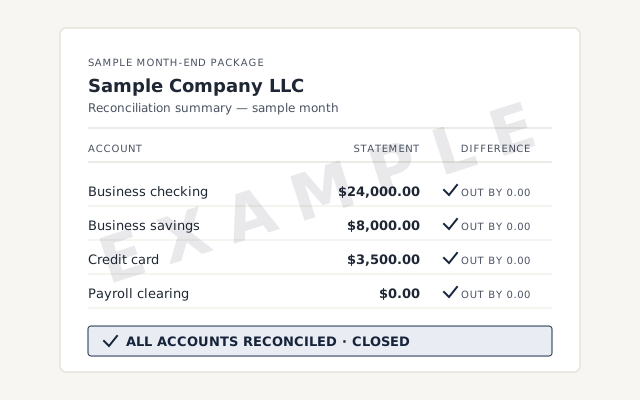
 Sample workflow — not a specific client’s data
A real profit-by-property report
The exact class-based report your file produces once it's wired and tested.
QuickBooks for real estate
QuickBooks works for real estate when it is built for how the business runs: profit tracked per property through class or location tracking, separate books for separate entities, and commissions, 1099s, draws, and deposits recorded correctly. One senior specialist wires and keeps the file. We keep the books — your CPA sets your entity structure and files the taxes.
QuickBooks for real estate means wiring the file so it answers the question the business actually lives on — is this property making money? — rather than only reporting one blended bottom line across everything you own or manage. That takes property-level tracking through classes or locations, clean separation between legal entities, correct handling of commissions and 1099s, and disciplined treatment of owner draws and any tenant funds you hold.
Real estate is not the generic small business QuickBooks is sold to. You might run rentals across several LLCs, broker deals and split commissions with agents, manage other people's properties and hold their money in trust, or all three at once. Each of those carries an accounting rule that a plain profit and loss ignores: income and cost have to land on the right property to mean anything, separate entities have to stay in separate books, a security deposit is money you owe back rather than money you earned, and the cash an owner pulls out is not an expense. Get the structure right and QuickBooks tells you which properties earn and which quietly lose. Get it wrong and you have confident-looking numbers that blur the whole portfolio together. The sections below cover how each piece works, honestly, including where the software stops and your CPA, attorney, or state regulator begins.
Property-level profit and loss is the practice of tagging every transaction — rent income, repairs, management fees, insurance, mortgage interest — to the specific property it belongs to, so QuickBooks can report margin for each property instead of one blended portfolio number. For a real estate operator it is not a refinement; it is the reason to keep the books at all.
QuickBooks does not report by property on its own. The mechanism is class tracking, or location tracking in QuickBooks Online Plus and Advanced, running alongside your ordinary chart of accounts: each property becomes a class or location, and every rent deposit, repair bill, and fee carries its property tag as it is entered. A payment that skips the tag drops into an untagged bucket and makes the portfolio report lie by omission. This is the same discipline behind our dedicated QuickBooks class tracking setup — for real estate it is simply how property-level reporting exists at all. It also assumes a coherent chart of accounts underneath: property tagging built on a messy file just produces precise-looking wrong answers, which is why property-level reporting belongs after a chart of accounts cleanup, not before.
Income and cost to profit by property
When you hold real estate across more than one legal entity — several LLCs, a partnership, an S-corp holding company — each entity should have its own QuickBooks file, because commingling them in one file undermines the liability separation the structure exists to create and makes each entity's tax return harder to prepare. Separate books per entity is the general rule; separate files per individual property inside one entity is usually not.
The distinction matters because people conflate the two. A single LLC holding six rentals does not need six QuickBooks files — it needs one file with the six properties as classes or locations, so you get property-level reporting inside a single, reconcilable set of books. Splitting one entity across six QuickBooks files instead of six classes breaks portfolio reporting: there is no profit-and-loss-by-class report that spans separate company files, so the entity's real position exists only if someone adds six sets of books together by hand. Two different LLCs, though, are two different taxpayers and should not share a file, no matter how tempting it is to keep everything in one place. Where exactly that line falls for your holdings — and whether a given property sits in its own entity — is a legal and tax structuring decision your attorney and CPA make, not us. Our job is to keep whatever structure they set clean: the right number of files, no transactions leaking between entities, and intercompany movements recorded honestly rather than blurred.
Commission accounting has two sides, and a real estate file has to record both cleanly: the commission income earned when a deal closes, and the split or payout to the agent who earned it. Blur them together and neither your income nor your agent costs are trustworthy.
On the income side, commission earned is booked when the closing settles, tagged to the property or deal where that helps you see deal-level profitability. On the payout side, the split paid to an agent is an expense to that agent — and if the agent is an independent contractor rather than an employee, those payments accumulate through the year toward a 1099-NEC, which is why the payout has to be tracked per agent, not lumped into one commissions-out account. We set up the income and payout accounts, keep the running total per agent so year-end reporting is a report and not an archaeology project, and make sure a W-9 is on file before an agent is paid. Broker files that came from generic bookkeeping routinely mix earned commission with pass-through splits or lose the per-agent detail; untangling that is a common part of a QuickBooks cleanup.
Everything above is the brokerage's side of the arrangement — the party that receives the commission and pays it out. The agent on the receiving end has the opposite problem, because the brokerage reports the gross while only the net reaches their account, and their books have to carry the gross with each withheld fee deducted separately. If those are your books rather than the brokerage's, QuickBooks for real estate agents covers that side.
Real estate businesses pay a lot of non-employees — independent-contractor agents, repair and turnover crews, cleaners, landscapers, bookkeepers — and payments to unincorporated contractors for services are generally reportable to the IRS on a 1099-NEC once they cross the annual threshold, with specific exceptions. Getting this right is a matter of record-keeping discipline set up long before January, not a year-end scramble.
We are not your tax advisor on who is reportable and at what amount — the current threshold, the exceptions, and the filing rules are the IRS's to state, so confirm your situation against the IRS guidance on whether you are required to file a Form 1099 and with your CPA. What we own is the bookkeeping that makes filing painless: collecting a W-9 before a vendor or agent is paid, tagging payments to the right payee and account so nothing is missed or double-counted, and producing accurate per-payee totals at year end. When payments have been mis-tagged or W-9s are missing, we fold the fix into a cleanup so the records are right before the deadline, not after.
Money an owner takes out of a real estate business is not an expense and must never be recorded as one — booking a draw as an expense understates profit, distorts every property's margin, and misstates the return. It is an equity transaction, and how it is recorded depends on the entity.
In a single-member LLC or sole proprietorship, an owner pulling cash out is an owner's draw recorded against an owner's equity account. In a partnership or multi-member LLC, it is a distribution tracked per partner against each partner's equity. In an S-corp it is a shareholder distribution, and it sits alongside — not instead of — the reasonable W-2 compensation the owner is generally required to take, a distinction with real tax weight. Which equity accounts you need and how distributions should be handled for tax are your CPA's to set, especially the S-corp reasonable-compensation question; we do not decide how much you should draw or how it is taxed. What we do is record every draw and distribution against the correct equity account so the books and the eventual return agree, and so property-level profit is never quietly eaten by an owner withdrawal miscoded as a cost.
Where an owner draw posts
If you manage property for others, you hold money that is not yours — tenant security deposits, and rent collected on behalf of owners before it is remitted — and that money carries rules ordinary bookkeeping does not. A security deposit is a liability, recorded against a liability account because it is owed back to the tenant, and in many jurisdictions the funds themselves must sit in a separate trust or escrow bank account, apart from the management firm's operating cash. Recording a tenant security deposit as rent income instead of to a liability account overstates rental income by money that has to be handed back, and leaves the deposit you owe the tenant missing from the balance sheet entirely.
Described generally, trust accounting means the money you hold for others is kept separate, tracked per beneficiary — this deposit belongs to this tenant, this rent balance belongs to this owner — and the trust bank account reconciles to the sum of what you owe. QuickBooks can hold that structure: liability accounts for deposits and owner-held funds, a dedicated trust bank account, and reconciliation against it. What QuickBooks cannot do is know your obligations, because the specific trust-accounting rules — how deposits must be held, how quickly they are returned, how the trust account is reconciled and reported — are set by your state's real-estate regulator and vary by state. We will not assert those rules or claim to keep you compliant with them. We structure and reconcile the accounts in QuickBooks; you confirm your trust-accounting obligations with your state regulator and your CPA or attorney, and we keep the books consistent with what they tell you.
That is the short version, and it is enough if you own property and hold the occasional deposit. If managing property for other owners is the business — rent collected on their behalf, owner statements going out monthly, a management fee as your only real revenue — the structure runs deeper than a liability account, and QuickBooks for property management covers it properly. If instead the properties are let nightly through a booking platform, the revenue side is a different problem again: see QuickBooks for short-term rentals.
Real estate files drift in a handful of predictable ways, and almost all of them trace back to a structure that was never built for property, entities, or held funds. These are the recurring ones, and how we fix them.
Where the file has already drifted, the fix is a scoped, fixed-fee QuickBooks cleanup: we tie every account back to its statement, then a chart-of-accounts cleanup and a rebuilt class structure make property-level reporting, entity separation, and clean deposit handling actually work. You get a documented, reconciled baseline, and from there the monthly work only has to keep pace with new activity instead of chasing old mistakes.
What it costs
Every engagement is a fixed scope at a fixed fee, quoted after a free view-only review of your file. The figures below are published starting floors; the review sets the real range for your real estate business.
| Engagement | Typical range | Timeline | What's included |
|---|---|---|---|
| Real estate file setup | From $1,500 | 1–3 weeks | Property classes or locations, deposit and equity accounts, a chart of accounts built for real estate. |
| Cleanup + restructure | Custom fixed quote | 2–6 weeks | Reconcile the file, separate entities, fix deposits and draws, rebuild property-level reporting. |
| Monthly bookkeeping | From $400/mo | Ongoing | Property-costed monthly close: transactions tagged, accounts reconciled, reports that tie. |
| Get your exact quote | |||
Real estate file setup
Cleanup + restructure
Monthly bookkeeping
One senior specialist wires your file for real estate and keeps it that way — properties set up as classes and tested against a real month, deposits held as liabilities, draws posted to equity, agent payouts clean for year end — not an offshore pool applying a generic template and hoping the portfolio report means something.
Our method is verification, not assertion: we do not hand back a structure and call it done, we run a real month through it and check that the profit-by-property report ties before you rely on it. Access stays minimal — view-only for the free review, then QuickBooks' accountant access to make and log every change (or a screen-share you drive on Desktop), never your bank logins — and every structural choice is documented in writing so the setup outlives the engagement. Read exactly how we work on our methodology page. We work entirely remotely, which means where your properties are has no bearing on whether we can help; operators in real-estate-heavy markets reach us the same way, whether you want a QuickBooks consultant in Florida or a QuickBooks consultant in Texas. And we hold a bright line at what we are: bookkeeping specialists, not CPAs. We keep the books accurate and property-costed; your CPA sets the entity structure and tax positions, your attorney handles the legal structure, and your state regulator governs trust accounts. When something can only be settled by one of them, we name it in the handoff rather than guessing.
You don't have to take our word for it. Here is the evidence you can check — the deliverable you receive, the structure the property-level reports depend on, and our response commitment.
Sample workflow — not a specific client’s data
The exact class-based report your file produces once it's wired and tested.
Property-level reporting lives or dies on the class and account structure. See how we build it.
See class tracking setupA written reply within one business day.
Remote-first, nationwide
Mon–Sat · 8am–6pm CT
We work entirely remote — view-only access for the free review, QuickBooks' accountant access to make and log the setup itself, screen-share to review it with you, and every structural choice documented in writing.
Yes, when the file is wired for it. QuickBooks does not report by property on its own, but class tracking (or location tracking in QuickBooks Online Plus and Advanced) lets you tag every rent deposit, repair bill, management fee, and mortgage-interest entry to the specific property it belongs to. Once every transaction carries its property tag, a profit-and-loss-by-class report shows margin property by property instead of one blended number. We set the class or location list to your properties, tag historical activity where it matters, and test the report before you rely on it.
Separate legal entities should have separate books — one QuickBooks file per LLC, partnership, or S-corp — because commingling entities in one file undermines the liability separation the structure was set up to create and makes each entity's return harder to prepare. Individual properties inside a single entity, by contrast, are usually best tracked as classes or locations within that entity's one file, not as separate files. Where the line falls between separate files and classes is a question for your CPA and attorney, who set the entity structure; we keep whatever structure they set clean and consistent.
Commissions have two sides, and both have to be recorded. Commission income the brokerage or agent earns is booked when the closing settles, ideally tagged to the property or deal. Commission splits and payouts to agents are recorded as an expense to the agent, and if that agent is an independent contractor the payments accumulate toward a year-end 1099-NEC. We set up the income and payout accounts, tag each side to the deal where it helps, and keep the running total per agent so year-end reporting is a report, not a reconstruction.
Generally, if you pay an unincorporated independent contractor — a non-employee agent, a repair vendor, a bookkeeper, a cleaner — $600 or more in a year for services in the course of your business, that payment is reportable on a 1099-NEC, with specific exceptions. The current threshold and the exceptions are the IRS's to state, so confirm your situation against the IRS guidance and with your CPA rather than our memory. What we own is the bookkeeping that makes filing painless: collecting a W-9 before a vendor is paid, tagging payments correctly, and producing accurate per-payee totals at year end.
An owner taking money out of the business is not an expense and must never be recorded as one — doing so understates profit and distorts the return. In a single-member LLC or sole proprietorship it is an owner's draw against equity; in a partnership or S-corp it is a distribution to the partner or shareholder, tracked per owner. The correct equity accounts and the tax treatment behind a distribution are your CPA's to set, especially reasonable-compensation rules for an S-corp. We record draws and distributions against the right equity accounts so the books and the eventual return agree — we do not decide how much you should draw.
It can hold the records, with important limits, and this is where property management differs most from ordinary bookkeeping. A tenant security deposit you hold is not your income — it is a liability, money owed back to the tenant, and it is recorded against a liability account, not revenue. Many states also require property managers to keep tenant and owner funds in a separate trust or escrow bank account, apart from the firm's operating money, and to be able to reconcile it. We can structure the liability accounts and the trust bank account in QuickBooks and reconcile them, but the specific trust-accounting rules are set by your state's real-estate regulator; confirm your obligations with them and your CPA or attorney.
No. We are bookkeeping specialists, not your CPA, tax preparer, or attorney. We keep your QuickBooks accurate — income and expenses tagged by property, entities kept separate, commissions and 1099 totals clean, draws and deposits posted correctly — so the people who do file your returns and structure your entities are working from reliable books. The entity structure, the tax positions, and the trust-account compliance are theirs; the clean books underneath are ours.
Yes, and it is often where we start. Real estate files drift in recognizable ways: properties never set up as classes so the P&L is one blended blur, two entities run through one file, security deposits booked as income, owner draws buried in expenses, agent payouts with no W-9 behind them. We scope a fixed-fee cleanup, reconcile every account to its statement, rebuild the class structure and chart of accounts so property-level reporting works, and hand you a documented baseline. From there the monthly work keeps pace with new activity instead of chasing old errors.
Real estate books stand on property-level reporting: start with a class tracking setup to split profit by property, keep the chart of accounts clean underneath it, and if the file has already drifted, reset it with a QuickBooks cleanup first. See how we work on our methodology page, or get a free QuickBooks review.