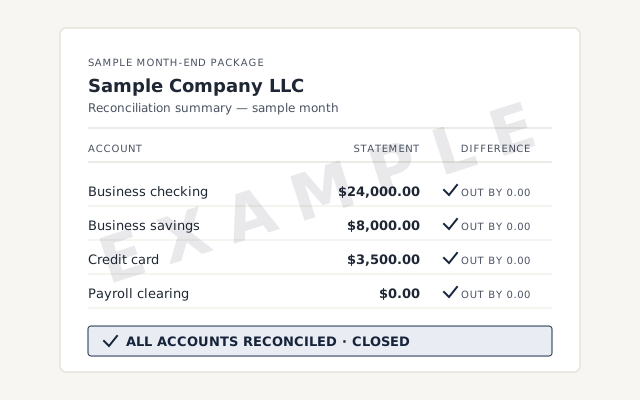
 Sample workflow — not a specific client’s data
A real three-way reconciliation
The monthly trust tie your file produces once it's wired and tested — bank, liability, and client ledgers in agreement.
QuickBooks for law firms
Trust accounting that ties, matter by matter.
QuickBooks works for a law firm when built around client trust: an IOLTA account kept separate from the firm's money, a client ledger for every matter, and a monthly three-way reconciliation proving the trust bank equals what you owe clients. One firm keeps the books that support your trust compliance — your practice and its bar own the obligation.
QuickBooks for a law firm means running two very different sets of books in one file: the firm's own operating business — fee income, payroll, rent, and overhead — and the client trust account, which is not the firm's money at all. Getting the trust side right is the whole game, because it is where the ethics rules, the bar audits, and the real risk live.
A law firm is not a typical small business QuickBooks is sold to. When a client pays a retainer, that money belongs to the client until the firm earns it, and it has to sit in a separate trust (IOLTA) account, tracked to that specific client, untouched by the firm's operating expenses. Mix the two — even briefly, even by accident — and you have commingling, which is one of the most common reasons lawyers face discipline. Structure the file correctly and QuickBooks can show, on demand, exactly how much trust money you hold for each client and prove the total ties to the bank. Structure it carelessly and you get confident-looking numbers hiding a trust account that no longer balances. Law firms are not the only organizations bookkeeping money that is not theirs to spend freely — the same discipline, applied to restricted funds instead of client trust, is the heart of our QuickBooks for nonprofits work. The sections below cover how each piece works, honestly, including the bright line between the bookkeeping we own and the compliance the firm owns.
An IOLTA (Interest on Lawyers' Trust Accounts) account is a pooled trust bank account where a firm holds client funds it is not yet entitled to — advance fees, settlement proceeds, filing-fee deposits — with the interest remitted to the state's IOLTA program rather than kept by the firm or the client. The governing principle, adopted in every jurisdiction from the ABA model, is simple and absolute: client money is held separate from the lawyer's own property and is never used for firm purposes.
In QuickBooks that translates into a specific structure. The trust bank account is its own asset account on the balance sheet, and it is paired with a trust liability account of equal size, because every dollar sitting in trust is a dollar the firm owes back to a client. The two move together: a trust deposit raises the trust bank asset and the trust liability at the same time; a proper disbursement lowers both. The firm's income statement is never touched by trust activity — money only becomes firm revenue when it is earned and transferred to the operating account against an invoice. This is why a clean chart of accounts matters so much for a firm: if trust and operating accounts are tangled, the file cannot keep client money separate, which is the one thing it absolutely must do. The specific rules — deposit timing, the small firm-fund allowance for bank charges, recordkeeping periods — come from your state bar's version of ABA Model Rule 1.15 on safekeeping property, and they, not us, define your obligation.
Matter-based tracking means every client — and often every distinct matter for that client — is a separate ledger in QuickBooks, so both trust balances and firm profitability can be read one matter at a time instead of only in aggregate. It is the backbone that makes per-client trust accounting possible in the first place.
The mechanism depends on your edition. QuickBooks Desktop and Enterprise use customer:job, where the client is the customer and each matter is a job beneath it; QuickBooks Online uses sub-customers or Projects. Either way, every trust deposit, every disbursement, and every earned-fee transfer carries the client:matter tag, so the firm can produce a trust ledger for a single client that shows exactly what is held and what has moved. Without that tagging discipline, trust becomes one undifferentiated pool and you can no longer answer the essential question — how much of this account is Ms. Alvarez's money? — which is precisely what a bar auditor will ask. We set up the client:matter structure, keep the list disciplined so tagging stays fast, and make sure trust activity always lands against the right matter.
Three-way trust reconciliation is the monthly check that three independent numbers agree exactly: the balance on the trust bank statement, the trust liability balance on the firm's books, and the sum of every individual client trust ledger. When all three tie, you have demonstrated that the money in the bank equals the money owed to clients and that no client's funds are overdrawn — the core proof of a healthy trust account. Most state bars require this reconciliation on a set schedule.
Here is why the third leg matters. A plain bank reconciliation — statement against the checkbook — can balance while an individual client is quietly overdrawn, their trust funds effectively covering someone else's disbursement. Only when the sum of the per-client ledgers is added as the third point does that error surface. QuickBooks holds all three pieces when the file is structured for trust, and each month we tie the trust bank to the trust liability to the client-ledger total and document the result. We are honest about the boundary: our reconciliation is the evidence your compliance rests on, but the certification of that reconciliation to your bar, and the reporting obligation, remain the firm's.
Three-way reconciliation has its own reference page, which sets out the three balances and the failure a two-way check cannot catch. Where the three have not agreed for months, closing the gap is a trust account cleanup rather than a reporting exercise — the per-client detail underneath the total has to be rebuilt before the balances can tie.
Three-way trust reconciliation
An unearned retainer or advance fee is a liability, not income — the money belongs to the client until the firm actually earns it by doing the work, so it is deposited into trust and recorded against that client's trust ledger, never booked as revenue on the day it arrives. Treating a retainer as income on receipt is one of the most damaging bookkeeping errors a firm can make: it overstates fee income by money the firm has not yet earned, leaves the trust liability understated by the same amount, and reports as revenue funds the firm may still have to return to the client.
The correct flow runs in stages. The advance lands in the trust bank account and raises the trust liability and the client's ledger together. As the firm performs work and issues an invoice, the earned portion — and only the earned portion — is transferred from the trust account to the operating account, at which point it finally becomes firm revenue. What is left in trust still belongs to the client and stays tracked to their matter. Whether a specific fee is genuinely earned on receipt, or must remain in trust until billed, is a fee-agreement and bar-rule question the firm and its counsel decide, not something we assert. Our role is to record the deposit, the earning, and the transfer exactly the way the firm and its rules direct, and to keep an unbroken trail from advance to earned fee so nothing is recognized early or spent before it is the firm's to spend.
The retainer's path
QuickBooks, structured properly, can carry a firm's operating books and a trust account with per-matter ledgers and a monthly three-way reconciliation — but it has no native trust module, and for some firms a dedicated legal trust or practice-management tool alongside it is the better fit. We are honest about where that line falls rather than forcing one answer.
The deciding factors are volume and how you bill. A firm with a modest trust caseload can run entirely in a well-built QuickBooks file, with trust deposits, disbursements, and earned-fee transfers all tagged to client:matter and reconciled three ways each month. A higher-volume firm, or one that wants trust and matter balances tied directly to time-and-billing, often runs a purpose-built legal tool for trust and matters and syncs summarized results into QuickBooks for the general ledger. Both are legitimate. We set up and keep whichever arrangement you run, tell you plainly where QuickBooks alone is sufficient and where a specialized tool earns its cost, and make sure the trust numbers reconcile regardless of which system holds them.
Alongside trust, a law firm still has an ordinary business to keep books for — fee income, partner and staff compensation, rent, malpractice insurance, filing costs, and the rest of the overhead — and matter-based tracking lets the firm read profitability by practice area or by matter, not just as one firm-wide bottom line.
This is where class tracking and the client:matter structure pay off a second time. Earned fee income flows to the operating account and can be tagged to the matter that produced it and, with class tracking, to a practice area such as litigation, estate planning, or real estate, so partners can see which work actually carries the firm. Costs advanced on behalf of a client — filing fees, expert costs, deposition expenses — are recorded as receivables from the client rather than firm expense, then billed back, so they never quietly erode reported profit. We build the operating side to answer the questions partners actually ask, keep it reconciled monthly, and hold it cleanly apart from trust so the two never blur.
Law-firm files drift in a handful of predictable ways, and on the trust side almost every one of them is the kind of error that draws a bar auditor's attention. These are the recurring ones, and how we fix them.
Where the file has already drifted, the fix is a scoped, fixed-fee QuickBooks cleanup: we rebuild each client's trust ledger, reconcile the trust bank to the liability to the client ledgers, and correct any commingled or mis-booked activity. Where the account structure itself is wrong, a chart-of-accounts cleanup resets it so trust can be tracked correctly from then on. You get a documented, reconciled baseline, and from there the monthly work only has to keep the trust tie current instead of chasing old errors.
What it costs
Every engagement is a fixed scope at a fixed fee, quoted after a free view-only review of your file. The figures below are published starting floors; the review sets the real range for your firm.
| Engagement | Typical range | Timeline | What's included |
|---|---|---|---|
| Trust-ready file setup | From $1,500 | 1–3 weeks | IOLTA trust account, client:matter ledgers, and a chart of accounts built for a law firm. |
| Cleanup + trust reconciliation | Custom fixed quote | 2–6 weeks | Reconcile the file, rebuild client trust ledgers, and stand up three-way reconciliation. |
| Monthly bookkeeping | From $400/mo | Ongoing | Monthly close with three-way trust reconciliation and matter-level reporting. |
| Get your exact quote | |||
Trust-ready file setup
Cleanup + trust reconciliation
Monthly bookkeeping
One firm wires your file for trust and keeps it that way — the same hands start to finish, the trust account separated from operating, a ledger per matter, three-way reconciliation performed and documented every month — not an offshore pool applying a generic template to money that carries an ethics obligation.
Our method is verification, not assertion: we do not hand back a structure and call it done, we tie the trust bank to the liability to the client ledgers and show you the reconciliation before you rely on it. Access stays minimal — the free review runs on view-only access, and the work itself uses QuickBooks' accountant access to make and log every change, never your bank logins — and every structural choice is documented in writing so the setup outlives the engagement. Read exactly how we work on our methodology page. We work entirely remotely, so where your firm practices has no bearing on whether we can help. And we hold a bright line at what we are: bookkeeping specialists. We keep the trust records accurate and reconciled so they support your compliance; the compliance obligation, the certification to your bar, the tax positions, and any legal question stay with the firm, its bar authority, and its CPA. When something can only be settled there, we name it in the handoff rather than guessing.
You don't have to take our word for it. Here is the evidence you can check — the deliverable you receive, the structure the trust reconciliation depends on, and our response commitment.
Sample workflow — not a specific client’s data
The monthly trust tie your file produces once it's wired and tested — bank, liability, and client ledgers in agreement.
Trust accounting lives or dies on the account structure that keeps client money separate. See how we build it.
See chart-of-accounts cleanupA written reply within one business day.
Remote-first, nationwide
Mon–Sat · 8am–6pm CT
We work entirely remote — view-only access for the free review, QuickBooks' accountant access for the work itself, screen-share to review the trust reconciliation with you, and every structural choice documented in writing.
Yes, when it is set up deliberately — QuickBooks has no built-in trust module, so trust accounting has to be structured. The client trust (IOLTA) bank account is recorded as its own asset account and paired with a trust liability account, because every dollar in the trust bank is money you owe to specific clients, not firm revenue. Each client matter gets its own ledger (a customer:job in Desktop or a sub-customer/Project in QuickBooks Online) so trust activity is tracked per client and never pooled. We wire the accounts and the client:matter structure, then test them so a trust balance can be produced per client on demand. The compliance obligation itself stays with the firm and its state bar.
Three-way reconciliation is the monthly check that three numbers agree exactly: the trust bank statement balance, the trust liability balance on your books, and the sum of every individual client ledger. When all three tie, it demonstrates that the money in the trust account equals the money owed to clients and that no client's funds have been overdrawn. Most state bars require this reconciliation on a set schedule. QuickBooks holds the pieces when the file is structured for trust, and we perform the three-way tie each month and document it. We are honest that our reconciliation supports your compliance — the certification and the reporting to your bar remain the firm's responsibility.
An unearned advance fee deposited into trust is a liability, not income — the money still belongs to the client until it is earned. The standard treatment records the deposit into the trust bank account and against the client's trust ledger and the trust liability, then moves funds to the firm's operating account only after the firm has issued an invoice for work actually performed. Recognizing a retainer as revenue on receipt, or spending it before it is earned, is exactly the kind of error that creates trust trouble. Whether a particular fee is earned on receipt is a fee-agreement and bar-rule question for the firm and its counsel, not a call we make — we record it the way the firm and its rules direct and keep the trail clean.
Commingling — mixing client trust funds with the firm's own operating or personal money — is prohibited under the trust-accounting rules every jurisdiction adopts from the ABA model, and it is one of the most common reasons lawyers face discipline. Practically, it means a trust deposit must never land in the operating account, the firm must not pay office expenses out of trust, and firm money must not sit in the trust account beyond a small allowance for bank fees where the rules permit it. Our job is to structure the file so the two are physically separate accounts with separate ledgers, and to flag any transaction that crosses the line during the monthly close. Curing an actual commingling event is a matter for the firm and its bar authority.
No, and any bookkeeper who promises that is overreaching. Trust-account compliance is a legal and ethical obligation that belongs to the firm and is enforced by its state bar under rules modeled on ABA Rule 1.15. What we provide is the bookkeeping that compliance rests on: separate trust accounts, accurate per-client ledgers, monthly three-way reconciliation, and a documented, reconciled trail an auditor can follow. We keep the books that support your compliance; we do not — and cannot — certify it, give legal advice, or stand in for your bar's requirements or your own review.
It depends on your volume and how you bill. QuickBooks, structured properly, can carry a firm's operating books and a trust account with per-matter ledgers and a clean three-way reconciliation. Higher-volume firms, or those that want trust and matter tracking tied directly to time-and-billing, often run a dedicated legal practice-management or trust tool alongside QuickBooks and sync the results. We are straight about the boundary: we set up and keep whichever arrangement you run, and we tell you plainly where QuickBooks alone is enough and where a purpose-built trust tool earns its keep, rather than forcing one answer.
Yes — that is often where firms come to us. Trust records drift in recognizable ways: client ledgers that no longer sum to the trust bank balance, retainers booked as income, trust and operating activity mixed in the same account, or reconciliations that were never truly three-way. We scope a fixed-fee cleanup, rebuild each client's trust ledger, reconcile the trust bank to the liability to the client ledgers, and hand you a documented baseline plus a repeatable monthly process. Where the underlying account structure is wrong, we pair it with a chart-of-accounts cleanup so trust can actually be tracked correctly from then on.
No. We are bookkeeping specialists, not your CPA, tax preparer, or legal advisor. We keep your QuickBooks accurate — operating income and expenses recorded, trust separate and reconciled, matters tracked, retainers handled as liabilities — so your CPA has reliable books to file from. IOLTA interest is remitted by the bank to the state's IOLTA program under the program's rules, not booked as firm income; we record the account correctly and leave the tax positions and any legal questions to your CPA and your bar. The clean books underneath are ours; the filings and the compliance are theirs.
Law-firm books stand on clean trust separation: if the file has already drifted, reset it with a QuickBooks cleanup and a chart-of-accounts cleanup so trust can be tracked correctly, and see exactly how we work on our methodology page. Ready when you are — get a free QuickBooks review.