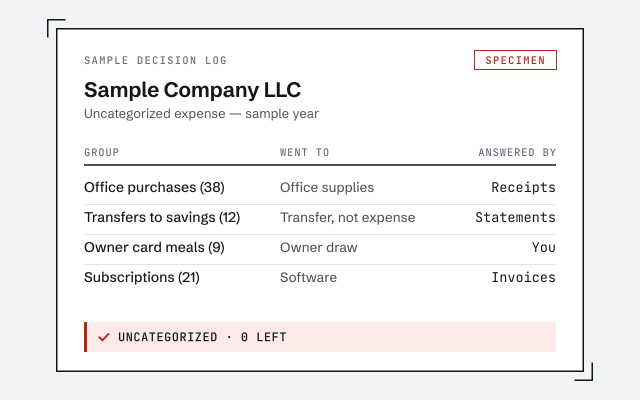
Four situations decide how an uncategorized cleanup actually runs, and each one has a boundary we hold rather than a judgment we make for you.
Personal spending in a business account
Personal spending run through the business is not an expense and does not get categorized as one. It is grouped, surfaced as its own list, and recorded the way you and your tax preparer decide — usually as an owner draw. Forcing it into an expense account would overstate costs and understate what the owner took, which is the opposite of a cleanup.
Transfers between your own accounts
Money moved between two accounts the business owns is not spending, and a holding account often has a lot of it. Each side has to be recognized as the same movement rather than counted as an expense on one side and income on the other. Where the matching side is missing entirely, that is a reconciliation problem and we flag it as one.
Transactions dated in a closed period
Categorizing a transaction inside a period you have already filed on can change a figure that a return was built from. Those are separated out, listed with their dates and amounts, and handed to you and your tax preparer to decide — we do not quietly recategorize a closed year to make a report look tidier.
Genuinely unresolvable items
Some transactions cannot be identified from any record that still exists. Those stay visible as a named remainder with what is known about them, rather than being swept into a plausible-looking category to empty the account. An honest small balance beats a tidy wrong one.