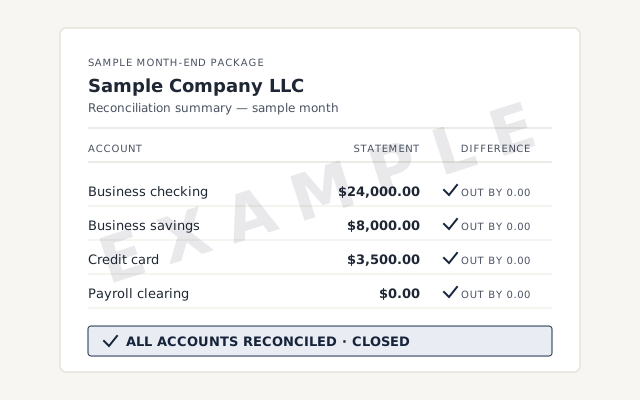
 Sample workflow — not a specific client’s data
See a sample month-end package
The exact reconciliation report and statement pack you receive for each month closed.
QuickBooks catch-up bookkeeping
Back to current, month by month.
QuickBooks catch-up bookkeeping enters and reconciles the months your file never recorded — bank and card feeds, categorization, and statement reconciliation — until the books are current and you can file. Most catch-ups run one to three weeks at a fixed scope and fee, remote, with the same hands start to finish.
The basics
Catch-up bookkeeping is the work of recording the months your QuickBooks file never captured — entering the transactions from your bank and card activity and reconciling each month to its statement until the file is current.
It is a defined, one-time project, not open-ended data entry. A catch-up runs from the last month your books were reliable to today, or to the year-end you need to file. Everything in between gets entered, categorized, and reconciled in order, so the file tells one continuous story again.
The reconciliation step is what separates a catch-up from simply typing transactions in. Entering activity puts numbers on the page; tying each month back to its bank and card statements proves those numbers are complete and real. A month isn't caught up until it reconciles to zero.
The four states of a catch-up
Who it's for
You need catch-up bookkeeping when whole months are missing from QuickBooks: unentered transactions, unreconciled accounts, a file that stops partway through the year. You need cleanup when the months are there but recorded wrong.
In practice the two overlap. A file a year or more behind is usually a catch-up with some QuickBooks cleanup folded in, because the months before the gap were often rushed or half-done. We scope both up front, so nothing is entered twice or corrected that was never wrong.
If you're not sure which describes you, the honest test is whether the months exist at all. Missing months are catch-up; present-but-wrong months are cleanup. Both at once — the common case once you've been behind for a while — is a single engagement we scope as one fixed fee.
Which do you need?
Catch-up gets you back to current, cleanup gets you back to correct, and monthly bookkeeping keeps you there. Most files that have fallen behind need the first, sometimes the second, and benefit from the third.
| Catch-up | Cleanup | Monthly | |
|---|---|---|---|
| Enters missing periods | It depends | — | |
| Corrects existing errors | — | It depends | |
| Reconciles each month to the statement | It depends | ||
| Gets a prior year ready to file | It depends | — | |
| Keeps books current going forward | — | — | |
| Typical timeline | 1–3 weeks | 2–4 weeks | Ongoing |
| Best when | Months are missing | Books exist but wrong | You want it kept current |
| Verdict | Behind, not wrong | Wrong, not behind | Done, staying done |
How it works
Catch-up bookkeeping runs the same way every time: a view-only review scopes the missing months and fixes the fee, then every gap is entered from your bank and card activity, reconciled to its statement, reviewed, and handed back as current books with a written summary.
We work the months oldest first, so opening balances carry forward correctly. Transactions come from your bank and card feeds and statements; we categorize them to your chart of accounts and clear the common traps — payments stranded in undeposited funds, transfers double-counted as income, deposits that never matched a sale.
Then each month is reconciled. We tie every bank, card, and loan account to its statement until the difference is zero — the same reconciliation method a clean month-end uses. A month that won't reconcile gets flagged in writing, with the specific discrepancy named, rather than closed on a guess.
Day 0
View-only look at the file; we scope the missing months and quote a fixed fee.
Days 1–7
Every missing month's transactions entered from bank and card feeds and statements.
Days 8–12
Each account tied back to the statement, month by month, until the difference is zero.
Day 13
Current books, a written summary of every month closed, and a call to walk it through.
Timeline
Most catch-ups run one to three weeks. The drivers are how many months are missing, how many bank and card accounts are involved, and transaction volume — not how old the gap is on the calendar.
A single-account file twelve months behind can close faster than a busy three-account file six months behind. Entry is usually the longest phase and reconciliation the next; review and hand-back are short. Whatever the shape, the timeline is committed in your fixed-scope quote before work begins, so the finish date isn't a moving target. For a rough read before you talk to anyone, the catch-up timeline calculator turns your months behind and account count into an estimated finish window.
Where the time goes
What you get
You get current QuickBooks books with every month reconciled to its statement, a month-by-month reconciliation package, a written summary of what was entered and closed, and a call to walk through it.
The deliverable is a file your tax preparer can work from and reports you can actually read — a profit-and-loss and balance sheet that reconcile back to your statements. Where we made a judgment call or set an opening balance, it's noted, so nothing is a mystery to you or your CPA.
None of it is a black box: the written summary lists every month closed and account reconciled, so "caught up" is specific and checkable, not a status we assert.
Sample workflow — not a specific client’s data
The exact reconciliation report and statement pack you receive for each month closed.
A written reply within one business day.
What it costs
What a catch-up costs is set by how many months are missing, how many accounts are involved, and transaction volume — quoted as one fixed fee after a free review, with the ranges below as published starting floors until then.
There are no hourly surprises. After the free review we quote one fixed fee for the whole catch-up, and it doesn't move unless the scope does. The figures below are starting floors; your real number is set once we've seen the file.
| Engagement | Typical range | Timeline | What's included |
|---|---|---|---|
| Standard catch-up | From $1,500 | 1–3 weeks | Up to 12 missing months, all accounts entered and reconciled. |
| Extended catch-up | Custom fixed quote | 3–6 weeks | 12–24 months, multi-entity, or high transaction volume. |
| Catch-up + monthly | From $400/mo | Ongoing | Catch up, then we keep the books current every month. |
| Get your exact quote | |||
Standard catch-up
Extended catch-up
Catch-up + monthly
Edge cases
Catch-up bookkeeping's hard cases are routine for us: files several years behind, multiple entities to keep separate, cash-versus-accrual questions, a tax deadline already in the past, and months where the records themselves are incomplete.
Several years behind is a scope question, not a feasibility one. We work the oldest year first and carry its ending balances forward — so a three-year catch-up is three catch-ups in sequence, each reconciled before the next. The earliest year often pairs with some year-end cleanup, which we scope in up front. Wondering where the practical limit sits? We've answered how far back books can actually be caught up — your records, not the calendar, set the reach.
Multiple entities stay strictly separate. Each company file is caught up and reconciled on its own — we never commingle or net them. Where inter-company transfers exist, we record both sides, so each entity's books stand alone.
Cash versus accrual is settled before entry, not after. We match the basis your books and return already use, so the catch-up doesn't shift your reporting. Unsure which you're on? Our doc on cash vs. accrual accounting explains the difference in plain English, and we confirm your basis during the review.
A looming or already-passed tax deadline changes the order of work, not whether it's possible. Tell us the date and we reconcile the filing year first, hand your preparer numbers they can rely on, and finish the rest after.
Missing records get worked, not waved away. Statements reconcile most activity even when receipts are gone; where a figure genuinely can't be sourced, we set a documented opening balance or flag the item — so the gap is visible and defensible, not papered over.
Why us
The same hands do your catch-up start to finish — one firm, never a rotating pool or an offshore data-entry team. The scope is fixed, every month is reconciled and documented, and you can watch the work at any point.
The difference shows up in what happens next. Because every month is reconciled and documented, the hand-off to a monthly close is clean — no second discovery phase, because the file is already tied out. Fixed scope means the number you approve is the number you pay; reconciliation on every account makes "done" provable, not asserted.
Access is least-privilege and revocable. The free review runs on view-only access; if you hire us, the catch-up uses QuickBooks' accountant access to make and log every correction — never your bank logins, and never your passwords. You grant access in a few minutes and revoke it the moment the work is done, and every change we make is documented in writing, so there's a record of exactly what happened to your books and when.
Remote-first, nationwide
Mon–Sat · 8am–6pm CT
We work entirely remote — view-only access for the free review, QuickBooks' accountant access for the catch-up itself, screen-share whenever you want to watch, and every month documented in writing.
Be honest
If you're only a month or two behind and your accounts still reconcile, you probably don't need us — you can catch that up yourself in an afternoon. Paying a specialist for a small, clean gap isn't worth it.
For a short gap, start with our free tools instead of our invoice. The bookkeeping health score tells you in a few minutes how far off you really are, the how-to-clean-up-QuickBooks guide walks the method, and the cleanup checklist is the same list we work from. Many one- or two-month gaps close with those alone. If your gap is missing months rather than wrong entries, the catch-up bookkeeping guide walks the DIY route month by month, and the catch-up bookkeeping checklist is the same sequence as a printable list.
We're also the wrong call if what you really need is to never fall behind again — that's ongoing monthly bookkeeping, not a one-time catch-up. And if you're unsure which camp you're in, the free review will tell you honestly, including when the answer is that you don't need us yet.
No. Catch-up enters periods your books never recorded; cleanup corrects periods that were recorded wrong. Many files need some of both, which we scope up front after a free review so nothing is double-counted.
A few months or several years — how far behind is a scope question, not a feasibility one. Multi-year gaps run oldest year first, each year reconciled before the next. You get the scope and a fixed fee before any work starts.
One to three weeks for most files. A one-account file a year behind can close faster than a busy three-account file six months behind — volume drives the timeline, not the calendar. The finish date is committed in your quote.
Standard catch-ups start from $1,500, quoted as one fixed fee after a free review. The price is set by how many months are missing, how many accounts are involved, and transaction volume — and it doesn't move unless the scope does. No hourly billing.
That's the point. Every missing month is reconciled, so the year closes to numbers your preparer can rely on. If a return is already late, tell us the deadline — we reconcile the filing year first and finish the rest after.
Both. The free review runs on view-only access; the catch-up itself uses QuickBooks Online's accountant access, or Desktop by screen-share or a hosted copy of the file — fully remote either way.
View-only access to QuickBooks and the bank and card statements for the missing months. Granting access takes a few minutes, and we change nothing until you approve the scope and fee.
No. The free review runs on view-only access; if you hire us, the catch-up uses QuickBooks' accountant access to make and log every entry — never your online-banking logins or passwords. We work from the statements you provide, and the access you grant is revocable the moment the work is done.
Statements reconcile most activity even when receipts are gone. Where a figure genuinely can't be sourced, we document the assumption in writing and flag the item — the gap stays visible, not papered over.
Either. We match the basis your books and tax return already use, confirmed during the free review, so the catch-up doesn't shift your reporting.
If you're a month or two behind and your accounts still reconcile, yes — our free cleanup checklist and how-to guide close most gaps that size in an afternoon. Past that, volume decides it, and the free review will tell you honestly which side you're on — including when you don't need us.
You get current books and a written summary of every month closed. From there you can keep them yourself, or we can run a monthly close so they never fall behind again. There's no obligation to continue.
Related cleanup work: year-end cleanup, bank reconciliation, payroll cleanup, and audit-ready books — or book a call to talk it through.