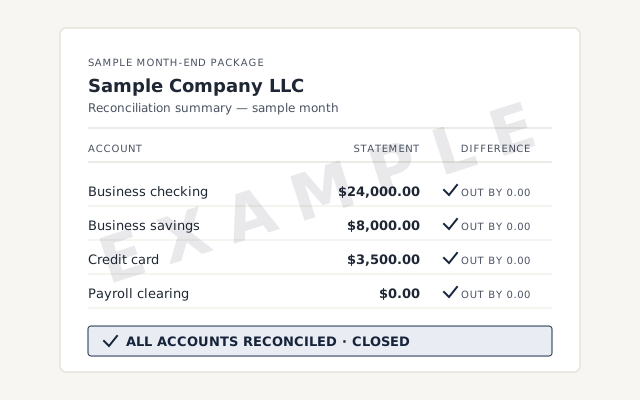
 Sample workflow — not a specific client’s data
A real catch-up summary
The month-by-month summary you receive when your books are back to current.
QuickBooks behind on bookkeeping
Months behind? Here's how you get current.
Behind on bookkeeping in QuickBooks means months of unentered or unreconciled transactions piling up until reports and taxes are unreliable. The fix is catch-up bookkeeping — every missing month entered and reconciled back to current, usually one to three weeks, at a fixed scope. A month or two is a do-it-yourself job; longer gaps are worth hiring out.
Which do you need?
Falling behind is one of the most common QuickBooks problems we get called about — and one of the most fixable. The right engagement depends only on how far the gap runs, and our catch-up timeline calculator gives you a rough read on how long closing that gap takes.
Start here
How far off are your books?
Catch-up + cleanup
Enter the missing months, then correct what was recorded wrong along the way.
See QuickBooks cleanupRescue first
Diagnose and stabilize the company file before any catch-up begins.
See QuickBooks rescueHonest answer
Behind on bookkeeping has a recognizable shape inside QuickBooks: bank-feed transactions piling up unaccepted in the For Review tab, a register that has stopped matching the bank, and no reconciliation report for any month since the gap began. The reports drift with it — a profit and loss missing months of expenses looks healthier than the business actually is, and that gap matters most at exactly the moments you need the numbers: a tax estimate, a loan application, a pricing decision.
Being behind is also worth separating from being wrong. Months that were never entered are a catch-up; months that were entered incorrectly are a cleanup. Long gaps usually need some of both, which is why the scope is set by looking at the file, not by guessing — and the bookkeeping health score gives you a quick self-read before anyone else looks.
Do-it-yourself
If you're only a month or two behind on bookkeeping in QuickBooks, catching up is a do-it-yourself job, and you don't need us for it. Work the oldest missing month first: accept and categorize its bank-feed transactions, enter anything the feed didn't capture, then reconcile that month to its bank statement before touching the next. One month proven complete at a time — that order is the whole method, whoever does the work.
The catch-up order
You can shorten the timeline — yours or ours — by gathering the bank, credit-card, and loan statements for each missing month, payroll reports if you run payroll, and the last tax return you filed, which anchors where the catch-up has to begin. Where do-it-yourself ends is scale: many months across several accounts, feed transactions that no longer match the register, or months that were entered wrong along the way. That's when the gap is a catch-up engagement, and if the file itself is a mess underneath, a rescue comes first.
Sample workflow — not a specific client’s data
The month-by-month summary you receive when your books are back to current.
Every missing month entered and reconciled to the statement. Read the method.
Read the reconciliation referenceA written reply within one business day.
Remote-first, nationwide
Mon–Sat · 8am–6pm CT
We work entirely remote — view-only access for the free review, QuickBooks' accountant access if you hire us to catch the months up, screen-share whenever you want to watch, and every month documented in writing.
There's no point that's too far — a few months or several years, we take it on. How far behind you are drives the scope and timeline, not whether it can be fixed. Whether it's one quarter of unaccepted bank-feed transactions or years with no reconciliations at all, a few minutes of view-only access tells us the scope, and we tell you both after a free review.
Catch-up enters months your books never recorded; cleanup corrects months that were recorded wrong. Being behind is usually catch-up, but a long gap often needs some cleanup too. A quick tell: months of unaccepted bank-feed transactions with no reconciliation reports usually means catch-up. We scope both up front, so nothing is double-counted.
Yes. Catch-up brings each missing month to reconciled, so the year can be filed. Tell us the deadline and we sequence the work to meet it, and hand your preparer numbers they can rely on. Having statements for the missing months ready shortens the timeline.
Sometimes — and when it's the right call, we say so. If the old file is years stale and its history has no remaining tax or audit value, starting a clean file going forward can cost less than reconstructing the past. But any year with open tax exposure still has to be caught up before it can be filed, so most gaps are closed, not abandoned. The free review tells you which side you're on.
No. Falling behind is one of the most common reasons people call us, and it's rarely anyone's fault — the work just piled up. We look at the file, tell you what it needs, and get it current. No lectures.
Most catch-ups run one to three weeks. The drivers are how many months are missing, how many accounts are involved, and transaction volume. The work moves month by month, oldest first, and each month is reconciled to its statement before the next begins — so progress is measurable, not vague. The timeline is committed in the fixed-scope quote before any work starts.