QuickBooks cleanup cost
What a QuickBooks cleanup costs — and what drives it.
A QuickBooks cleanup is priced by scope, not by an hourly meter. Ours start from $1,500 for up to 12 months on one entity, usually planned at two to four weeks with the finish date set in your written scope; the fee grows with months behind, transaction volume, connected accounts, and payroll or prior tax years. We read your file in a free review, then quote one fixed fee.
Last reviewed October 2026 by a Certified QuickBooks ProAdvisor
What this page is based on: our reconciliation-first methodology and our published pricing floor, with Intuit’s own Expert Cleanup price quoted as listed (checked October 2026) — no competitor prices
- Fixed fee, fixed scope
- Quoted after a free review
- No open-ended hourly bill
What drives the cost of a QuickBooks cleanup
What a QuickBooks cleanup costs comes down to scope: how far behind the file is, how many transactions have to be reviewed, how many bank and card accounts connect to it, and whether payroll or prior tax years are tangled in. None of those is an hourly rate — together they are the size of the job.
The drivers we weigh:
- How many months, or years, are unreconciled or uncategorized.
- Transaction volume — a file with a few hundred lines a month is not the file with several thousand.
- The number of connected bank, card, and loan accounts that each have to tie to a statement.
- Whether payroll, sales tax, or inventory is involved, since each adds its own reconciliation.
- Whether prior closed years have to be corrected, or only the current one.
A single recent quarter with clean statements sits at the low end; several years of compounding drift across many accounts sits at the high end. Many files fall in between, and it is one part of your overall QuickBooks cost. The free review is how we find where a QuickBooks cleanup for your file actually falls.
What it costs
What a QuickBooks cleanup costs
Every cleanup is a fixed fee for a defined scope, quoted after a free view-only review. The figures below are published starting floors; the review sets the real range for your file — we never quote a cleanup we haven't looked at.
Our published starting floor is not a market-average claim. It is the lowest price we charge, for the smallest scope we take on — not a statement about what a QuickBooks cleanup normally costs. Other firms price differently, and what they charge is theirs to publish, not ours to characterize. Read the floor as our number, and compare it against the scope it buys.
The one outside price we quote is Intuit's own. Intuit lists Expert Cleanup as low as $600, priced by the number of months cleaned up, for QuickBooks Online files (checked October 2026). The two are built for different files: Intuit's service for a QuickBooks Online file with simple operations; a fixed scope from us for Desktop and Enterprise files, multi-year backlogs, inventory, payroll liabilities and more than one entity. How the two split is in is QuickBooks Live worth it.
| Engagement | Starting price | Planned timeline | What's included |
|---|---|---|---|
| Standard cleanup | From $1,500 | 2–4 weeks, planned | One entity, up to 12 months: accounts reconciled, transactions recategorized, a written change log. |
| Extended or multi-year | Custom fixed quote | 3–6 weeks, planned | 12–24 months or more, many connected accounts, or more than one entity, corrected and tied back to statements. |
| Cleanup + monthly | From $400/mo | Ongoing | Clean up the file first, then we keep it reconciled every month so it never drifts back out. |
Scope and acceptance
What the cleanup fee covers, and what done means
QuickBooks cleanup: From $1,500. This is the written scope in short: what is in, what is not, what moves the quote, your part, and the test the work has to pass.
- Included
- Every account in scope reconciled to its statement; miscategorized and duplicate transactions corrected; Opening Balance Equity investigated and corrected with supporting evidence; Undeposited Funds reconciled to actual deposits and valid receipts still awaiting deposit; a written change log.
- Not included
- Preparing or filing tax returns, tax advice, running payroll, filing sales-tax returns, and the QuickBooks subscription. Months never entered are a catch-up; a damaged file is a rescue.
- What changes the quote
- Months in scope, number of accounts, transaction volume, payroll or inventory in the books, and corrections that touch a return already filed.
- Your part
- Statements for every account and month in scope, answers to the questions the review lists, and the access agreed for the work.
- Done means
- Each bank, card and loan account in the agreed scope is reconciled for each agreed period, with zero unexplained reconciliation difference. Opening Balance Equity, Undeposited Funds and Uncategorized are corrected or each remaining amount is explained in writing. Remaining timing items and unresolved exceptions are documented, and the change log is delivered.
Why we quote a fixed fee after a review
Fixed-scope model
Read this as text
A free view-only review defines a written scope, which sets one fixed fee you approve before any work starts. The price is fixed at the point you approve it, not metered as the work runs. Illustrative example, not a measured figure.
We price after we read the file, not before, because an honest cleanup quote depends on what is actually in the file — and one fixed fee protects you from the open-ended hourly bill that cleanups are notorious for.
The sequence is deliberate: a free, view-only look at your books; a written scope of exactly what we will reconcile and correct; and one fixed fee you approve before any work starts. If the file turns out larger than the review suggested, that is our estimate to own, not a surprise on your invoice. The scope is the contract, and the number you approve is the number you pay. You can read exactly how we work in our methodology.
What makes a cleanup cost more — or less
The same cleanup can cost more or less depending on a few things you partly control. What pushes it up: more months behind, higher transaction volume, more connected accounts, and payroll or prior-year corrections. What brings it down: catching the drift early, keeping statements and access ready, and not needing closed years reopened.
What a cleanup price doesn't include
A fixed fee is only comparable if you know where it stops. Ours covers the bookkeeping inside QuickBooks — every account reconciled, every correction documented. It does not include tax preparation or filing, which stays with your CPA; running payroll, which stays with your payroll provider (we correct the payroll liability balances, they run the payroll); filing sales-tax returns (we tie the sales-tax liability to what was filed); or your QuickBooks subscription, which Intuit bills you directly. Ask any firm quoting a cleanup the same four questions, and compare the answers along with the number.
The single biggest lever is time. A file caught a quarter after it drifts is a short, low-cost job; the same file left for three years compounds — every unreconciled month has to be tied to its statement in order, so the work grows faster than the calendar does. If you are close to the low end, our free review will say so plainly rather than talk you into scope you don't need.
What moves the number
Read this as text
Four cost drivers on a qualitative adds-less to adds-more scale: how many months are behind is the biggest lever, because every unreconciled month must be tied to its statement in order; transaction volume, the number of connected accounts, and payroll or prior-year corrections each add less. Relative bar lengths are illustrative, not measured amounts.
Which route?
How fixed-scope pricing compares to hourly and outsourced
A fixed-scope specialist quotes one number after looking; an hourly bookkeeper bills as the meter runs; an outsourced pool is cheap per hour but often re-does drift it can't diagnose. Here is how the three compare on what a cleanup actually costs you.
| Fixed-scope specialist | Hourly bookkeeper | Outsourced pool | |
|---|---|---|---|
| Price known before work starts | It depends | ||
| Fixed fee, not an open meter | |||
| Scoped from a review of your file | It depends | ||
| One specialist, start to finish — not a pool | It depends | ||
| Documented change log you can audit | It depends | ||
| Best when | You want the number up front | A one-off small fix | Cheapest hourly rate matters most |
| Verdict | A number you can approve | Meter keeps running | Cheap until it isn't |
Why specialist-led cleanup costs more — and what cheap cleanup risks
A cheaper quote usually buys a different thing, not the same thing for less. The low end of this market is priced for volume: a pool of bookkeepers, a fixed number of hours, and a hand-back when the hours run out. That model works when a file only needs tidying. It struggles on the thing you are actually paying a cleanup to do — proving the numbers.
What the price difference buys is specific, and each item is checkable:
- A reconciled hand-back, not a tidy-looking one. The expensive part of a cleanup is not categorizing transactions; it is driving every account's difference to zero and proving it against the statement. A file can look immaculate and still not tie.
- A written change log. Every entry we touched, what happened to it, and why — the document your CPA or a lender can audit. Undocumented corrections are indistinguishable from errors, and they are the reason a second bookkeeper often re-does the first one's work.
- One accountable person. Your file is handled by a Certified QuickBooks ProAdvisor, from the review through to the hand-back. There is no pool, no rotation, and no one learning your business again next month.
- Prior periods that still tie. We snapshot your reports before touching anything and re-run them after, so a correction cannot quietly move a number inside a year you already filed on.
- An honest scope. If the review finds you don't need the work, we say so — which is not an outcome a volume model is structured to deliver.
The risk of the cheap route is rarely that the work is bad on the day. It is that the file comes back unreconciled, the changes are undocumented, and nobody can say which figures moved — so the work is done again at tax time, when it is urgent and a preparer is billing for the untangling. Paying twice is the expensive outcome, and it is the one a floor price is designed to avoid.
"Who will actually do the work?" — a fair question to ask anyone
Ask it, of us and of anyone else, and expect a straight answer. Ours: the work is done by one specialist, a Certified QuickBooks ProAdvisor, working remotely for U.S. businesses, on U.S. business hours — not routed to a pool, not subcontracted, and not handed to a different person each month. What matters is whether one accountable person did the work and signed the record. A rotating pool, wherever it sits, cannot give you continuity or one accountable person against the change log, and continuity is most of what a cleanup is worth.
When a cleanup isn't worth the cost
Skip the spend when the file is already close to right, or when a single miscategorized transaction is all that's wrong. There is no reason to pay for a cleanup a free afternoon would settle.
If your accounts reconcile each month and only a handful of transactions sit in the wrong place, you can move them yourself — no engagement needed. If the file is only a month behind and the statements are clean, catching up is a small job you may not need us for. We will tell you which case you are in during the free review, even when the honest answer is that you don't need to hire anyone. Pricing by scope is the whole point: a small problem stays a small number. And when you want that number rather than the drivers, a free view-only review turns your file into an actual fixed quote before anything starts.
How to verify what you're paying for
You approve a fixed fee against a written scope — here is the evidence behind it, so the number is never a black box.
Who’s responsible for your file
A Certified QuickBooks ProAdvisor handles your file from the review through the corrections to the hand-back — the same person throughout, never a rotating pool.
About QBSpecialist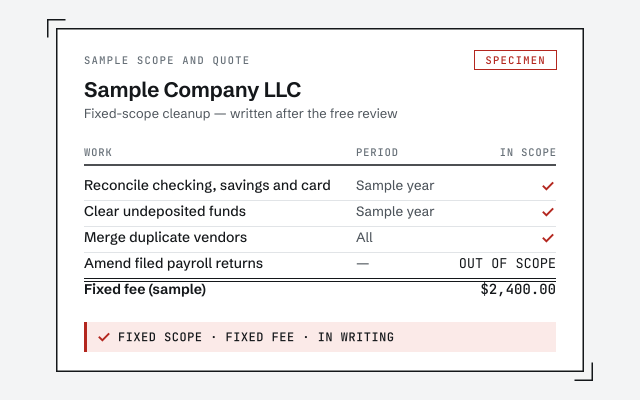 Illustrative example — not a client file.
A written scope and quote
The defined scope and fixed fee you receive after the free review, before any work starts.
Our methodology
How we scope, reconcile, and document a cleanup. Read exactly how.
Read the full methodResponse commitment
A written reply within one business day.
Questions about QuickBooks cleanup cost
How much does a QuickBooks cleanup cost?
It depends on scope, so the honest range is 'from $1,500' until we read your file. Cost tracks how many months are behind, how many transactions and accounts are involved, and whether payroll or prior years are in play. We quote one fixed fee after a free, view-only review, so you approve the number before any work begins.
Do you charge by the hour?
No. Cleanups are the classic job where an hourly meter runs open-ended, so we quote a fixed fee for a defined scope instead. If the file turns out larger than expected, that is our estimate to own — the number you approved is the number you pay.
Why can't you give me a price over the phone?
Because an honest cleanup price depends on what is actually in the file, and no one can see that from a description. A few minutes of view-only review tells us the real scope; quoting before that would be guessing, and a guess is how open-ended bills start.
What makes one cleanup cost more than another?
Scope. More months behind, higher transaction volume, more connected accounts, and payroll or prior-year corrections all add work. The biggest single factor is how long the file has drifted — caught early it's a small job; left for years it compounds, because every month has to be reconciled in order.
How does that compare with Intuit's own cleanup service?
Intuit publishes its price: Expert Cleanup is listed as low as $600, priced by the number of months cleaned up, for QuickBooks Online files (Intuit, checked October 2026). It suits a QuickBooks Online file with simple operations. A fixed scope from an independent specialist is built for what sits outside that: Desktop or Enterprise files, multi-year backlogs, inventory, payroll liabilities, more than one entity, and a written change log your CPA can trace.
What isn't included in a cleanup price?
Tax preparation and filing, which stay with your CPA or tax preparer; running payroll, which stays with your payroll provider, although we correct the payroll liability balances in the books; filing sales-tax returns, although we tie the sales-tax liability to what was filed; and your QuickBooks subscription, which Intuit bills you directly.
Can I estimate the cost myself first?
Partly. The cleanup cost calculator sizes your file as a light, standard or complex cleanup from a few questions, before you talk to anyone. It deliberately stops short of a dollar figure, because printing one would mean assuming a rate per transaction we don't publish. What it does show is the published floor — a standard cleanup starts at $1,500 — and the fixed fee still comes from the free review.
Where to go next
- QuickBooks cleanup service— Fix a file that exists but cannot be trusted.
- Monthly QuickBooks bookkeeping— Keep a clean file clean, closed every month.
- Pricing— the cleanup floor beside every other published fee
- Bookkeeping cost— what keeping the file right costs after the cleanup
- Consultant cost— the same job priced the hourly way, for comparison
Not sure how bad it is?
Talk to a QuickBooks specialist.
Describe the file and a specialist will tell you which of these you are dealing with — including when the answer is that you don't need us.