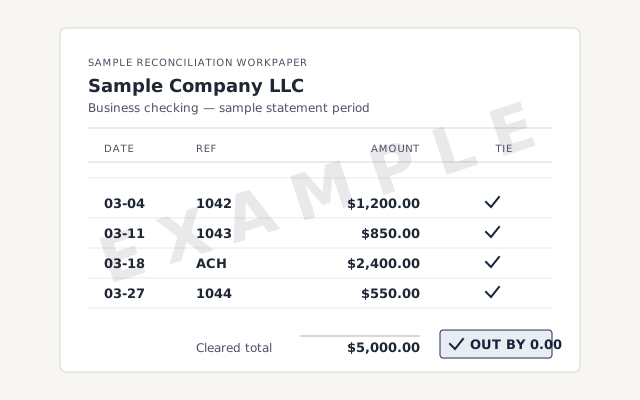
 Sample workflow — not a specific client’s data
A real year-end package
The reconciliation reports and closing summary you receive when the year is closed.
QuickBooks year-end cleanup
Close the year before you file.
A QuickBooks year-end cleanup reconciles every account, clears suspense and Opening Balance Equity, and ties the year's books to your statements so your return is filed on numbers you can defend. We aim to finish two to four weeks before your deadline — remote, at a fixed scope, the same hands start to finish.
What it is
A year-end cleanup reconciles every account for the year, clears the balances that should not be there — Opening Balance Equity, suspense, and uncategorized activity — and closes the period, so the file ties to your statements and your return can be filed on numbers you can defend.
Three things keep a year from being filable, and a cleanup resolves all three. Every bank, card, and loan account has to reconcile to its statement, so the cash on your return is real. Opening Balance Equity — where QuickBooks parks a balance entered without a source — has to clear to zero. And suspense or uncategorized transactions have to be sorted to real accounts, because anything left there is income or expense the return has not counted.
It is bookkeeping, not tax work: we make the numbers correct and defensible, and your CPA files the return from them.
Year-end state
Who it is for
You need a year-end cleanup if your accounts have not been reconciled through the year, if Opening Balance Equity or suspense still carries a balance, or if tax season is coming and you are not sure the numbers your return will be built on are real.
In practice, the files that need one show the same signals:
How it goes
We start with a free, view-only review to scope the year and quote a fixed fee. Then we reconcile every account, clear what does not belong, close the period, and hand your preparer a written summary they can file from.
Day 0
View-only look at the file; we scope the year's cleanup and quote a fixed fee.
Week 1
Every bank, card, and loan account tied back to its year-end statement.
Week 2
Suspense, Opening Balance Equity, and miscategorized entries resolved and explained.
Before deadline
A closed year, a written summary for your preparer, and a call to walk it through.
When to start
Start two to four weeks before your filing deadline for a single-entity file. Reconciliation almost always surfaces something — a duplicate, a wrong opening balance, a missing statement — and that buffer is what lets it be fixed calmly instead of in the final days.
The four phases map to that window: review on day one, reconcile in the first week, clear Opening Balance Equity and suspense in the second, then close and hand off before the deadline.
If you are further behind — several months open, or more than one year — tell us the deadline and we sequence the work to reach fileable numbers by it. If the date cannot be met, your CPA can file an extension. Keeping each month closed with a month-end close makes the following year-end short, and our accounting calendar maps the filing deadlines for the whole year so the start date is planned, not guessed.
Timeline
What you get
A closed year: every bank, card, and loan account reconciled to its year-end statement, Opening Balance Equity and suspense cleared to zero, and a written summary of every closing entry — with the reasoning — that your preparer can file directly from. The close is also when QuickBooks rolls the year's net income into retained earnings, which is why a clean close matters: that balance carries forward into every year after.
Concretely, the package is:
Continue with a monthly close afterward and each period stays reconciled and locked, so next year-end is a confirmation, not a rebuild.
What it costs
Year-end cleanup is a fixed fee set after a free, view-only review, not an hourly bill — because honest scope depends on how many accounts, how many open months, and how tangled the file is. The ranges below start from the published floor; the real number is set once we have seen it.
| Engagement | Typical range | Timeline | What's included |
|---|---|---|---|
| Standard year-end | From $1,500 | 2–4 weeks | One entity, one year: every account reconciled, OBE and suspense cleared, the year closed. |
| Multi-entity year-end | Custom fixed quote | 3–6 weeks | Several entities or a complex chart reconciled and closed together. |
| Year-end + monthly | From $400/mo | Ongoing | Close this year, then we keep each month reconciled so next year-end is quick. |
| Estimate your cost with the calculator | |||
Standard year-end
Multi-entity year-end
Year-end + monthly
Edge cases
Most year-ends are one entity, on one basis, closed in a couple of weeks. The ones that go sideways usually carry a wrinkle — several entities, a cash-versus-accrual mismatch, 1099 vendors, a return already filed, or partnership K-1s. Here is how we handle each.
Multiple entities. Each entity is reconciled and closed on its own books, and we check that intercompany entries agree across them.
Cash vs. accrual. We close on the basis your business files on, and flag a file that mixes the two — a common reason a year-end will not tie.
1099s. Cleanup categorizes vendor payments correctly, which is what accurate 1099s depend on. Preparing and filing the forms is a separate, scoped step — see 1099 cleanup.
A prior-year return already filed. We can reconcile a filed year and show you where it went wrong, but we do not quietly rewrite a filed period. Whether it warrants an amended return is your CPA's call.
Partnerships and K-1s. Partner equity, draws, and contributions have to be right before accurate K-1s can be issued, and that is part of the close. We correct the books; your preparer issues the K-1s.
Payroll. Payroll liabilities and wage accounts that do not reconcile distort a year-end, so we tie them out as part of the close. Deeper tangles go to payroll cleanup.
Which route?
There are three honest routes to a closed year. Do it yourself if the books are already close and you have the time — our year-end close guide walks the full sequence, and the year-end closing checklist is the same steps as a printable list. Hire a specialist if you want the year reconciled and defensible; or wait for your CPA if all you need is filing — but most preparers file from your numbers, they do not rebuild them.
| Specialist | DIY | Wait for CPA | |
|---|---|---|---|
| Reconciles every account | It depends | — | |
| Clears Opening Balance Equity | — | — | |
| Ready before the deadline | It depends | It depends | |
| Typical timeline | 2–4 weeks | Varies | Filing season |
| Best when | You want it defensible | Books are already close | You only need filing |
| Verdict | Closed and defensible | If you have the time | Filing, not cleanup |
How we are different
One firm does your file start to finish — never a rotating pool — at a fixed fee agreed before we begin, with every closing entry documented so you and your preparer can see exactly how each number was reached.
The same hands, start to finish. The firm that scopes your year reconciles it, closes it, and signs off on it. You are not handed to whoever is free, and not left training a junior on your own books.
Documented, not opaque. Every account is tied to its statement and every closing entry written down with its reasoning — the same discipline set out in our reconciliation reference.
Fixed scope. The fee is set after the free review and does not move because a reconciliation ran long. You know the number before the work starts.
Logged access, remote. The free review runs on view-only access; the cleanup itself uses QuickBooks' accountant access to make and log every correction — never your bank logins. We screen-share whenever you want, and change nothing without a written note.
Sample workflow — not a specific client’s data
The reconciliation reports and closing summary you receive when the year is closed.
A written reply within one business day.
Remote-first, nationwide
Mon–Sat · 8am–6pm CT
We work entirely remote — view-only access for the free review, QuickBooks' accountant access for the cleanup itself, screen-share whenever you want to watch, and every closing entry documented in writing.
Honest fit
If your year is already reconciled and you just want a second set of eyes, you do not need a paid cleanup — start with a free review or the health score. And if the books are clean and you only need the return prepared, that is your CPA's job, not ours.
A few situations where we will point you elsewhere:
We would rather send you to the right, cheaper option and be here when you actually need a cleanup.
Sooner is calmer. Two to four weeks before your filing deadline suits most single-entity books, because reconciliation usually surfaces something that takes time to fix. If you are further behind, tell us the deadline and we sequence the work to meet it.
Yes, and it usually works best that way. We reconcile and close the books; your preparer files the return. We hand off a written summary of every closing entry so your CPA can see how each number was reached.
They can be. Year-end cleanup makes sure vendor payments are categorized correctly, which is what 1099s depend on. Preparing or filing the forms is a separate, clearly scoped add-on, and we tell you up front whether your file needs it.
Both. We close the year on whichever basis your business files on, and we tell you if the file is mixing the two — a common reason a year-end does not tie. If you are unsure, your preparer can confirm it.
Yes. Each entity is reconciled and closed on its own books, and we watch for intercompany entries that have to agree across them. Related companies are common, and we quote them together after seeing the files.
Yes. Partner equity, draws, and contributions have to be right before your preparer can issue accurate K-1s, and getting them right is part of the close. We correct the books; your CPA issues the K-1s from them.
We can reconcile the prior year and show you where it went wrong, but we do not quietly rewrite a filed period. Whether it needs an amended return is your CPA's call, and we give them a clear written summary.
The free review runs on view-only access; if you hire us, the cleanup uses QuickBooks' accountant access to make and log every correction — never your bank logins. We screen-share whenever you want to watch, and every entry we make carries a written note explaining what and why.
Related fixes often scoped with a year-end: 1099 cleanup, payroll cleanup, and the Opening Balance Equity fix.