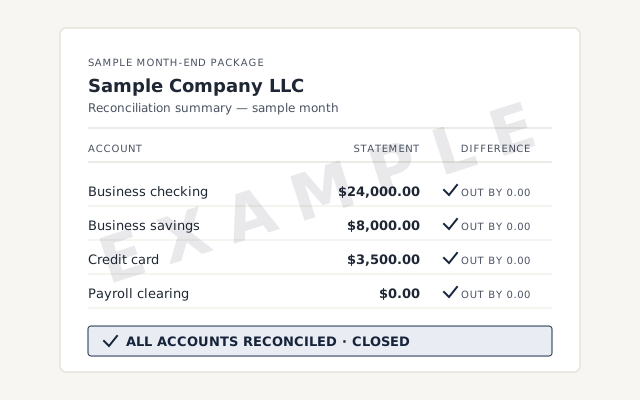
 Sample workflow — not a specific client’s data
A real billed-vs-collected reconciliation
The worksheet tying gross charges, contractual adjustments, and collections to the deposit on the bank.
QuickBooks for medical practices
Kept the way a practice actually collects.
Medical-practice bookkeeping in QuickBooks turns on one fact: what you bill is not what you collect. Insurance writes charges down to a contracted rate, patients owe the rest, and the books must record the contractual adjustment honestly. We set that up, reconcile insurance and patient A/R to the deposit, and track income by provider — financial data only, never clinical records.
QuickBooks for a medical practice means running the financial ledger so it tells the truth about a business where the amount billed and the amount collected are two very different numbers. That takes correct handling of insurance and patient accounts receivable, honest recording of contractual adjustments and write-offs, a clean way to bring charges in from the billing system, income tracked by provider and location, and payroll structured so clinical and administrative labor read separately — all built without pulling patients' clinical records into the accounting file.
A medical practice is unlike most small businesses QuickBooks is sold to. A retail store rings up a sale and collects it; a practice renders a service, bills an insurer a gross charge, receives a fraction of that charge at the payer's contracted rate, chases a patient balance for the rest, and writes off what never comes in. Layer on multiple providers, more than one location, and a payroll that mixes physicians, nurses, and front-office staff, and a generic profit-and-loss stops meaning anything. Get the structure right and QuickBooks shows real revenue, real collections, and which provider or site actually earns. Get it wrong and gross charges masquerade as income while the practice quietly runs on far less cash than the books claim. The sections below cover each piece honestly, including the bright line between the financial data we handle and the clinical data we do not.
Accounts receivable in a medical practice comes in two streams that behave differently: insurance A/R, which is what payers owe on submitted claims, and patient A/R, which is what patients owe after insurance has adjudicated — copays, coinsurance, deductibles, and self-pay balances. Both are money you are waiting on, but they age, deny, and collect on entirely different timelines, and lumping them together hides which one is actually the problem.
The detailed aging — claim by claim, patient by patient — lives in your practice-management or billing system, and that is where it should live. What QuickBooks needs is an accurate financial picture that reconciles to that system: the receivable balances recorded so they tie to the billing aging, collections posted as they arrive, and the split between insurance and patient responsibility visible rather than merged into one undifferentiated pile. When those two streams are separated and reconciled, you can see whether cash is slow because payers are sitting on claims or because patient balances are not being collected — a distinction that changes what you do about it. When they have drifted apart, the fix is the same discipline as our QuickBooks accounts receivable cleanup, applied to a practice's dual receivables.
Two receivable streams
The single most important fact in medical-practice bookkeeping is that billed is not collected. When you bill an insurer a gross charge, the payer pays its contracted rate and the difference is a contractual adjustment — an amount you agreed, under contract, never to collect. It is not a loss and not a bad debt; it is a write-down to the rate you actually get. On top of it sit patient responsibility, denials, and true write-offs of balances that prove uncollectible. The books have to record each of these for what it is.
Billed to collected
Skip this structure and the damage is specific: book gross charges as revenue with no contractual adjustment and the practice looks far more profitable than the cash proves; treat the write-down as a loss and expenses are overstated instead. Either way the profit-and-loss lies. We configure QuickBooks so gross charges, contractual adjustments, and write-offs are each recorded distinctly, so net revenue reflects what the practice actually earns at contracted rates — and so the deposit that lands in the bank ties back through the adjustments to the charge that produced it. We record what your billing system reports; we do not decide adjudication or reprice a claim.
The same structure carries the variants smaller practices run on. A behavioral-health or allied solo practice on a sliding scale is doing something that looks different and posts the same way: a fee agreed below the standard rate is a reduction from that rate, recorded as an adjustment rather than as a lower charge, so the practice can still see what it discounted and to whom over a year. A practice that is largely private-pay and issues superbills for clients to submit themselves has no payer adjudication at all, but still needs the charge, the amount collected, and any discount told apart. Whether the reduction came from a contract, a policy, or a conversation with one client, the accounts that keep revenue honest are the same three.
A superbill — the encounter form that captures a visit's procedure and diagnosis codes — is the starting point of billing, not of bookkeeping. The superbill and the claims it produces live in your practice-management or EHR system, and that system, not QuickBooks, is the system of record for clinical charges and patient-level detail. The bookkeeping question is how the financial result of all that billing lands in the ledger.
The correct pattern is summary posting, not re-keying. Rather than entering every encounter into QuickBooks, we bring in periodic summary figures — collections, contractual adjustments, refunds, and merchant fees — as a deposit or a summary journal that reconciles to both the bank and the reports your billing system produces. That keeps the clinical detail where it belongs and out of the accounting file, avoids duplicating protected information, and still gives you an accurate financial ledger. It also keeps the two systems honest against each other: the collections your billing system says it posted should tie to the deposits QuickBooks records, and when they do not, the discrepancy is exactly what a reconciliation is meant to catch. We set the summary posting up once, test it against a real period, and document it so it runs the same way every month.
Cash-basis and accrual-basis accounting recognize money at different moments, and which one a practice uses is a decision for its CPA rather than something we assert. On a cash basis, revenue is recognized when payment is received and expenses when they are paid, which keeps the books close to the bank and is common for smaller practices. On an accrual basis, revenue is recognized when it is earned and expenses when they are incurred, which can matter as a practice grows or carries significant receivables between billing and collection.
The distinction matters more in a medical practice than in most businesses precisely because of the lag between rendering a service, billing it, and collecting the contracted amount — the gap where accrual and cash can paint noticeably different pictures. That is a reason to get the method right with your accountant, not a reason for us to choose it. What we do is keep the underlying records clean and consistent either way: collections, adjustments, and expenses recorded on the same basis your CPA has elected, so the financial statements sit on data that actually supports the method. We do not select or switch your accounting method, and we do not restate your revenue to fit one — those are your accountant's calls, and we keep the books so either call rests on solid ground.
Class tracking splits the profit and loss by a dimension you choose — for a practice, usually provider, service line, or location — so a multi-provider group or a two-office practice can see how each provider or site contributes alongside the practice-wide totals. It is what turns a single bottom line into an answer to the question every group practice eventually asks: which providers and which locations actually carry the business? Without that dimension the practice-wide total is the only number available, so a provider whose collections do not cover their cost is invisible — the group averages the shortfall away and cannot see it until someone reconstructs a year by hand.
The mechanics are straightforward and the honesty is in the limits. Collections and the labor and overhead behind them have to be tagged to the right provider or location as they are posted; when they are, provider- and location-level reports mean something, and when they are not, the report is confident and wrong. We set up a class structure that fits how the practice is actually organized and keep the class list short so tagging stays fast and the reporting stays clean. For a practice with distinct sites or a clear split between providers, this is where QuickBooks stops being a tax-time chore and starts answering real management questions — provided the financial data feeding it is tagged with discipline, which is exactly what we maintain.
Payroll in a medical practice covers several kinds of worker whose cost means different things — owner-providers or physicians, nurses and clinical staff, and front-office and administrative staff — and the bookkeeping value comes from grouping them so clinical labor reads separately from administrative overhead rather than collapsing into one wage line. That grouping, combined with class tracking, is what lets you see labor by provider or by location and weigh it against the revenue each produces.
We set payroll up so wages, employer taxes, and benefits are recorded accurately and reconciled, and so the account structure keeps those staff categories readable. Where a practice runs its own providers as owners, the split between salary, owner draw, and distribution has real bookkeeping consequences, and we record whatever structure your CPA has set — we do not design physician compensation, decide draw versus salary, or advise on the tax treatment of any of it. If payroll itself has become tangled, we fix it first with a focused QuickBooks cleanup so the labor numbers feeding provider reports and the profit-and-loss are right before anyone relies on them.
We handle your practice's financial data and only its financial data: deposits, payments, contractual adjustments, expenses, payroll, and the general ledger. The protected health information — patient names tied to diagnoses, procedure codes, and claim-level detail — lives in your practice-management or EHR system, and our work does not require it. Because we reconcile from summary postings and bank statements, we neither need nor request patient-level clinical records, which is the most honest form of data minimization there is: we cannot mishandle information we never take in.
We are deliberately precise about what this is and is not. It is HIPAA-mindful data handling: minimal access, financial data only — view-only access for the free review, QuickBooks' accountant access for the work, a screen-share you control, never your logins — and every structural choice documented. It is not a claim to hold a HIPAA compliance certification, to be a certified covered-entity vendor, or to have completed a formal compliance program — we will not overclaim a credential we do not hold. If your arrangement calls for a business associate agreement or a specific compliance posture, that is a conversation to have openly with your practice's compliance advisor about scope and paperwork; what we bring to it is a genuinely narrow data footprint. You can read the discipline behind how we work, and the access limits we hold to, on our methodology page.
Practice files drift in a handful of recognizable ways, and nearly all of them trace back to treating a medical practice like an ordinary cash-and-carry business. These are the recurring ones, and how we fix them.
Where the file has already drifted, the fix is a scoped, fixed-fee QuickBooks cleanup: we tie every account back to its statement, then an accounts receivable cleanup reconciles the insurance and patient streams to the billing system and records the adjustments and write-offs so revenue tells the truth. You get a documented, reconciled baseline, and from there the monthly work only has to keep pace with new activity instead of chasing old distortions.
What it costs
Every engagement is a fixed scope at a fixed fee, quoted after a free view-only review of your file. The figures below are published starting floors; the review sets the real range for your practice.
| Engagement | Typical range | Timeline | What's included |
|---|---|---|---|
| Practice file setup | From $1,500 | 1–3 weeks | Chart of accounts for contractual adjustments, insurance and patient A/R, and provider or location classes. |
| Cleanup + reconcile | Custom fixed quote | 2–6 weeks | Reconcile the file, record adjustments and write-offs, tie A/R to the billing system, restore honest revenue. |
| Monthly bookkeeping | From $400/mo | Ongoing | Summary postings reconciled, collections and adjustments current, provider or location P&L that ties. |
| Get your range after a free review | |||
Practice file setup
Cleanup + reconcile
Monthly bookkeeping
One firm wires your file for a practice and keeps it that way — the same hands start to finish, contractual adjustments recorded, insurance and patient A/R reconciled to the billing system, income tracked by provider — not an offshore pool applying a generic template to numbers it does not understand. And one firm means one narrow, accountable point of access to your financial data, which matters more in a practice than almost anywhere else.
Our method is verification, not assertion: we do not hand back a structure and call it done, we run a real period through it and check that collections, adjustments, and the deposit tie before you rely on the reports. Access stays minimal by design — the free review runs on view-only access, the work itself uses QuickBooks' accountant access to make and log every change, never your bank logins, and never a request for patient clinical records we have no business holding. Every structural choice is documented in writing so the setup outlives the engagement, and you can read exactly how we work on our methodology page. We hold a bright line at what we are: bookkeeping specialists who handle financial data. Your CPA sets cash-vs-accrual and the tax positions; your billing team runs the claims; we keep the ledger underneath both accurate and reconciled. When something can only be settled by your accountant, your biller, or your compliance advisor, we name it in the handoff rather than guessing.
You don't have to take our word for it. Here is the evidence you can check — the deliverable you receive, the discipline the numbers depend on, and our response commitment.
Sample workflow — not a specific client’s data
The worksheet tying gross charges, contractual adjustments, and collections to the deposit on the bank.
Financial data only, minimal access, every reconciliation shown rather than asserted. Read the discipline we apply.
Read the full methodA written reply within one business day.
Remote-first, nationwide
Mon–Sat · 8am–6pm CT
We work entirely remote — view-only access for the free review, QuickBooks' accountant access for the work itself, screen-share to review the setup with you, and every structural choice documented in writing. We handle financial data only, never patient clinical records.
No. We work with the financial side of your practice — deposits, payments, adjustments, payroll, and the general ledger — not clinical records. Your practice-management or EHR system holds the protected health information (PHI): patient names tied to diagnoses, procedure codes, and claim detail. QuickBooks holds the money: what was deposited, what fees were taken, what was written off. We reconcile from summary postings and bank statements, so we do not need, ask for, or receive patient-level clinical data. We keep access to the minimum required to do the bookkeeping, and we are honest that this is HIPAA-mindful data handling, not a HIPAA compliance certification.
Because in a medical practice billed and collected are almost never the same number, and that gap is normal rather than an error. When you bill an insurer a gross charge, the payer applies its contracted rate and writes the difference down as a contractual adjustment — money you were never going to collect under that contract. On top of that sit patient responsibility amounts (copays, coinsurance, deductibles), denials, and eventual write-offs of uncollectible balances. The books have to record the contractual adjustment as an adjustment, not pretend the full charge was revenue or that the shortfall was a loss. We structure QuickBooks so gross charges, adjustments, and actual collections are each visible, and the deposit ties to the bank.
Usually not one charge at a time. The clinical charges live in your practice-management or billing system — the superbill or encounter form is where a visit's procedure and diagnosis codes are captured — and that system produces the claims and the patient statements. QuickBooks is the financial ledger underneath, so the common and correct pattern is to bring in summary figures: a periodic deposit or a summary journal that records collections, payer adjustments, and fees, rather than re-keying every encounter. We set that summary posting up so it reconciles to the bank and to the reports your billing system produces, without duplicating the clinical detail that belongs in the billing system.
That is a decision for your CPA, and it depends on your entity, your size, and the tax method your accountant has elected — we do not assert one for you. Many small practices keep their books and file on a cash basis, recognizing revenue when payment is received and expenses when paid, which keeps the books close to the bank. Accrual recognizes revenue when it is earned and expenses when incurred, which can matter as a practice grows or if it carries significant receivables. What we do is keep the underlying records clean either way — collections, adjustments, and expenses recorded consistently — so whichever basis your CPA uses sits on accurate data. We do not choose or change your accounting method.
Yes, when the file is built for it. Class tracking splits the profit and loss by a dimension you choose — most often provider, service line, or location — so a multi-provider group or a two-office practice can see how each provider or site contributes, alongside the practice-wide numbers. The honest limit is that QuickBooks reports on the financial data it is given: if collections and payroll are tagged to the right provider or location as they are posted, the report is meaningful; if they are not, it is not. We set up the class structure and the tagging discipline so provider- and location-level reporting reflects reality rather than guesswork.
We set payroll up so the different kinds of staff a practice runs — physicians or owner-providers, nurses and clinical staff, and front-office and administrative staff — are grouped so their cost is readable rather than lumped into one line. That grouping is what lets you see clinical labor against administrative overhead, and, combined with class tracking, labor by provider or location. We keep the payroll bookkeeping accurate — wages, employer taxes, and benefits recorded and reconciled. We do not set physician compensation formulas, decide owner draws versus salary, or give tax advice on any of it; those are decisions for you and your CPA.
No to both. We are bookkeeping specialists. We do not prepare or file tax returns, set tax positions, or give tax advice — that is your CPA's work, and we hand them a clean, reconciled file to work from. And we do not run your medical billing, submit claims, post payments at the patient level, or work inside your practice-management or EHR system — that is your billing team's or biller's job. We sit underneath both: the financial ledger that reconciles what your billing system collected to what actually reached the bank, structured so your CPA and your billing operation both trust the numbers.
Yes — that is often where we start. Practice books drift in predictable ways: gross charges booked as revenue with no contractual adjustment recorded, so income looks inflated; patient and insurance receivables that never tie to the billing system's aging; merchant and deposit fees never separated; write-offs that piled up unrecorded. We scope a fixed-fee cleanup, reconcile every account back to its statement, record the adjustments and write-offs so revenue is honest, and hand you a documented baseline. It runs on the same discipline as our <a href="/quickbooks-accounts-receivable-cleanup/">accounts receivable cleanup</a> and full <a href="/quickbooks-cleanup/">QuickBooks cleanup</a>, pointed at a practice's books.
Medical-practice books stand on the gap between billed and collected. When insurance and patient receivables have drifted, reset them with an accounts receivable cleanup and a full QuickBooks cleanup, run on the discipline we describe on our methodology page. Adjacent clinical settings shift the emphasis: QuickBooks for dental practices keeps production out of the ledger and bridges to it monthly, and QuickBooks for veterinary practices adds dispensing and retail inventory to the same problem. Ready when you are — get a free QuickBooks review.