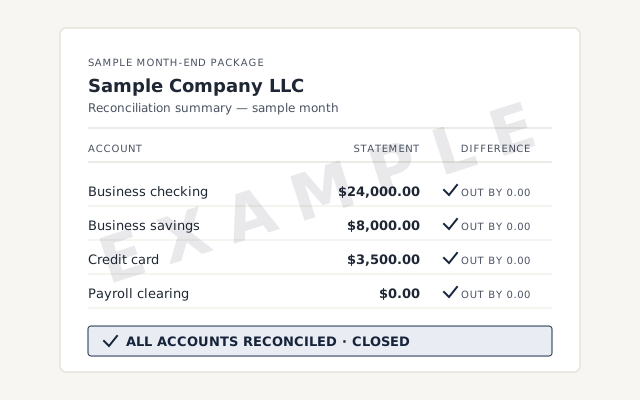
 Sample workflow — not a specific client’s data
A written, neutral recommendation
The plain-language write-up of which option fits your needs and why, yours to keep whether or not you hire us.
Compare QuickBooks
Comparing QuickBooks is really two separate questions: which software your books should live in, and who should keep those books correct. Most working files aren't worth switching — the honest answer is often 'stay where you are.' This hub sends you to a plain, neutral comparison for each decision, and we have no stake in which one you land on.
Start here
Comparing QuickBooks almost always means one of two questions, and they are worth keeping apart: which software should your books live in, and who should keep those books correct. The first is a product comparison; the second is a provider comparison, and the honest answer to each depends entirely on your own situation.
People land here asking “is QuickBooks better than Xero,” or “should I move from Desktop to Online,” or “is QuickBooks Live worth it” — and those are three different kinds of question. Two are about software; one is about who does the bookkeeping. You can run almost any provider on almost any platform, so blurring them together is how people end up switching software when what they really needed was help, or hiring help for a file that just needed the right platform first. This hub separates the two and points you at a plain, neutral comparison for each.
The distinction
The single most useful move before you compare anything is to decide which axis you are actually on: are you choosing a platform, or choosing who keeps the books? They are independent, and mixing them up is the most common mistake we see.
Choosing a platform is about features and fit — access, collaboration, inventory, how the two QuickBooks products differ, or how QuickBooks lines up against Xero or Sage. Choosing a provider is about capacity and trust — whether Intuit's own assisted service, an independent ProAdvisor, a dedicated bookkeeper, or your own time is the right way to keep the file correct. A perfect platform with the wrong provider still produces a mess; the right provider can make almost any capable platform work.
Two independent decisions
Route yourself
Pick the comparison that matches your actual question. Each one is a plain, neutral write-up — including where the alternative genuinely wins.
Start here
What are you comparing?
Compare the two QuickBooks products
Same company, two products with different strengths — Online for access and collaboration, Desktop for offline control and inventory depth.
QuickBooks Online vs DesktopCompare QuickBooks with Xero or Sage
Both rivals are capable and each fits some businesses. The question is fit, not which is best — and a clean, working file is rarely worth uprooting.
QuickBooks vs XeroCompare who does the work — it depends
QuickBooks Live, a ProAdvisor, an independent bookkeeper, or yourself. The right answer depends on how complex your books are and how current you've stayed.
Is QuickBooks Live worth it?The six comparisons this hub routes to:
All of them
Every comparison below has its own page with the honest trade-offs — where QuickBooks or a specialist fits, and where the alternative is the better call.
QuickBooks Online vs Desktop
Two QuickBooks products — access and collaboration vs. offline control and inventory depth. Neither is universally better.
Compare the twoXero vs QuickBooks
Both are capable cloud platforms. An honest look at fit — no Xero-bashing, and where Xero genuinely wins.
Compare the twoSage vs QuickBooks
Where Sage fits and where QuickBooks does, without the marketing spin — a fit comparison, not a winner declaration.
Compare the twoQuickBooks Live vs a bookkeeper
Intuit’s assisted service vs. an independent bookkeeper who owns your file. Continuity, ownership, and cost.
Compare the twoQuickBooks Live vs a ProAdvisor
A pooled Intuit service vs. a certified independent advisor you engage directly. When each one makes sense.
Compare the twoDIY vs professional cleanup
When cleaning up QuickBooks yourself is genuinely fine — and when the mess has grown past a do-it-yourself fix.
Compare the twoRead it honestly
The software question and the provider question answer to different things and have different honest defaults. Read the column that matches what you’re actually deciding.
| Which software | Who does the work | |
|---|---|---|
| The question | Online vs Desktop, or QuickBooks vs Xero or Sage | QuickBooks Live, a ProAdvisor, a bookkeeper, or DIY |
| What it decides | The platform your books live in | Who keeps those books correct |
| Honest default | A clean, working file is rarely worth switching | Depends on complexity and how far behind you are |
| Where the alternative wins | Xero and Sage genuinely fit some businesses | DIY is fine for a simple, current file |
| The real cost to weigh | Migration, retraining, proving it reconciles | Your time, or a monthly fee, against the risk of errors |
| They're independent | Pick the platform on fit | Pick the provider on need |
Software
Switching platforms is worth it only when a specific need your current software genuinely can’t meet outweighs the real cost of moving. For most businesses with a clean, working file, it isn’t — and we’ll say so rather than sell you a migration.
Leaving a platform that already holds your history is not free. There is the migration itself, the retraining, the reports that need rebuilding, and the risk that the converted file doesn’t tie to the old one — a cost that has to be cleared before any benefit counts. So the honest test isn’t “is the other product good” — Xero and Sage are both good — it’s “does the other product solve a real problem this one can’t, by enough to justify the move.” If your file works and no such problem exists, staying put is the right answer, and the comparisons above will tell you the same.
The switching test
Provider
The right provider depends on two things: how complex your books are, and how current you’ve kept them. There is no single best option — each of the four fits a different situation honestly.
Doing it yourself is genuinely fine for a simple, current file with a handful of transactions a month — no shame in it, and no reason to pay for help you don’t need. QuickBooks Live, Intuit’s assisted service, suits an owner who wants a hand staying on top of a straightforward file but isn’t chasing a specialist relationship. A ProAdvisor — an independent advisor certified by Intuit — or a dedicated bookkeeper suits a file that’s complex, behind, or important enough that you want one person who owns it and knows it. The trade the provider comparisons keep coming back to is continuity: a pooled service versus a single specialist who carries your file from month to month. When the answer is genuinely “it depends,” our is-QuickBooks-Live-worth-it answer works through the trade-offs in detail.
How we compare
An honest QuickBooks comparison starts from your real file, ends in a written recommendation, and carries no stake in the outcome. Because we’re a bookkeeping firm and not a reseller, we earn nothing on which software you choose — so the recommendation is a straight read of your needs, not a nudge toward whatever pays a commission.
A comparison starts with a free, view-only look at how your books are actually set up and where they hurt. We line your genuine must-haves up against each option, name the rows that decide it, and tell you plainly where a rival product or a different provider would serve you better — including when the honest verdict is to change nothing. If a move is worth it, the value we add is the same reconciliation-first discipline behind the rest of our work: proving a converted file ties back to the original before you rely on it, exactly as our methodology spells out. And when QuickBooks and a specialist are the right answer, our QuickBooks services lay out what that engagement looks like.
Straight talk
Plenty of the time, the honest answer to a comparison is to do nothing. If your file is clean and your platform does what you need, you don’t have to switch — and if your books are simple and current, you don’t have to hire anyone, us included.
Here is the version that saves you money. You probably shouldn’t switch software when your current product still holds your must-haves and the only gains are conveniences you can live without — moving a working file just to chase a feature usually costs more than it returns. You probably don’t need a paid provider when you keep a simple file current in an afternoon a month; that’s a job you can own. And you don’t need us for a single, obvious, recent problem you can already see and fix. We’re worth hiring when the books are wrong across months or accounts, when a migration has to be proven correct, or when the file matters enough that one specialist should own it. If you’re not sure which side you’re on, a free review tells you honestly — and if the answer is “you’re fine,” we say so at no charge.
How we help
When you do want a second read, the path is simple: a free, view-only review, a neutral recommendation in writing, and a fixed scope only if there’s real work to do. No pressure to switch, and no commission pulling the answer one way.
We look at your file and your must-haves and tell you plainly which product fits, whether a move is worth its cost, and whether you need a provider at all. You keep the written recommendation whether or not you hire us. If it’s a fix you can do yourself, we point you at it and you’re on your way. If it’s real work, you get a fixed scope and fee before anything starts — and a written reply lands within one business day, not a ticket queue.
You don't have to take our word for it. Here's what you can check — a neutral recommendation you own, the method we use to prove a switch reconciled, and our response commitment.
Sample workflow — not a specific client’s data
The plain-language write-up of which option fits your needs and why, yours to keep whether or not you hire us.
How we prove a converted file reconciles to the old one after a switch. Read exactly how.
Read the full methodA written reply within one business day.
Remote-first, nationwide
Mon–Sat · 8am–6pm CT
We work entirely remote — a neutral read of your file and your needs, screen-share whenever you want to walk through a comparison, and every recommendation documented in writing.
Rarely, if your file is clean and doing the job. Xero and Sage are both capable, and each fits some businesses well — but moving a working file costs you the migration, the retraining, and the work of proving the new file ties to the old. Switch only when a specific need your current platform can't meet outweighs that cost.
They're two independent decisions. Comparing products — QuickBooks Online vs Desktop, or QuickBooks vs Xero or Sage — decides which software your books live in. Comparing providers — QuickBooks Live, a ProAdvisor, an independent bookkeeper, or doing it yourself — decides who keeps those books correct. Almost any provider works on almost any platform, so decide them separately.
Neither is universally better. Online wins on access and collaboration; Desktop wins on offline control and inventory depth. Count which product holds more of your must-haves — our QuickBooks Online vs Desktop comparison walks through the rows that tend to decide it.
That depends on how complex your books are and how current you've kept them. QuickBooks Live is Intuit's assisted-bookkeeping service, and for a simple, current file it can be enough. For a file that's complex or behind, a dedicated bookkeeper who owns it end to end is usually the better fit. Our is-QuickBooks-Live-worth-it answer lays out the trade-offs.
QuickBooks Live is Intuit's own pooled service, run to Intuit's process. A ProAdvisor is an independent accountant or bookkeeper certified by Intuit, whom you engage directly. The practical difference is continuity — one specialist who carries your file month to month, versus a pooled team. Our QuickBooks Live vs ProAdvisor comparison covers when each makes sense.
If the mess is small and recent — one account, one month, a handful of duplicates — fix it yourself; hiring anyone would be overkill. Hire a professional when the problem spans months or accounts, when balances no longer tie, or when you can't tell what broke. Our DIY vs professional cleanup comparison draws that line, including the cases where DIY is the right call.
No. We're a bookkeeping firm, not a reseller — we earn nothing on which software you choose, and no commission steers the answer. That's why the recommendation is sometimes 'stay where you are' or 'you don't need to switch.'
With a free, view-only review of your actual file. We look at how your books are set up and where they hurt, then give you a written, neutral recommendation — which product fits, whether a switch is worth its cost, and whether you need a provider at all. If the answer is that you're fine as you are, we say so, at no charge.
Not sure yet? Start with the two most common questions: QuickBooks Online vs Desktop or whether QuickBooks Live is worth it — or get a neutral read with a free review.