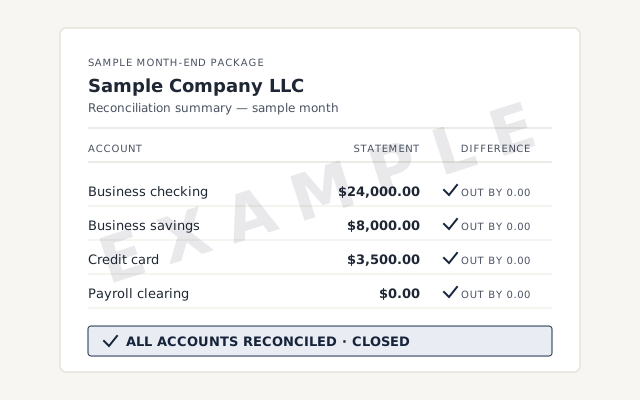
 Sample workflow — not a specific client’s data
A real fixed-scope quote
The written scope and fixed fee you receive after the free review — no hourly meter, no surprises.
QuickBooks cost
QuickBooks cost splits in two: the software subscription you pay Intuit, and the professional help you pay a specialist to fix or run the books. They're unrelated numbers. Our work is a fixed scope with a fixed fee, quoted after a free, view-only review — never by the hour, and never before we've seen your file.
Start here
Most confusion about QuickBooks cost comes from pricing two different things as if they were one. Sort which one you mean first — the answer routes you straight to the number that matters.
Start here
What are you pricing?
A one-time cleanup fee
A file that won't reconcile or is months behind is scoped as a fixed cleanup — priced by the tangle, not the hour.
What a cleanup costsA recurring monthly fee
Ongoing bookkeeping is a flat monthly cost to keep the file reconciled and reports current after any cleanup.
What monthly bookkeeping costsA scoped consultant engagement
Setup, a second opinion, or a specific fix is scoped to the task — worth it only when there's real work.
What a consultant costsThe software cost and the help cost are two different bills to two different companies. Your QuickBooks subscription is billed by Intuit, priced by product and plan; the work of fixing or running your books is billed by a specialist, priced by scope. Confusing the two is why a search for "QuickBooks cost" returns numbers that can't both be right.
We don't publish Intuit's prices, because we don't set them and they change — for current QuickBooks Online, Desktop, Enterprise, or Payroll figures, see Intuit's official pricing pages. What we can tell you honestly is our side of the ledger: we're independent specialists who work inside the file you already own. We don't resell the subscription, mark it up, or take a cut of it. You keep your own Intuit account, and everything below is the cost of the human work — nothing else.
Three things set almost every number: how far back the books have drifted, how many accounts and connected feeds are involved, and how much the history was patched over before you called. The calendar barely matters — a tangle decides the price, not the age of the file.
Drift is the biggest lever. One recent month off on one account is minutes of work; a year of unreconciled statements across several accounts, with cleared transactions edited inside closed periods, is a structured rebuild. Connected bank and credit-card feeds multiply the surface area, and every prior "adjustment" someone posted to force a balance is a knot we have to untie before the real number appears. That's why we quote after seeing the file, not before.
What sets the number
We price a fixed scope for a fixed fee because hourly billing charges you for how tangled the file is and leaves the total open-ended — the opposite of what you want when you're already unsure what's wrong. A fixed scope puts the number in front of you before any work begins, and it doesn't move because a month took longer than we thought.
An hourly meter also creates the wrong incentive: the slower and more painstaking the work, the bigger the bill, so there's no reward for efficiency and no ceiling for you. A fixed fee flips that — we absorb the risk of a file being messier than it looked, and you get certainty. If the review under-read the scope, we come back and tell you before doing anything extra; nothing is added to the total in silence.
Two pricing models
The decision
The pricing model matters as much as the price. Here's the honest side-by-side of paying by the hour versus paying for an agreed scope — including where hourly is genuinely simpler.
| Hourly | Fixed scope | |
|---|---|---|
| Number known before work starts | — | |
| Total can move as the file surprises you | — | |
| Who carries the risk of a messy file | You | Us |
| Rewards fast, efficient work | — | |
| Simple for a tiny, obvious task | It depends | |
| Changes require your approval first | It depends | |
| Verdict | Open-ended | Certainty up front |
A cleanup is a one-time fixed fee, from $1,500, set by how many months have drifted and how many accounts are involved. You pay it once to bring a file that won't reconcile — or that's been ignored for months — back to a state you can trust and hand to a preparer.
A single account off for one recent period sits at the small end; several accounts drifting across a year, with edited cleared history and forced adjustments to unwind, is a larger scope. We don't invent a figure before the review, because the file decides it. For a full breakdown of what moves the number, see what a QuickBooks cleanup costs, or get a tokenized planning range from the cleanup cost calculator before you ever talk to us.
Monthly bookkeeping is a flat recurring fee, from $400/mo, priced by how much moves through your books each month — transaction volume, the number of accounts and feeds, and whether payroll or sales tax are in the picture. Unlike a cleanup, you pay it each month to keep the file reconciled and the reports current.
Many owners run the two together: a one-time cleanup to fix the past, then monthly bookkeeping so it never drifts again. Because the fee is flat and agreed up front, there's no per-transaction meter and no month-end surprise. The detail lives on what monthly bookkeeping costs.
A consultant engagement is scoped to the task, from $1,500 — a setup, a second opinion, a specific fix, or advice on how to run the file. It's the right shape of cost when you don't need an ongoing service or a full cleanup, just a specialist's hands on one defined problem.
Because the work is bounded, so is the fee: we agree what "done" looks like before starting, and that defines the number. If the task turns out to be a symptom of a larger mess, we say so and re-scope with you rather than run a meter. See what a QuickBooks consultant costs.
Every engagement, one place
Each cost has its own page with the drivers spelled out. Start with the one that matches what you're pricing, or see every engagement together on the pricing page.
Cleanup cost
A one-time fixed fee to bring a drifted file back to trustworthy. Priced by the tangle.
See the costBookkeeping cost
A flat monthly fee to keep the file reconciled and reports current.
See the costConsultant cost
A scoped fee for setup, a second opinion, or one defined fix.
See the costFull pricing
Every engagement and its fixed-scope range on one transparent page.
See pricingCleanup calculator
A tokenized planning range for a cleanup, from a few questions about your file.
Estimate a rangeCompare options
Weighing DIY, QuickBooks Live, or a bookkeeper against a specialist? Compare honestly.
CompareHow the number is set
Your number comes from one place: a free, view-only review of your actual file. We look at how far the books have drifted, which accounts and feeds are involved, and what's been patched over — then quote a fixed scope and fee before anything starts.
Access stays view-only for the review; if you approve a scope, the work uses QuickBooks' accountant access to make and log every correction — never your bank logins. You can screen-share and watch the review happen. Reviewing is genuinely how we quote, not a sales step — it's why every dollar figure on this site is a published floor like From $1,500 rather than a made-up range: a real price needs your file, and we won't pretend otherwise. Ready when you are: get your free review.
The honest part
Sometimes the honest answer is that you shouldn't pay anyone. If your problem is one recent month you can reconcile yourself, a software error with a documented DIY step, or a handful of duplicates you can merge in an afternoon, hiring a specialist is overkill — and we'll tell you so during the review.
We'd rather point you to the free steps and keep your goodwill than sell you a project you don't need. A cleanup earns its fee when the numbers are wrong across months, when a balance won't tie no matter what you try, or when a file has to be rebuilt without throwing away the periods that are already right. If you're weighing whether to do it yourself at all, the honest trade-offs live on our compare pages. The review costs nothing, and "you don't need us" is a real outcome — one we give often.
Why our pricing is different
Our pricing is fixed, quoted after seeing the file, and never billed by the hour — so you carry no open-ended risk and approve every number before work starts. There are no setup charges, no per-transaction surprises, and no add-ons that appear at the end.
That posture is a method, not a slogan. We save your key reports before touching anything and re-run them after, so we can show — not just claim — that the work did what we quoted. If a scope needs to grow because the file held more than the review revealed, we stop and tell you first; nothing is added silently. The same principle runs through our whole practice, documented in our methodology. Prices you can check, work you can verify, and a specialist who tells you when the answer is no.
You don't have to take the number on faith. Here's what you can check — the quote you receive, the method that stands behind it, and our response commitment.
Sample workflow — not a specific client’s data
The written scope and fixed fee you receive after the free review — no hourly meter, no surprises.
A written reply within one business day.
Remote-first, nationwide
Mon–Sat · 8am–6pm CT
We work entirely remote — view-only access for the free review, QuickBooks' accountant access for the work itself, screen-share whenever you want to watch, and every quote and change documented in writing.
Two separate numbers. The software is a subscription you pay Intuit, priced by product and plan on their site. Professional help — a cleanup, monthly bookkeeping, or a consultant — is what you pay a firm like ours, and it's quoted from your file, not a price list. Mixing the two is why the numbers you find online disagree.
Free tiers, trials, and plan lineups are Intuit's to set, and they change — so we don't republish them; the current answer lives on Intuit's official pricing page. The one genuinely free thing on our side is the review: a view-only look at your file that ends in a plain verdict, including 'you don't need us.'
A fixed scope with a fixed fee, quoted after a free view-only review — never by the hour. An hourly meter makes the mess your risk and leaves the total open-ended. With a fixed scope you approve the number before work starts, and it doesn't move because a month ran long.
Because an honest number needs the file. The cost is set by how many months have drifted, how many accounts are involved, and how tangled the history is — none of which shows in a description. We review the file view-only, free, and quote a figure that holds, rather than invent one that changes the moment we open it.
Yes. It's a view-only look at your file that ends in a plain verdict: a fix you can do yourself, a scoped engagement with a fixed fee, or nothing worth paying for. No charge, no obligation — and if you don't need us, we say so.
A cleanup is a one-time fixed fee that brings a drifted file back to trustworthy; monthly bookkeeping is a flat recurring fee that keeps it that way. Many owners do the cleanup first, then move to monthly. Cleanups start at $1,500, monthly bookkeeping at $400/mo, and both are quoted after the review.
Yes. Your QuickBooks subscription is billed by Intuit and is separate from what you pay us. We're independent specialists working inside the file you already own — we don't resell the software, mark it up, or take a cut of the subscription.
For a cleanup, yes — the cleanup cost calculator turns a few questions about your file into a tokenized planning range. It can't see edited history or accounts that never reconciled, so treat it as a starting bracket, not a quote. The real figure comes from the review.
Then we tell you, and you pay nothing. If the problem is one recent month you could reconcile yourself, or a software error with a documented DIY fix, we point you to the free steps instead of quoting a project. 'You don't need us' is a real outcome of the review.
No. A cleanup is a one-time fixed fee for an agreed scope; monthly bookkeeping is a flat recurring fee agreed up front. No setup charges, no per-transaction surprises, no add-ons at the end. If the file holds more than the review showed, we tell you first and you approve the new scope before anything is added.
Pricing a specific engagement? Go straight to cleanup cost, bookkeeping cost, or consultant cost — or see the whole pricing page.