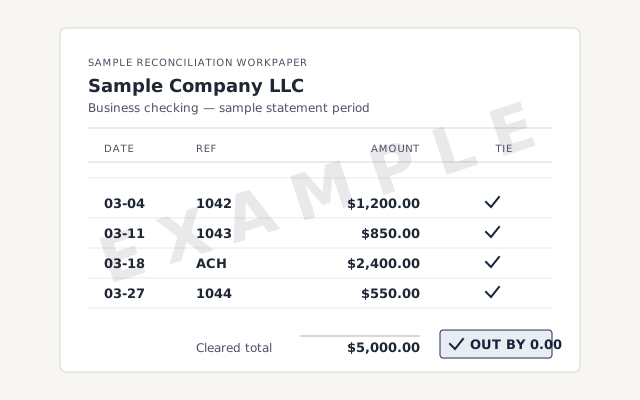
 Sample workflow — not a specific client’s data
A real audit-ready package
The exact reconciliation and documentation pack a reviewer receives.
QuickBooks audit-ready books
A trail a reviewer can follow, start to finish.
QuickBooks audit-ready books mean every balance is reconciled, every material entry is documented, and the trail from bank statement to financial report is complete. The goal is simple: an auditor, lender, or buyer can follow your numbers end to end, without sending back a follow-up list of questions.
Audit-ready QuickBooks books are books where every balance is reconciled, every material entry is documented, and a reviewer can trace any number from the bank statement all the way to the financial report without asking you a single question.
The phrase describes a standard, not a product. An auditor, a lender's credit team, and a buyer's due-diligence group all run the same test: pick a figure on the balance sheet or profit and loss, and follow it back to source. In audit-ready books that trail is complete — the balance ties to a statement, the reconciliation is on file, and any adjusting entry has a reason attached. In as-is books the trail breaks somewhere in the middle, and every break becomes a question on a follow-up list. Getting audit-ready is one endpoint of a full QuickBooks cleanup: a cleanup fixes the books, audit-ready proves they hold.
The trail
You need audit-ready books when someone outside the business is about to examine your numbers — an auditor, a bank underwriting a loan, or a buyer's team running due diligence — and a follow-up list would cost you time, credibility, or the deal.
The usual triggers:
If none of these apply and no outside party is looking at your numbers, you may not need this yet — a point we return to below. Not sure where the file stands? A free bookkeeping health score flags the gaps an auditor would catch in a few minutes.
An auditor checks four things: that each balance is reconciled to an independent source, that material entries are supported by a reason, that the trail from statement to report is unbroken, and that the numbers stay consistent from one period to the next.
The four checks
None of these is about catching you out; they are about being able to rely on the file without interviewing you for every figure. The check that fails most often is the trail — a balance that's correct but unsupported, an adjusting entry with no note, a reconciliation that was never saved. That is why bank reconciliation sits at the center of audit-ready work, and why an out-of-balance balance sheet or a pile of undeposited funds has to be cleared before a file can pass.
How it goes
We get your books audit-ready in four steps: a free review to scope the work, reconciling every account to its statement, documenting the trail behind material entries, and a handback with a walkthrough.
Day 0
View-only look at the file; we scope what audit-ready will take and quote a fixed fee.
Days 1–10
Each bank, card, and control account tied back to its statement, month by month.
Days 11–16
Material entries supported, so a reviewer can follow statement to report without asking.
Day 17
Audit-ready books, a documentation pack, and a call to walk a reviewer through them.
What it means
Audit-ready books satisfy an outside reviewer; tax-ready books are enough to file a return; as-is books are fine only until someone asks a question. Here is how the three compare.
| Audit-ready | Tax-ready | As-is | |
|---|---|---|---|
| Every account reconciled | It depends | — | |
| Material entries documented | — | — | |
| Trail from statement to report | — | — | |
| Workpapers a reviewer can follow | — | — | |
| Consistent period over period | It depends | — | |
| Survives due diligence | — | — | |
| Typical timeline | 2–4 weeks | 1–2 weeks | None |
| Best when | Auditor, lender, or buyer | Filing a return | Nobody's looking yet |
| Verdict | Follows through | Enough to file | Fine until asked |
A financial audit tests whether your statements fairly present the business, a tax audit tests a single filed return, and due diligence tests both plus how consistent the numbers are over time — the books need to be clean for all three, but each asks a different question.
A financial audit is usually driven by a lender, investor, or board that wants independent assurance your statements are reliable. The reviewer works top-down from the balance sheet and profit and loss, sampling balances and tracing them to source. What matters is that every material line is reconciled and supported, so the sample holds wherever they look.
A tax audit examines one filed return, so its questions are narrower: substantiation for specific deductions, income that ties to what was reported, entries that support the numbers on the form. The books still need to be clean, but the trail runs from the return down into the ledger rather than across the whole file. Tell us which return and year, and we prepare that path.
A buyer's team asks everything an auditor asks and then adds consistency: do revenue and margin move the way the story says, month over month and year over year? Gaps that a tax preparer would shrug at — an unexplained swing, a reclassified expense with no note — can stall or reprice a deal. This is the most demanding of the three, so we assemble a documentation binder built to be read by a skeptic.
Every one of them rewards the same underlying file: reconciled balances, supported entries, and a trail a stranger can follow. That is why we prepare to a single standard and then tune the emphasis to whichever review you're facing, rather than rebuilding the books three different ways.
You get reconciled books, a documentation pack that supports every material number, a before-and-after set of reports that tie, and a call to walk a reviewer — or you — through the whole file.
Nothing is a black box. The documentation pack lists each account, what it ties to, and the support behind any adjustment, so your CPA or a buyer's team can audit our work as easily as they audit your books. Staying ready is the natural next step: many clients move to a monthly close so the trail is maintained each month rather than rebuilt under pressure the next time someone asks. When accounts stop reconciling between reviews, the same discipline catches it early instead of at the worst moment.
What it costs
Every audit-ready engagement is a fixed scope with a fixed fee, quoted after a free view-only review. The figures below are published starting floors; the review sets the real range for your file.
| Engagement | Typical range | Timeline | What's included |
|---|---|---|---|
| Audit-ready review | From $1,500 | 2–4 weeks | Every account reconciled, material entries documented, trail assembled. |
| Due-diligence package | Custom fixed quote | 3–6 weeks | Multi-year or sale-ready, with a documentation binder for reviewers. |
| Audit-ready + monthly | From $400/mo | Ongoing | Get ready once, then we keep the books audit-ready every month. |
| Estimate your range | |||
Audit-ready review
Due-diligence package
Audit-ready + monthly
One firm does the work — the same hands on your file start to finish, documenting as they go — so what you hand a reviewer is a trail we can defend line by line, not an offshore pool's best guess at your numbers.
Our methodology is verification, not assertion: we reconcile to independent statements and save the workpapers, so we can show — not just claim — that a balance holds. Access stays minimal: the free review runs on view-only access, and the work itself uses QuickBooks' accountant access to make and log every correction — never your bank logins. And we don't paper over a problem to hit a deadline — if a number can't be supported honestly, we tell you and fix the cause, because an audit-ready file that hides a gap isn't audit-ready at all.
Skip us when no outside party is looking at your numbers, or when the work you actually need is a routine cleanup rather than a defensible audit trail.
If nobody has asked to see verified statements — no lender, no auditor, no buyer — paying to assemble a formal documentation pack is premature; a standard cleanup or an ongoing monthly close keeps the books honest for far less. If your file is simply behind and just needs reconciling, start there — audit-ready is the finish line, not the first step. And if a reviewer only needs a single filed return supported, that is a narrower tax-ready job than a full audit trail. We'll tell you which case you're in during the free review, even when the answer is "you don't need this yet."
You don't have to take our word for it. Here is what you can check — the exact package a reviewer receives, the method we use to prove a balance holds, and our response commitment.
Sample workflow — not a specific client’s data
The exact reconciliation and documentation pack a reviewer receives.
Every account tied to its statement — the core of a trail that follows through.
Read the full methodA written reply within one business day.
Remote-first, nationwide
Mon–Sat · 8am–6pm CT
We work entirely remote — view-only access for the free review, QuickBooks' accountant access for the work itself, screen-share whenever you want, and every reconciliation and supporting note documented in writing.
That each balance is supported and reconciled, that material entries have a reason behind them, and that they can trace a number from the bank statement to the report without asking you. Surprises and unexplained adjustments are what turn a review into a follow-up list.
No. A financial audit tests whether your statements fairly present the business, often for a lender or investor. A tax audit tests a filed return. The books need to be clean for both, but the questions differ — tell us which you are facing and we prepare for it.
It is the evidence behind each number: the statement a balance ties to, the support for a material journal entry, the reason a correction was made. A trail means a reviewer can follow your books end to end on their own, instead of interviewing you for each figure.
Most files take two to four weeks, driven by how many accounts and months need reconciling and how much documentation already exists. We commit to a timeline in the fixed-scope quote after a free review, so you know the date before any work begins.
Yes. A buyer's team asks the same core questions an auditor does — reconciled balances, supported entries, a clean trail — plus period-over-period consistency. We assemble the books and a documentation pack so due diligence moves quickly instead of stalling on gaps.
Yes. The engagement produces a documentation pack — reconciliations tied to statements, support for material journal entries, and a change log — which is the set of workpapers a reviewer requests. You hand it over instead of reconstructing each number under questioning.
We can. Many engagements go faster when we coordinate with your CPA or the reviewer directly, answering questions straight from the workpapers so you are not relaying accounting details back and forth. You stay in control of who we talk to and what we share.
Making books audit-ready reconciles and documents what already happened; it does not invent income or expense, so it does not change your tax liability by itself. If reconciling surfaces a genuine error in a filed period, we flag it and tell you before anything moves.
You get reconciled books, a documentation pack, and a call to walk a reviewer through them. To stay ready, many clients move to a monthly close with us, so the trail is maintained each month rather than rebuilt under pressure the next time someone asks.
The habits that keep books audit-ready: a disciplined month-end close, clean reconciliations, and the cleanup checklist as a running guide.