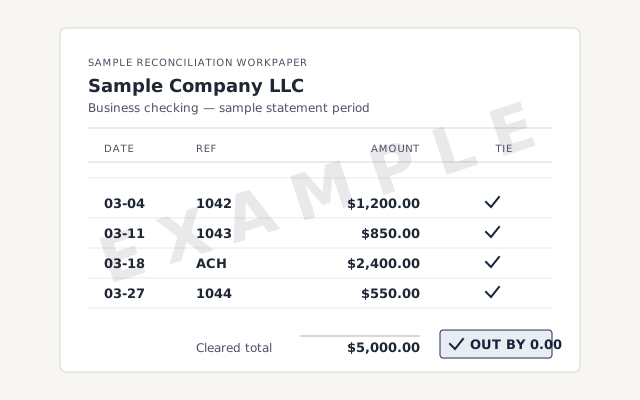
 Sample workflow — not a specific client’s data
See a sample month-end package
The exact reconciliation reports and statement pack you receive each month.
QuickBooks month-end close
A close that stays closed.
A QuickBooks month-end close reconciles every account, reviews the P&L and balance sheet for errors, and produces a documented month-end package — so each month closes to numbers you can trust and doesn't quietly re-open later. We run it remotely, at a fixed monthly fee, with the same firm signing off every month.
The concept
A month-end close is the monthly routine that finalizes one period's books — every account reconciled to its statement, the profit-and-loss and balance sheet reviewed for errors, adjusting entries booked, and the period locked with a closing date.
Recording transactions and closing the books are different jobs. A file with a live bank feed can look current all month and still never be closed — nothing checked against a statement, nothing locked. Closing resolves timing differences, catches miscodings, fixes odd balances, then freezes the result so months stay comparable. Where the close sits among the rest of the year's recurring work — quarterly filings, annual tasks — is mapped out in our accounting calendar template.
The close, in order
The work runs in one direction: reconcile first (you can't review what you haven't proven), then review, then lock. Bank reconciliation is the check it's built on.
Who it's for
You need a managed monthly close once your numbers drive decisions — when a lender, investor, or partner reads your statements, when you carry inventory or payroll, or when more than one account has to tie out every month.
A close earns its keep the moment someone relies on the numbers between tax filings — a bank covenant, a credit line, an investor update, a partner's draw, a pricing call that can't wait for April.
The businesses that need it most have moving parts that drift quietly — inventory, payroll, deferred revenue, or accrual reporting. You'd likely benefit from a managed close if:
If none of that fits — a solo service business, one account, no inventory — a lighter routine may do. We say so in monthly bookkeeping below.
How it goes
A month-end close works as a fixed checklist: reconcile every bank, card, and loan account to its statement; review the profit-and-loss and balance sheet for errors; book adjusting entries; then set the closing date and assemble the package.
Days 1–3
Every bank, card, and loan account tied to the statement for the month just ended.
Day 4
Scan the profit-and-loss and balance sheet for miscodings, missing entries, and odd balances, and fix them.
Day 5
Book adjusting entries, set the closing date, and lock the period so it can't drift.
Day 6
You get the month-end package and a short note on anything worth watching next month.
Behind those four steps is a longer list, worked the same way every month. Reconciliation covers every account that issues a statement — checking, savings, credit cards, loans — and clears the holding accounts that hide errors, like undeposited funds.
The review is where a close pays for itself: we read the balance sheet account by account, where mistakes hide, then scan the profit-and-loss against prior months. Adjusting entries go in with a reason, payroll and sales-tax liabilities are checked, and only then is the date set. The full sequence is public: the month-end close process guide documents every step, the month-end close checklist is the printable version, and the month-end close template is the workpaper it fills in.
How long
Most closes finish within the first week of the following month, but the timeline starts when your bank and card statements post — not on the first. Once statements are available, a standard close usually takes a few business days.
Statements govern the start. Some banks post on the first; others take days, and a card with a mid-month cycle pushes part of the work later. So when it's done is measured from when the data arrives, not the calendar.
Days after month-end
We commit to a specific turnaround in your engagement, so each month has a date you can count on. When a month is heavy — year-end, an audit, a new entity — we tell you before it starts.
Our method
Every account is tied to its statement before a number is trusted; every entry is logged with a reason; the same hands sign off every month; the closing date is set so the month stays closed. Read how reconciliation works.
The deliverable
After each close you get a month-end package: reconciliation reports for every account, the finished profit-and-loss and balance sheet, a log of any adjusting entries, and a short written note on anything worth watching.
The package is the same shape every month, so you can lay two side by side and compare: a reconciliation report for each account tied to the statement, the profit-and-loss for the month and year to date, the balance sheet at month-end, and every adjusting entry with its reason.
The close note is what owners read first — anything unusual, any follow-up, anything worth a decision. At year-end, it's what your tax preparer wants. Missing months first? That's catch-up bookkeeping, not a close.
Everything about the close is verifiable — the package you receive, the method behind it, the person who signs off. No badges, no testimonials, just evidence.
Sample workflow — not a specific client’s data
The exact reconciliation reports and statement pack you receive each month.
Every close starts by tying each account to the statement. Read how.
Read the reconciliation referenceA written reply within one business day.
Why it matters
The difference between closed and open books is verification and permanence. A closed month has been reconciled, reviewed, documented, and locked. An open month is data no one has proven — and nothing stops a later edit from changing it.
| Closed | Open | |
|---|---|---|
| Every account reconciled | — | |
| P&L and balance sheet reviewed | — | |
| Period locked with a closing date | — | |
| Documented month-end package | — | |
| Verdict | Closes and stays closed | Quietly re-opens |
Online vs. Desktop
Month-end close works in both QuickBooks Online and Desktop, and the accounting is identical. What differs is the logistics — how we reach the file and how many people can work in it at once — not whether the month closes.
| QuickBooks Online | QuickBooks Desktop | |
|---|---|---|
| How we reach your file | QuickBooks' accountant access, every entry logged | Screen-share or hosted copy |
| Close from any location | It depends | |
| Several people in the file at once | It depends | |
| Closing date locks the period | ||
| Edits after close are flagged | ||
| Verdict | Same close, easier to reach | Same close, access varies |
What it costs
A monthly close is a fixed monthly fee, set after a free review of your file — the price tracks the work, not your revenue. The floor shown is the published starting point; the review sets the real fee for your file.
| Engagement | Typical range | Timeline | What's included |
|---|---|---|---|
| Monthly close | From $400/mo | Ongoing | Every account reconciled, statements reviewed, and a documented package each month. |
| Close + catch-up | From $1,500 | 2–4 weeks | Catch up and reconcile the open months first, then start a monthly close. |
| Close + review call | Custom fixed quote | Ongoing | Monthly close plus a standing call to walk the numbers with you. |
| Get your exact quote | |||
Monthly close
Close + catch-up
Close + review call
The hard parts
Most months are routine, but a few situations change the work: cash versus accrual basis, inventory and cost of goods sold, multiple entities, the closing-date lock itself, and deferred revenue. Each is handled explicitly, never glossed over.
We close on whichever basis matches your books and return, consistently. Accrual closes carry more adjusting entries — accrued expenses, prepaids, deferred revenue — because income and cost are recognized when earned, not when cash moves.
If you carry inventory, the close ties the inventory-asset account to a count so cost of goods sold falls out correctly. Average-cost drift and negative quantities distort the balance sheet and margin. Badly off means an inventory cleanup first.
Related companies close separately, then intercompany balances are reconciled so a transfer isn't counted twice. Each keeps its own file and package; nothing is merged to save time.
Setting a closing date is what makes a closed month stay closed. If someone edits a locked period, QuickBooks flags it, and we review that exception rather than let a prior number change silently. A password adds a guard.
Money taken before it's earned — retainers, annual plans, deposits — is a liability until you deliver; a prepaid is an asset until used. The close recognizes the right slice each month, so profit isn't flattered by cash that isn't yet yours. Where the whole business runs on paid-ahead terms, that release schedule is the close: see QuickBooks for SaaS and QuickBooks for gyms and fitness.
Why us
Our close is fixed-fee, documented, and done by one firm: the same hands reconcile and sign off every month, you get the same package each time, and the period is locked — not an automated rule or an anonymous offshore pool.
One firm does the work and signs off on it, month after month. Ask why an entry was made and you get a real answer from the same hands that made it — not a ticket in a queue. The fee is fixed, set after a free review — no hourly surprises.
The way we work is safe by default: the free review runs on view-only access, and the close itself uses QuickBooks' accountant access to make and log every correction — never your bank logins. Screen-share to watch any step. Your file stays in your account, every change in the audit trail — nothing asks you to trust us blind. To see it on your file, start with a free review.
The honest limit
If you're a single-owner service business with one bank account, no inventory, and no payroll, you probably don't need a formal monthly close — light monthly bookkeeping, or even a solid quarterly and year-end tidy, is usually enough.
A monthly close is a real, recurring cost, and not every business needs one. If no one outside the company reads your statements between filings, and your file is simple, it can be more rigor than your decisions require. We'd rather point you to monthly bookkeeping than sell you a close you won't use.
There's also a sequencing limit: a close finalizes a month, but not months never recorded or recorded wrong. Far behind? You need catch-up first. Books full of errors? A cleanup first. We'll say which at the free review — and if a close isn't worth it yet, we'll say so.
Remote-first, nationwide
Mon–Sat · 8am–6pm CT
We work entirely remote — view-only access for the free review, QuickBooks' accountant access for the close itself, screen-share whenever you want to watch, every month documented in writing.
Every bank, card, and loan account reconciled to its statement, a review of the P&L and balance sheet for errors, adjusting entries booked with a reason, and the period locked with a closing date.
Usually within the first week — but the clock starts when your statements post, not on the first. We commit to a specific turnaround in your engagement.
Either — we match your books and tax return. Accrual closes carry more adjusting entries, like prepaids and deferred revenue. If you're unsure which you're on, we confirm it at the free review.
Not every business does. A single-owner service business with one account and no inventory or payroll may be fine with light monthly bookkeeping or a quarterly tidy. We'll tell you honestly.
One firm reviews and signs off on every close — never a rotating pool, and not an automated rule. Ask about any entry and you get a plain-language answer from the same hands that made it.
Yes. Once a month is reviewed, we set the closing date so prior numbers can't change by accident. If someone edits a locked period, QuickBooks flags it and we review it.
Yes. We recognize deferred revenue as it's earned, expense prepaids as they're used, and record depreciation and accrued liabilities — so each month's profit isn't distorted by timing.
A month-end package — reconciliation reports for every account, the finished P&L and balance sheet, a log of adjusting entries, and a short note on anything worth watching. We can walk through it on a call.
Related reading: the bank reconciliation reference behind every close, monthly bookkeeping to stay current between closes, catch-up bookkeeping if you're behind, and QuickBooks cleanup if a month won't close. Not sure where you stand? Check your bookkeeping health score, then get a free review.