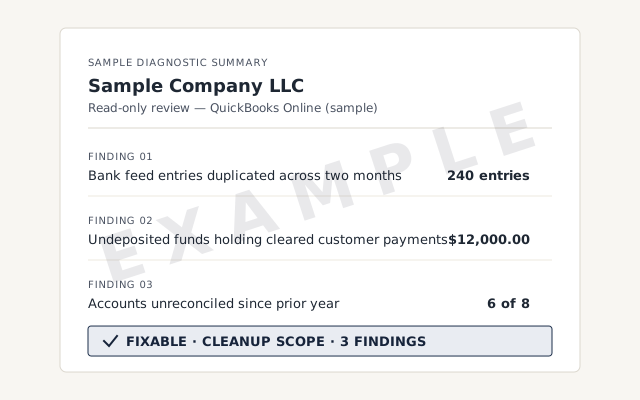
 Sample workflow — not a specific client’s data
A real reclassification worksheet
The exact before-and-after showing each entry moved out of Opening Balance Equity.
QuickBooks Opening Balance Equity fix
Cleared to zero — traced, not plugged.
A QuickBooks Opening Balance Equity fix clears the balance that setup or an import left parked in the temporary account. Each entry is traced back to its real account — bank, loan, or retained earnings — until Opening Balance Equity reads zero, without distorting your historical equity.
Opening Balance Equity is a temporary holding account QuickBooks creates during setup — a leftover balance in it means value was parked there and never moved to the real account it belongs in.
When you give a new account an opening balance — a bank account, a loan, a credit card — QuickBooks has to balance the entry, so it posts the other side to Opening Balance Equity. The same thing happens when transactions are converted or imported. That offset is meant to be temporary: as each opening balance is reconciled and each entry assigned to its real account, the account drains back to zero. When that final step is skipped, the balance simply sits there, quietly overstating or understating your equity. If your balance sheet is out of balance or your equity section looks wrong, an uncleared Opening Balance Equity line is one of the first things to check. Our Opening Balance Equity reference explains the mechanics in full.
You need an Opening Balance Equity fix when the account still carries a balance months after setup or a migration — a sign that opening balances or imported entries were never reclassified to the accounts they belong in.
The usual signs:
If your equity section already reads cleanly and Opening Balance Equity sits at zero, you may not need this at all — a point we return to below. Not sure? A free bookkeeping health score flags an uncleared Opening Balance Equity line in a few minutes.
Almost every Opening Balance Equity balance traces to one of three sources: an opening balance typed into a new account, transactions converted during setup, or entries migrated from another system. Each posts its offset to Opening Balance Equity and waits to be reclassified.
Opening Balance Equity fix
Knowing the source matters, because it tells us where each amount should land. A bank opening balance belongs against the reconciled bank account; a loan opening balance belongs in the loan liability; the residue of a conversion often belongs in retained earnings. When the balance appeared right after a move, it is worth reading our notes on QuickBooks data conversion and QuickBooks migration — migrations are the single most common way a large Opening Balance Equity balance is created.
How it goes
Day 0
View-only look at the file; we find every entry sitting in Opening Balance Equity and quote a fixed fee.
Days 1–3
Every parked amount is followed to the account it belongs in — bank, loan, or retained earnings.
Days 3–5
Each entry is reclassified so Opening Balance Equity nets to zero, with real equity left intact.
Day 5
A balance sheet that ties, a written record of every reclassification, and a call to walk it through.
An Opening Balance Equity fix is tracing, not erasing: we follow each amount sitting in the account to the place it should have reached, reclassify it there, and let the holding account fall to zero on its own. No blind journal entry, no deleted account.
The reason the tracing matters is that the two shortcuts people reach for both cause damage. Deleting the Opening Balance Equity account does not remove the value — QuickBooks will not let you delete an account with a balance, and forcing the file into an inconsistent state is worse than the original problem. Zeroing it with a single "plug" journal entry to retained earnings is faster, but it buries real detail: the loan that should have been a liability, the bank balance that was never reconciled, the duplicate that should have been removed. Once the amount is plugged, the story of where it came from is gone. So we open each parked entry, identify its true home, and move it deliberately — and where an amount genuinely does belong in retained earnings, it lands there for a documented reason, not as a catch-all. A clean Opening Balance Equity is also easier to keep clean once the accounts underneath it are reconciled and the chart of accounts is tidy.
You get Opening Balance Equity at zero, a written record of every entry we reclassified and where it went, a balance sheet that ties, and a call to walk the whole thing through.
Nothing is a black box: the reclassification worksheet lists each amount that was parked, the account it moved to, and the reason, so you — or your CPA — can audit the work and see that your real equity was revealed, not rewritten. If the tracing surfaces accounts that also need attention — an unreconciled bank account, a loan that was never set up properly — we flag those in the handback and scope them separately rather than quietly expanding the job.
Which do you need?
Clearing Opening Balance Equity now gives you a correct balance sheet and equity you can hand to a preparer; leaving it means the number keeps distorting your reports until someone deals with it. Here is how the two compare, and what actually changes.
| Fix it now | Leave it | |
|---|---|---|
| Balance sheet is correct | — | |
| Equity reflects reality | — | |
| Reports tie out for a preparer | — | |
| Opening Balance Equity account | Cleared to zero | Still carries a balance |
| Risk at tax time | None from OBE | Preparer questions the equity |
| Ready to hand to a preparer | — | |
| Verdict | Books you can file | Numbers you cannot trust yet |
What changes
Four details decide an Opening Balance Equity fix: when the balance really does belong in retained earnings, why a single journal entry is the wrong tool, how migrations create the problem, and how the work differs between Online and Desktop.
Sometimes it does. If the file was set up mid-life with a trial balance, the accumulated prior-year profit legitimately rolls into retained earnings, and Opening Balance Equity is the way-station it passes through. The difference between that and a plug is documentation: we move it because we can show it is prior-period equity, not because it is a convenient place to make a number disappear.
A single journal entry to zero the account is fast and almost always wrong. It collapses several different amounts — a bank balance, a loan, a conversion residue — into one line, destroying the detail a preparer needs. We reclassify entry by entry so each amount ends up in a real account with a real reason.
When a file is converted or rebuilt, opening balances and carried-over transactions post their offset to Opening Balance Equity all at once, which is why the number is often large right after a move. Our data conversion notes cover how to keep it small in the first place.
The account behaves identically in both — a temporary offset waiting to be reclassified — so the tracing is the same. Only access differs: QuickBooks' accountant access in Online, with every reclassification logged, or a screen-share or hosted file in Desktop.
One firm traces every parked amount by hand — the same hands start to finish — and hands you a worksheet you can audit, not a pool that plugs the account and moves on. Every reclassification is documented, and your real equity is shown to be unchanged, not asserted to be.
Our method is verification, not a plug: we save your equity section and balance sheet before touching the file and compare them after, so we can show that total equity held while Opening Balance Equity fell to zero. Access stays minimal — the free review runs on view-only access, and the fix itself uses QuickBooks' accountant access to make and log every correction — never your bank logins. If clearing an entry would move a number on a period you have already filed, we flag it and ask first. An Opening Balance Equity fix should reveal your books, never quietly rewrite a return.
Skip us when the fix is small or premature. A single opening balance you can reconcile yourself does not need a paid engagement, and a brand-new file needs careful setup, not cleanup.
If the balance is one line you can trace — an opening bank balance that just needs reconciling against a statement — our QuickBooks cleanup checklist walks you through it for free. If your file is brand-new, the right move is entering opening balances correctly from the start so Opening Balance Equity never lingers, not paying to untangle a mess that does not exist yet. And if Opening Balance Equity already sits at zero and your equity section reads cleanly, leave it alone — there is nothing to fix. We will tell you which case you are in during the free review, even when the answer is "you don't need us."
What it costs
Every Opening Balance Equity fix is a fixed scope with a fixed fee, quoted after a free view-only review. The figures below are published starting floors; the review sets the real range for your file.
| Engagement | Typical range | Timeline | What's included |
|---|---|---|---|
| Opening Balance Equity fix | From $1,500 | 3–5 days | Trace and clear every entry parked in Opening Balance Equity, one company file. |
| Fix + reconciliation | Custom fixed quote | 1–2 weeks | Clear Opening Balance Equity and reconcile the accounts the entries touched. |
| Part of a full cleanup | Custom fixed quote | 2–4 weeks | Rolled into a complete cleanup when the wider file also needs work. |
| Estimate your cost with the calculator | |||
Opening Balance Equity fix
Fix + reconciliation
Part of a full cleanup
You don't have to take our word for it. Here is the evidence you can check — the deliverable you receive, the account reference that explains our method, and our response commitment.
Sample workflow — not a specific client’s data
The exact before-and-after showing each entry moved out of Opening Balance Equity.
Every amount traced to the account it belongs in. Read exactly how the account works.
Read the Opening Balance Equity referenceA written reply within one business day.
Remote-first, nationwide
Mon–Sat · 8am–6pm CT
We work entirely remote — view-only access for the free review, QuickBooks' accountant access for the fix itself, screen-share whenever you want to watch us trace an entry, and every reclassification documented in writing.
It is a temporary holding account QuickBooks creates during setup. When you enter an opening balance for a bank account, loan, or other item, the offsetting amount lands in Opening Balance Equity until it is moved to the account it truly belongs in.
Usually from setup or a data import — opening balances, converted transactions, and migrated items post their offset to Opening Balance Equity. It is meant to be cleared as each entry is assigned to its real account, but that final step often gets skipped.
Almost always one of three places: an opening balance typed into a new bank, loan, or credit-card account; transactions converted when the file was set up; or entries brought over during a migration from another system. Each posts its offset to Opening Balance Equity and waits to be reclassified.
A leftover balance is a signal, not a catastrophe. It means value is still parked in a temporary account, so your equity section — and often the balance sheet — does not yet reflect reality. It should be traced and cleared, not ignored.
No. Deleting it or zeroing it with a blind journal entry hides the problem instead of fixing it, and it can throw the balance sheet out. Each amount has to be traced to its real account first; then the balance clears on its own.
Done correctly, it does not change real equity. It moves amounts out of a temporary account into the accounts they belonged in all along, such as retained earnings or a loan. Your true equity is revealed by the fix, not altered by it.
A focused Opening Balance Equity fix is usually three to five days: day 0 to scope it, a couple of days to trace every parked entry, then reclassify and hand back. Files with many migrated entries, or where the balance is tangled with a wider mess, take longer and are quoted after the free review.
Both. The account behaves the same in Online and Desktop — a temporary offset that waits to be reclassified — so the tracing work is identical. Only the menus and the type of access differ: QuickBooks' accountant access in Online, with every reclassification logged, or a screen-share or hosted file in Desktop.
Reclassifying parked amounts moves them between accounts; it does not change what you earned or spent, so it does not change your tax liability by itself. What it changes is whether your equity and balance sheet are correct enough for a preparer to rely on.
Opening Balance Equity at zero, every reclassified entry documented in writing, a balance sheet that ties, and a call to walk through what moved and why. If other accounts also need work, we scope that separately after the review.
An uncleared Opening Balance Equity line often travels with other issues: a balance sheet out of balance, a messy chart of accounts, or accounts that were never reconciled.