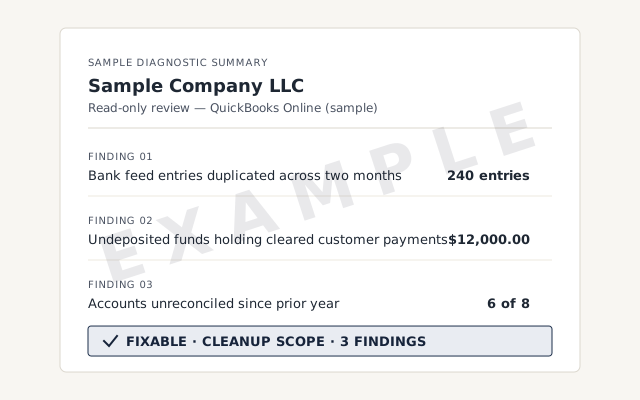
 Sample workflow — not a specific client’s data
A real recovery report
The verification and reconciliation summary you receive once a recovered file is stable and its accounts tie out.
QuickBooks file repair
Corrupt company file? Here's the honest path.
QuickBooks file repair addresses a company file that won't open or throws verify and rebuild errors, usually from data damage rather than a bug. Minor damage often clears with the built-in Verify and Rebuild tools or a recent backup. Real corruption — where those tools fail — is where our rescue service takes over.
Which do you need?
Start here
How bad is the damage?
Verify and rebuild yourself
The built-in Verify and Rebuild Data tools clear most small inconsistencies — a do-it-yourself fix.
See QuickBooks errorsRestore the backup
A recent, working backup is the fastest route back — restore it and re-enter only what came after.
Rescue
When rebuild can't complete, the file needs specialist recovery before more data is lost.
See QuickBooks rescueHonest answer
Not every QuickBooks error means a corrupt file, and not every corrupt file needs a specialist. QuickBooks flags verify warnings for small, self-healing inconsistencies all the time, and a rebuild clears most of them. If your file opens, runs, and only reports the occasional data issue on verify, you almost certainly don't need a repair service — you need a rebuild and a fresh backup.
The businesses that genuinely need help are the ones where the file won't open at all, where rebuild starts and never finishes, or where opening a specific list or report reliably crashes the program. That's structural damage, and pushing more transactions into a file in that state — or repeatedly force-closing it — tends to make the damage spread. At that point the priority is recovering clean data, not limping along, and that's a different job from routine cleanup.
Do-it-yourself
For minor damage the repair tools are built into QuickBooks Desktop, and this is a do-it-yourself fix. Run Verify Data (File, Utilities, Verify Data) to detect problems, then Rebuild Data to fix what it finds; QuickBooks forces a backup before a rebuild, which is exactly what you want. If verify reports nothing after a rebuild, the file is healthy again. Still failing? Intuit's free QuickBooks Tool Hub includes File Doctor, which clears some network and moderate file damage — try it before paying anyone.
The repair ladder
If the file won't open, restoring your most recent working backup is usually faster than any repair — you re-enter only the transactions dated after the backup. Keep the damaged file; don't overwrite it. Where do-it-yourself ends is when rebuild fails, loops, or reports errors it can't fix, when you have no clean backup, or when the only backup is as damaged as the live file. Forcing the file open again and again from there risks losing more than you save, and that's when rescue — specialist recovery of the data — is the right call.
One honest note on access: the free review is view-only, but repairing a file is not view-only work. We diagnose and repair on copies, never on your original, and where a Desktop repair needs admin-level access to the file, it runs over a screen-share or a hosted copy you control — every step documented, and never your bank logins.
Sample workflow — not a specific client’s data
The verification and reconciliation summary you receive once a recovered file is stable and its accounts tie out.
A recovered file isn't done until every account reconciles to the statement. Read the method.
Read the reconciliation referenceA written reply within one business day.
Remote-first, nationwide
Mon–Sat · 8am–6pm CT
We work entirely remote — a view-only free review first, then repair on copies over screen-share or a hosted file, with admin-level Desktop access only where the repair itself requires it, and every step of the recovery documented in writing.
Not if it's handled carefully. Minor damage is repaired in place with Rebuild Data, which backs the file up first. For deeper corruption, the goal of rescue is to recover clean data into a stable file — we work on a copy and keep your original untouched.
Verify Data scans the company file for internal inconsistencies and reports them; Rebuild Data attempts to fix what verify found. They resolve most minor damage. When rebuild can't complete or the same errors return, the damage is beyond the built-in tools.
Sometimes. File Doctor, part of Intuit's free QuickBooks Tool Hub, resolves certain network problems and some moderate file damage, and it's worth running after Verify and Rebuild — it costs nothing to try. When File Doctor also fails, or the same damage keeps returning, the free tools are exhausted and specialist recovery is the honest next step.
No. Repeatedly forcing a damaged file open, or killing it mid-operation, tends to spread the damage. Stop, preserve the file and any backups exactly as they are, and get the data recovered before adding anything new.
No. File repair fixes the file's structure so it opens and runs; cleanup corrects the bookkeeping inside it. A recovered file can still hold wrong or missing entries, so a serious rescue is often followed by a cleanup to get the numbers right.
Not always. Some error codes are network or hosting problems, not file damage — H202 and 6000-series errors often point to multi-user setup rather than corruption. We diagnose which it is first, so you're not rebuilding a file that was never broken.
Common error codes behind a damaged file: error H202, error 6123, and error 6000 77 — most are a network or hosting issue, not real corruption.