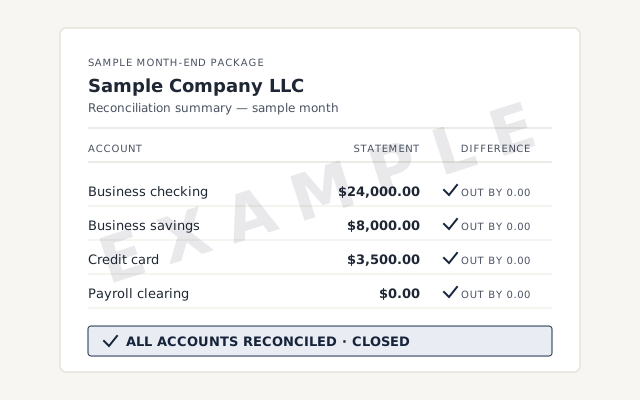
 Sample workflow — not a specific client’s data
A real mapping and reconciliation record
The written map of what moved, what was rebuilt, and the before-and-after reconciliation you receive when the move closes.
QuickBooks Desktop to Online migration
Desktop to Online, proven to reconcile.
A QuickBooks Desktop to Online migration moves your file — chart of accounts, customers and vendors, open invoices and bills, transaction history, and balances — into QuickBooks Online in four stages: source, mapping, validation, and cutover. Validation is the one that matters: we reconcile the converted QBO file back to Desktop and prove the numbers tie before you go live.
Moving QuickBooks Desktop to Online is the work of carrying a Desktop company file's data — its accounts, names, open balances, and transaction history — into a QuickBooks Online company, so the new file continues the story of the old one instead of starting a blank page.
That is different from setting up a fresh QuickBooks Online company. A fresh file begins at zero; a migration brings your existing chart of accounts, your customers and vendors, your open invoices and unpaid bills, and the history behind your prior-period reports across to QBO. It is the most common move in the whole QuickBooks migration picture — the one most people mean when they say "migration" — and it is the money move for most Desktop users as Intuit continues shifting toward Online. Our real specialty is QuickBooks bookkeeping with a reconciliation-first method, so we frame the move the same honest way every time: we convert the data, then we prove the QuickBooks Online file reconciles back to the Desktop file it came from.
You should move from QuickBooks Desktop to Online when Desktop is starting to work against you — you want browser and mobile access, you need your accountant or team in the file at the same time, or your Desktop version is aging out of payroll, payments, and security service. You can wait when your version is still fully serviced and does everything you need.
The trend is real, and worth stating plainly and without exaggeration. Intuit has shifted its focus to QuickBooks Online, new Desktop subscriptions are no longer sold to most new U.S. businesses, and each annual Desktop version stops receiving payroll, payments, and critical security updates roughly three years after it ships. That does not mean your file stops opening on a fixed date — an installed Desktop file keeps working locally — but it does mean the connected services around it wind down, which is what usually forces the decision. If any of these describe you, the move is worth planning now rather than under pressure:
If none of these bite yet, waiting is a legitimate choice, and the QuickBooks Desktop end-of-life page lays out what the wind-down actually means for your file so you can judge the timing yourself. Still on the fence about the decision itself? Our answer on whether to switch from Desktop to Online weighs who should move now and who should deliberately wait — and the migration readiness assessment turns the same question into five quick checks against your own file.
In a move from Desktop to QuickBooks Online, your structural data carries over and the software-specific pieces change or get rebuilt. Lists, account balances, open A/R and A/P, and posted transaction history convert with the file — while memorized transactions, some report layouts, the inventory costing method, and most payroll detail are recreated or set up deliberately in QuickBooks Online.
Desktop → Online · what maps
The practical point is that a Desktop-to-Online move is not "everything or nothing." The parts that determine whether your books are right — balances and history — come across. The parts that are conveniences you set up once — a memorized invoice, a saved report view, an estimate template — are recreated in QBO, and we list exactly which of yours fall in that bucket before we move, so nothing you rely on quietly disappears at cutover. The technical mechanics of how each list and history record maps across are covered in QuickBooks data conversion.
The four stages
Every Desktop-to-Online move runs the same four stages in order: read the Desktop file, map it to QuickBooks Online, validate the converted result against Desktop, then cut over. The order is deliberate — nothing goes live until it has been proven to reconcile.
The migration flow
Stage 1
We read the Desktop file as the source of truth — its chart of accounts, lists, open items, history, and balances — and save the reports we will later reconcile against.
Stage 2
Every account, name, and balance is mapped to where it belongs in QuickBooks Online, and we flag exactly what converts and what has to be rebuilt.
Stage 3
The converted QBO file is reconciled back to Desktop: same trial balance, same key reports, to the penny — the proof stage that ties to our method.
Stage 4
Only once the file reconciles do you go live in QuickBooks Online, with the rebuilt reports and templates in place and a written record of every mapping decision.
Most Desktop-to-Online moves land inside one to three weeks, but the honest answer is that it depends on the file: its size, its age, the add-ons it carries, and whether it needs a cleanup before it moves. A small, tidy file can convert in a few days; a large file with years of history, inventory, and payroll needs longer for mapping and validation.
What actually drives the clock is not the data transfer — that part is quick — but the mapping decisions and the reconciliation. Deciding how inventory lands, how payroll year-to-date is set up, and which reports get rebuilt takes deliberate work, and proving the converted file ties to Desktop takes more still. That is by design: we would rather spend the time up front and hand you a file that reconciles than move fast and leave you to discover a gap in month two. We scope the real timeline during the free review, before any work starts, so you are planning against a number rather than a hope. For a first read before that, the migration timeline calculator turns your file's size and add-ons into a rough duration.
We prove a Desktop-to-Online move by reconciling the QuickBooks Online file back to Desktop — same trial balance, same balance sheet, same key reports, to the penny — before you rely on it. Validation is not a courtesy step at the end; it is the reason to hire a specialist at all.
Anyone can push data through a conversion tool. The hard, valuable part is confirming that what came out the other side matches what went in. Our method is verification, not assertion: we save Desktop's trial balance and key statements before the move, then re-run them in QuickBooks Online and account for every difference until the two tie. That same reconciliation-first discipline runs through everything we do — it is why the move ends with proof rather than a promise. You can read exactly how the checking works in our methodology and in the bank reconciliation reference, which explains the core "difference resolves to zero" idea a validated migration depends on. If the file will not reconcile, we do not cut over — we find out why first. Access follows the same discipline: the free review runs on view-only access, and the migration itself uses QuickBooks' accountant access to make and log every change — never your bank logins — with your Desktop file reached by screen-share or a hosted copy.
What it costs
The move is a fixed fee quoted after a free review, starting from $1,500. What moves the number is the size and age of the file, the add-ons it carries — inventory, payroll, multi-currency — and whether it needs cleanup before it moves. Never a surprise at the end.
| Engagement | Typical range | Timeline | What's included |
|---|---|---|---|
| Standard Desktop → Online | From $1,500 | Scoped at review | Move a tidy Desktop file — chart of accounts, names, open items, history, and balances — and reconcile the result to Desktop. |
| Complex or large file | Custom fixed quote | Scoped at review | Large history, inventory, payroll, or multi-currency that needs extra mapping and validation before cutover. |
| Cleanup + migration | Custom fixed quote | Scoped at review | Fix the Desktop file first, then migrate — so you move a clean book, not the mess, into QuickBooks Online. |
| Get your exact quote | |||
Standard Desktop → Online
Complex or large file
Cleanup + migration
The figures above are floors, not quotes — a free view-only review sets the fixed price for your file. For a full breakdown of what drives the price — data volume, version age, add-ons, and whether the file needs a cleanup first — see the QuickBooks Desktop migration cost page. As a rule, it is cheaper to clean a file before you move it than to untangle the same mess twice, once in each system.
The details that complicate a Desktop-to-Online move are the ones that live differently in each product: inventory costing, payroll history, multi-currency, and custom or memorized reports. None is a dealbreaker, but each needs a decision made on purpose rather than discovered after cutover.
Inventory is the classic edge case, because Desktop and Online can value stock differently and QBO may not carry item-level history the same way. We confirm how your items and quantities land, and reconcile the inventory asset balance so it matches Desktop, rather than assuming the conversion got it right. If your file leans heavily on Desktop's inventory features, we say so before you move.
Payroll detail often does not move cleanly, and pretending otherwise is where migrations go wrong. Year-to-date figures and prior filings usually need to be set up deliberately in QuickBooks Online, and we coordinate that with your payroll provider or CPA instead of hoping a tool carried it across.
Files with foreign currency need their exchange settings and open foreign balances checked after conversion, because a rounding or rate difference here shows up as a reconciliation gap. We tie the converted balances back to Desktop before we call it done.
Custom report layouts and memorized reports are rebuilt, not moved — the figures behind them convert, but the saved views are recreated in QuickBooks Online. We note the reports you actually use and set them up again on the other side, so your month-end pack looks familiar after the move. Deeper, per-record mapping questions are covered in data conversion; heavier Enterprise files with advanced inventory or many users have their own path in Enterprise migration.
After the move
Once you are in QuickBooks Online you trade Desktop's installed, local power for anywhere access, automatic updates, and native app connections. Neither product is simply "better" — it depends on what you rely on. Here is how the two compare after a move, so you know what actually changes day to day.
| QuickBooks Online | QuickBooks Desktop | |
|---|---|---|
| Access from any browser or phone | — | |
| Works offline, installed locally | — | |
| Automatic updates and backups | — | |
| Multiple users in the file at once | By plan tier | Per-seat license |
| Deep, built-in inventory | Simpler, add-on driven | Strong |
| Native app connections | Broad | Limited |
| Best when | You want anywhere access and integrations | You rely on Desktop-only features |
| Verdict | Anywhere access, always current | Local power, if you still need it |
If you are still weighing the two products themselves rather than the move, the QuickBooks Online vs. Desktop comparison goes deeper on where each one fits before you decide.
Skip the move — for now — when Desktop still does everything you need, your version is still fully serviced, and nothing about your workflow is fighting you. "You should move eventually" is not the same as "you should move today," and waiting is a legitimate, sometimes cheaper, choice.
A few honest cases where we will tell you to hold. If your Desktop version is current and your payroll and payments still work, there is no emergency, and you can plan the move on your own schedule — the Desktop-to-Online migration guide lays the whole route out ahead of time, and the Desktop-to-Online checklist is the preparation list to work through when you are ready. If your file leans hard on a Desktop-only feature — deep assembly inventory, a specific industry edition workflow — moving before QuickBooks Online can match it just relocates a problem. And if the real issue is that your file is a mess, the honest answer is that it needs a cleanup more than it needs a new home; moving a mess only carries it across. We would rather point you to the right, smaller step — or to waiting — than sell you a migration you do not need, and we will say which case you are in during the free review, even when the answer is "not yet."
You do not have to take our word for it. Here is the evidence you can check — the deliverable you receive, the method we use to prove the converted file reconciles to Desktop, and our response commitment.
Sample workflow — not a specific client’s data
The written map of what moved, what was rebuilt, and the before-and-after reconciliation you receive when the move closes.
How we prove the QuickBooks Online file reconciles back to Desktop. Read exactly how.
Read the full methodA written reply within one business day.
Remote-first, nationwide
Mon–Sat · 8am–6pm CT
We migrate entirely remote — view-only access for the free review, QuickBooks' accountant access for the work in QuickBooks Online, your Desktop file reached by screen-share or a hosted copy, and every mapping decision documented in writing before cutover.
No, and any honest answer says so up front. Your lists, account balances, open invoices and bills, and posted transaction history carry over. What changes are the software-specific pieces — memorized transactions, some report layouts, the inventory costing method, and most payroll detail — which are rebuilt or set up deliberately in QuickBooks Online. We map exactly what changes for your file before we move it.
It depends on the size and age of the file and whether it needs cleanup first. A small, tidy Desktop file can move in a few days; a large file with years of history, inventory, or payroll takes longer. We scope the real timeline during the free review, before any work starts, so you are not guessing.
The numbers behind them do. Because we carry the transaction history and balances across, your profit and loss and balance sheet for prior periods still add up in QuickBooks Online. Some report layouts and memorized reports have to be rebuilt, but the underlying figures they draw on come with the data.
We reconcile the QuickBooks Online file back to the Desktop file. Before cutover we save Desktop's trial balance and key reports, then confirm QBO produces the same balances to the penny. Migration without that proof is just hoping the numbers matched; the validation stage is where we show they did.
Sometimes, yes. If your Desktop version still does everything you need and is still receiving service, there is no rule that says you must move. But Intuit has shifted its focus to QuickBooks Online, new Desktop subscriptions are no longer sold to most new U.S. businesses, and each annual version loses payroll, payments, and security updates roughly three years after release — so for many files the move is a question of when, not if.
Your Desktop file does not disappear when you move — you keep it, and it remains the archived record of everything up to cutover. More to the point, we do not cut over until the converted QuickBooks Online file reconciles back to Desktop, so you are never asked to abandon a working file for an unproven one. If the converted file will not reconcile, you do not go live — we find out why first.
Inventory is the classic edge case. Desktop and Online can value stock differently, and item-level history does not always carry the same way. We confirm how your items and quantities land and reconcile the inventory asset balance so it matches Desktop, rather than assuming the conversion got it right.
Not cleanly, and pretending otherwise is where migrations go wrong. Year-to-date figures and prior filings usually need to be set up deliberately in the new file. We coordinate that with your payroll provider or CPA instead of hoping a tool carried it across.
Yes. If you only need an opening balance and the current year, we can bring balances as of a chosen date and leave the deep history in the archived Desktop file, which you keep. It is often faster and cheaper. We help you weigh how much history you actually need during the review.
It is a fixed fee quoted after a free review, starting from $1,500. What moves the number is data volume, the age and health of the file, add-ons like inventory or payroll, and whether the file needs cleanup before it moves. We never quote blind, and there is no surprise bill at the end.
Keep going: the migration hub, what the Desktop wind-down means for your file, the technical detail in data conversion, or the cost breakdown. If the file carries foreign currency, the home-currency side often needs rebuilding after the move — that is a multi-currency cleanup.