QuickBooks bookkeeping cost
What monthly QuickBooks bookkeeping costs.
Monthly QuickBooks bookkeeping is a fixed fee from $400 per month, quoted after a free, view-only review — never billed by the hour. The price is set by what moves through your file: transaction volume, accounts and feeds, and how often you need reports. This is the ongoing cost of keeping books right, not a one-time cleanup.
Last reviewed October 2026 by a Certified QuickBooks ProAdvisor
What this page is based on: our published floors, with market context from NerdWallet, the Bureau of Labor Statistics and Intuit’s own Expert bookkeeping price (checked October 2026)
- Fixed monthly fee, not hourly
- Quoted after a free review
- Scope agreed before work starts
What monthly QuickBooks bookkeeping costs
Monthly QuickBooks bookkeeping starts at $400 per month, quoted as a single fixed fee after a free review of your file. It is the recurring cost of keeping your books reconciled, categorized, and reported every period — the work of staying current, not the work of cleaning up a backlog.
That distinction matters for what you pay. Because the work repeats every month against a file that is already in good shape, the fee is predictable and fixed: you agree it once, and it does not move because one month happened to be busier than another. The floors on this page are the published starting figures — the review turns them into one exact number for your file, never an invented quote. What follows is how the fee is actually built, and how it differs from a one-time cleanup.
What drives your monthly bookkeeping cost
What sets the scope
Read this as text
Three inputs — monthly transaction volume, the number of connected accounts and bank feeds, and reporting cadence — set the scope of a monthly engagement, which we quote as a single fixed fee starting from the floor price. Illustrative example, not a measured figure.
Three things set the fee: how many transactions move through your file each month, how many accounts and bank feeds have to be reconciled, and how often — and how detailed — the reports you need are. More of any one raises the scope; the fee follows the scope.
Volume is the big lever — a file with a hundred transactions a month is a fraction of the work of one with a thousand, so it sits at a lower fee. Accounts and feeds add to it: each checking account, credit card, loan, or merchant feed is another balance to reconcile every period. Reporting is the third: a straightforward profit-and-loss each month is lighter than class- or location-tracked statements, cash-flow reporting, or a monthly review call. Payroll and sales-tax activity, when they run through the file, raise the scope the same way. None of this is guessed at from a form — we look at the actual file first. If you want to feel how those levers move a number before anyone looks, our monthly bookkeeping cost calculator lets you try your own volume, accounts, and reporting against the published floors.
Why we quote a fixed fee after a review, not a rate card
We quote after a free, view-only review because an honest monthly number depends on what your file actually contains — and no published rate card can know that before it has seen your books. The review is how the fee becomes one we can hold to.
A rate card forces you into a tier that either overcharges you for work you do not have or undercharges and creeps upward once the real volume shows. An hourly rate does the same in reverse: the meter rewards a slow month and punishes a busy one, and you never know the total until the invoice lands. A fixed fee, set after we have actually looked at the file, removes both problems — you know the number before the first month starts, and it holds for the scope we agreed. If your volume later outgrows that scope, we tell you and re-quote in writing; the price only ever changes after a conversation. You can read exactly how we scope and reconcile in our methodology.
Three ways to price the month
Read this as text
Three pricing models compared. A rate card sets a tier before anyone has looked at the file, so it overcharges or creeps. An hourly meter runs open-ended, so the total is known only when the invoice arrives. A fixed fee quoted after a free review is known before the first month starts and holds for the agreed scope. Qualitative comparison, not a price quote.
What a monthly bookkeeping fee includes
The monthly fee covers the recurring close: every account reconciled to its statement, transactions categorized, and the reports you rely on delivered each period. It is the whole cycle of keeping the file current, not a menu of add-ons.
A standard monthly bookkeeping engagement includes reconciling each connected account and feed, categorizing and reviewing transactions, clearing the routine questions a real ledger throws off, and producing your monthly financial statements. Where payroll or sales tax runs through the file, keeping those reconciled each period is part of the scope. What the fee is not is a catch-all for fixing a backlog or untangling prior-year errors — that is cleanup, priced separately. If you want the fuller picture of what ongoing QuickBooks bookkeeping is and how we do it, our QuickBooks bookkeeping service page walks the whole engagement.
What it costs
Our monthly bookkeeping pricing
Every monthly engagement is a fixed fee for a defined scope, quoted after a free review. The figures below are published starting floors; the review sets the real fee for your file.
| Engagement | Starting price | Planned timeline | What's included |
|---|---|---|---|
| Essentials monthly | From $400/mo | Ongoing | Lower volume, a couple of accounts: reconciliations, categorization, and monthly statements. |
| Standard monthly | Custom fixed quote | Ongoing | Higher volume or more accounts and feeds, with fuller monthly reporting. |
| Complex monthly | Custom fixed quote | Ongoing | Payroll or sales tax in the file, class or location tracking, or a monthly review call. |
What QuickBooks bookkeeping costs elsewhere
A fair comparison needs other people's numbers, sourced and dated. Here are the five ways small businesses usually buy QuickBooks bookkeeping, with what each costs according to the party that publishes it (checked October 2026). Read the "what it covers" column as closely as the price: the cheapest line is not cheapest if it leaves out the work your file needs.
| What it costs | What it covers | |
|---|---|---|
| QBSpecialist monthly | From $400 a month, fixed after a free review | Every account reconciled, every transaction categorized, a closed month-end package; QuickBooks Online and Desktop |
| Intuit Expert Full Service | Starting at $300/mo after initial cleanup fee (Intuit) | A dedicated QuickBooks-certified bookkeeper; QuickBooks Online only; no invoicing, bill pay, inventory, A/R or A/P management, or tax filing; payroll extra |
| Typical small-business bookkeeping | Around $300 a month (NerdWallet, updated March 2026) | A typical figure across providers, not a quote — the spread around it is wide |
| In-house bookkeeper | Median $50,670 a year, about $4,200 a month (BLS, May 2025) | A full-time employee, before payroll taxes, benefits, software and management time |
| Hourly freelancer | Billed by the hour | Whatever hours the month takes — no fixed total, and a busy month costs more |
Sources: Intuit's Full Service Bookkeeping page, NerdWallet's bookkeeping pricing guide and the BLS Occupational Outlook Handbook. Two costs sit outside every line above: your QuickBooks subscription, which Intuit bills separately (plan prices, dated), and any one-time cleanup a drifted file needs before monthly work can start. How Intuit's service and an independent specialist split the work is set out in is QuickBooks Live worth it.
Monthly cost vs. a one-time cleanup
Monthly bookkeeping and a cleanup answer two different cost questions: the monthly fee is what it costs to keep the books right going forward, while a cleanup is a separate one-time fee to fix a file that has drifted. You may need one, the other, or both in sequence.
If your file already reconciles cleanly and simply needs keeping current, monthly bookkeeping is all you are buying. If it is behind, unreconciled, or full of miscategorized history, a cleanup usually comes first so the monthly work starts from a baseline that ties — paying a monthly fee on top of a broken file just carries the problem forward. We price and quote the two separately and never blur them into one number. For the full map of what each QuickBooks engagement costs and how they relate, start at the QuickBooks cost hub.
Straight talk
When monthly bookkeeping isn't worth the cost
Do not pay for monthly bookkeeping if you have almost nothing moving through the file and you keep it reconciled yourself without strain. A one-owner business with a handful of transactions a month and no payroll can often stay current in an afternoon — there is no prize for outsourcing work that is genuinely trivial.
Monthly bookkeeping earns its cost when the recurring work is real and the risk of falling behind is expensive: enough volume that reconciling every account each month is a chore, accounts and feeds that need watching, or reporting a lender, a partner, or your own decisions depend on. If the honest answer is that you do not need us yet, the free review will say so — we would rather tell you that than sell you a monthly fee you do not need.
How we set — and hold — the monthly fee
You don't have to take a number on faith. Here is how the fee is arrived at, the method behind the work it pays for, and our response commitment.
Who’s responsible for your file
A Certified QuickBooks ProAdvisor handles your file from the review through the corrections to the hand-back — the same person throughout, never a rotating pool.
About QBSpecialist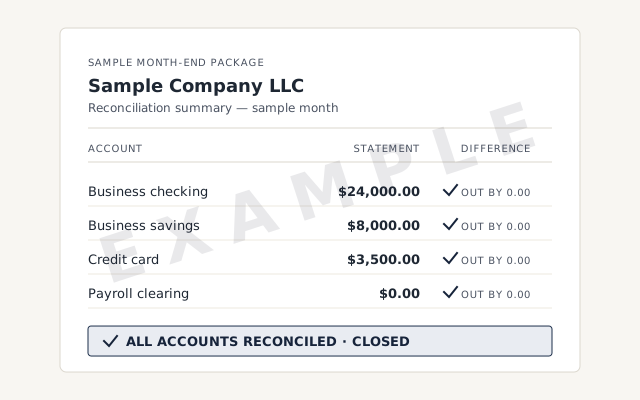 Illustrative example — not a client file.
Sample monthly package
The reconciled statements and close summary you receive each period once monthly bookkeeping is running.
Our methodology
How we scope, reconcile, and report each month. Read exactly how.
Read the full methodResponse commitment
A written reply within one business day.
Remote-first, nationwide
Mon–Sat · 8am–6pm CT
We work entirely remote — view-only access for the free review, QuickBooks' accountant access for the monthly work itself, every change visible to you in the audit log, and every month's close documented in writing.
- All 50 states
- Remote-first
- View-only review
Questions about monthly bookkeeping cost
How much does monthly QuickBooks bookkeeping cost?
Monthly QuickBooks bookkeeping starts at $400 per month, quoted as a single fixed fee after a free, view-only review of your file. What you pay is set by how much actually moves through your books — transaction volume, the number of accounts and feeds, and how often you need reports — not by an hourly meter.
How much does QuickBooks Live bookkeeping cost?
Intuit lists Expert Full Service Bookkeeping, the current name for QuickBooks Live's done-for-you service, as starting at $300/mo after initial cleanup fee, with a dedicated QuickBooks-certified bookkeeper, for QuickBooks Online only (Intuit, checked October 2026). Intuit's exclusions matter for the comparison: no invoicing or bill pay, no inventory or receivables and payables management, no tax filing, and payroll is extra.
What does an in-house bookkeeper cost?
The U.S. Bureau of Labor Statistics puts the median wage for bookkeeping, accounting and auditing clerks at $50,670 a year in May 2025 — about $4,200 a month before payroll taxes, benefits, software and the hours you spend managing the role. The lowest tenth earned under $36,000 and the highest tenth over $74,550.
Is the QuickBooks subscription included in the bookkeeping fee?
No. The subscription is a separate bill you pay Intuit — QuickBooks Online lists at $38 to $340 a month by plan (checked October 2026). We don't resell or mark it up; you keep your own account, and our fee covers only the bookkeeping work.
Why can't you give me a price without reviewing my file?
Because an honest monthly number depends on what your file actually contains, and no two files are the same. A business with two accounts and a hundred transactions a month is a very different scope from one with six accounts, payroll, and a thousand. The free review is how we find that out and quote a fixed fee we can hold to, rather than a rate that balloons later.
Is monthly bookkeeping the same cost as a QuickBooks cleanup?
No — they are two different questions. A cleanup is a one-time fee to fix the past; monthly bookkeeping is an ongoing fee to keep the books right going forward. If your file is behind or messy, a cleanup usually comes first so monthly work starts from a reconciled baseline. We price and quote the two separately, and tell you plainly which you need.
Do you ever charge by the hour?
No. Every monthly engagement is a fixed fee for a defined scope, agreed before the month starts, so the number on your invoice does not move because a month was busier. If your volume grows enough to change the scope, we tell you and re-quote openly — you are never surprised by an hourly total after the fact.
What happens to the cost if my transaction volume grows?
The fixed fee holds for the scope we agreed. If your business grows enough that the monthly volume clearly outgrows that scope, we flag it and quote a new fixed fee for the larger scope before it takes effect. There is no silent overage — a change in price only ever follows a conversation, in writing.
Can I start monthly bookkeeping if my books are behind?
Usually we catch the file up or clean it up first, then begin monthly work from a reconciled starting point. Starting monthly bookkeeping on top of a file that does not tie just carries the problem forward. The free review tells you whether you need catch-up or cleanup first, what that one-time cost is, and what the ongoing monthly fee looks like after.
Where to go next
- Monthly QuickBooks bookkeeping— Keep a clean file clean, closed every month.
- QuickBooks bookkeeping services— Ongoing categorization, reconciliation and close.
- Pricing— every published floor in one place, with what each one covers
- Consultant cost— if the job is a project rather than a monthly fee
- Cleanup cost— the one-time fee when the file needs fixing before monthly work
Not sure how bad it is?
Talk to a QuickBooks specialist.
Describe the file and a specialist will tell you which of these you are dealing with — including when the answer is that you don't need us.