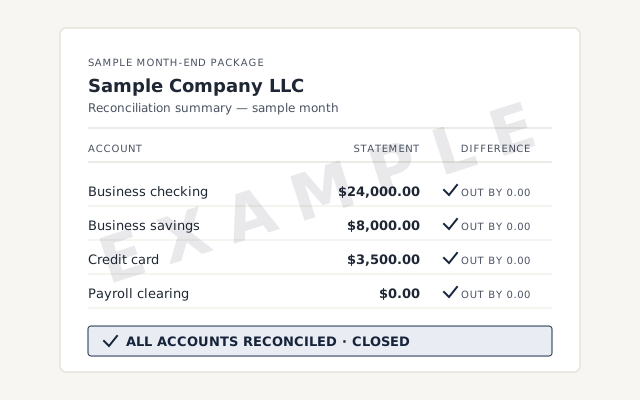
 Sample workflow — not a specific client’s data
A written, neutral recommendation
The plain-language write-up of which platform fits your must-haves and why, yours to keep whether or not you hire us.
Xero vs QuickBooks
Both Xero and QuickBooks are capable cloud accounting platforms — the right choice is about fit. Xero tends to win on simplicity and unlimited users at every plan; QuickBooks on reporting depth and how deeply it is embedded in U.S. accounting. We are QuickBooks specialists, and we will tell you honestly when Xero serves you well enough to stay.
There is no single winner between Xero and QuickBooks. Both are mature, cloud-based accounting platforms that handle the core work — invoicing, bank reconciliation, reporting, and connecting to a wide ecosystem of apps — well enough that most small businesses could run on either. The right choice depends on how you work, who needs access, and where your accounting help already lives.
That answer frustrates people who want to be told which one to buy, but it is the honest one, and it is the same conclusion we reach comparing QuickBooks Online vs Desktop: match the product to your must-haves rather than to a marketing claim. The rest of this page lays out where the two genuinely differ — including where Xero is the stronger pick — so you can weigh the differences against your own situation instead of a slogan.
Xero's clearest advantage is that every plan includes unlimited users. Adding your accountant, a bookkeeper, and staff never raises the subscription, which is a real cost and collaboration win for a business with several people in the books. QuickBooks Online tiers users by plan, so a growing team can push you up a level. If a lot of people need access, that single row can decide it for Xero outright.
Beyond users, many people find Xero's interface cleaner and simpler to learn, and its bank reconciliation flow is widely liked. Xero also has a large, well-regarded app marketplace and a strong presence outside the United States. None of that is us being diplomatic: for a business that values a simple, low-friction tool and wants everyone in the file without per-seat math, Xero is frequently the better product, and we will say so.
QuickBooks' strengths are depth and ubiquity. Its reporting is highly customizable, its class and location tracking suit businesses that need to slice results by department or site, and it connects to a very large ecosystem of U.S.-focused apps, payroll, and payment tools. For businesses that outgrow simple reports, that depth matters.
The quieter advantage is how embedded QuickBooks is in the U.S. accounting world. It is the more common platform among American accountants and bookkeepers, so it is usually easier to find someone who already works in it, hand a file to a CPA who knows it cold, or get help when something breaks. That shared familiarity is a practical, real-world edge — and it is a large part of why we specialize in QuickBooks rather than trying to be everything to everyone.
Real strengths on both sides
Side by side
The two diverge on a handful of things that matter: how users are priced, how deep the reporting goes, and how embedded each is where you work. Read the table by your own must-haves — the row that decides it for you may not be the one that decides it for someone else. Where a strength clearly belongs to Xero, it is marked that way.
| Xero | QuickBooks Online | |
|---|---|---|
| Delivery | Cloud — any browser | Cloud — any browser |
| Users included | Unlimited on every plan | By plan tier |
| Interface | Clean, simple to learn | Feature-dense, more to learn |
| Bank reconciliation | Strong, well liked | Strong |
| Reporting depth & customization | Solid, more streamlined | Deep, highly customizable |
| Class / location tracking | Tracking categories | Class and location by plan |
| App & integration ecosystem | Large marketplace | Large, U.S.-focused |
| U.S. accountant familiarity | Growing | Very widely used |
| Cost model | Subscription, unlimited users | Subscription, tiered by users/plan |
| Best suits | Simple, many-user, collaborative work | Report-heavy, U.S.-accountant-supported work |
| Verdict | Simplicity and unlimited users | Depth and U.S. ecosystem |
Xero suits a business that values simplicity and wants everyone in the file without counting seats — a small team, a collaborative owner-plus-bookkeeper setup, or anyone who finds a cleaner interface worth more than deep report customization. If that is you, Xero is not a compromise; it is a strong fit.
QuickBooks suits a business that needs richer reporting, class or location tracking, or the reassurance that almost any U.S. accountant can pick up the file. It also suits owners who want a large ecosystem of American payroll, payments, and industry apps close at hand. The most common tiebreaker we see is the accountant relationship: if the person who will rely on your books lives in QuickBooks, that alone often settles it — and if yours is happy in Xero, that is a real reason to stay.
If the comparison tips you toward QuickBooks, the switch is a data migration, and it runs the same stages every migration does: read the source, map it to the destination, validate the converted result against the original, then cut over. Nothing goes live until it has been proven to reconcile.
Lists, balances, and most transaction history carry across, but the two platforms model some things differently — tracking categories versus class and location, certain report layouts, and how historical detail lands — so we map exactly what changes for your file before we move it. Then we reconcile the converted QuickBooks file back to Xero and confirm it ties before you rely on it. The full move, and what does and does not transfer, is covered on our Xero to QuickBooks migration page; the reconciliation-first checking that proves it landed correctly is spelled out in our methodology.
Whatever platform you land on, our commitment in QuickBooks is the same: every account tied to its statement before we call a file done, and a converted file reconciled back to its source before you rely on it.
The migration, in stages
Straight talk
We are a QuickBooks bookkeeping firm, not a reseller for either product, so we have no stake in which platform you land on — and that is exactly why our answer is sometimes “stay on Xero.” If Xero is doing everything you need, everyone who needs access has it, and your accountant is comfortable there, moving to QuickBooks would solve a problem you do not have. We will tell you that plainly.
Where we add value is honesty and execution. We help you read your own must-haves against the comparison above without a sales script pushing you toward the option that pays a commission, and if the answer is QuickBooks, we run the migration and prove it reconciles. Compare the other options on our comparison hub, and when you want a straight recommendation — even one that ends in “you do not need us” — start with a free QuickBooks review.
You do not have to take our word for it. Here is what you can check — a neutral recommendation you own, the method we use to prove a switch reconciled, and our response commitment.
Sample workflow — not a specific client’s data
The plain-language write-up of which platform fits your must-haves and why, yours to keep whether or not you hire us.
How we prove a converted QuickBooks file reconciles to the Xero original after a switch. Read exactly how.
Read the full methodA written reply within one business day.
Remote-first, nationwide
Mon–Sat · 8am–6pm CT
We work entirely remote — a neutral read of your file and your needs, screen-share whenever you want to walk through the comparison, and every recommendation documented in writing.
Neither is universally better — both are capable cloud accounting platforms, and the right one depends on how your business works. Xero tends to win on simplicity and on including unlimited users at every plan level; QuickBooks tends to win on depth of reporting and on how deeply it is embedded in the U.S. accounting world. The honest answer is whichever product holds more of your genuine must-haves.
Yes — that is one of Xero's clearest advantages, and we will not pretend otherwise. Every Xero plan includes unlimited users, so adding your accountant, a bookkeeper, and staff does not raise the subscription. QuickBooks Online instead tiers the number of users by plan, so a growing team can push you to a higher plan. If a lot of people need access, weigh that row heavily.
QuickBooks is more widely used among U.S. accountants and bookkeepers, so it is often easier to find someone who already works in it day to day. Xero has a strong and growing base — and a larger share in some other countries — but in the United States, QuickBooks is still the more common shared language between a business and its accounting help. That familiarity is a real, practical factor, not a knock on Xero.
It depends on your plan and your team, so there is no honest single answer. The two use different subscription models, and the real cost has to include user count, payroll, and the add-ons you actually need — Xero's unlimited users can make it cheaper for a larger team, while a small single-user business may find the two comparable. We do not publish a sticker price for either; check each vendor's current pricing for exact figures.
Yes. Moving from Xero to QuickBooks is a data migration — lists, balances, and history are mapped from the source to the destination, then the converted file is reconciled back to Xero before you rely on it. The value is not the transfer itself; it is proving the new file ties to the old one to the penny. Our Xero to QuickBooks migration page covers exactly how that works.
We are QuickBooks specialists, and we are direct about that: we do not do ongoing bookkeeping inside Xero. Where we help a Xero user is in deciding honestly whether a move to QuickBooks is worth it, and in running that migration if it is. If Xero is serving you well, we will say so plainly rather than talk you into a switch that solves nothing.
Still weighing options? See all our comparisons, the QuickBooks Online vs Desktop decision, or — if you have chosen to move — the Xero to QuickBooks migration.