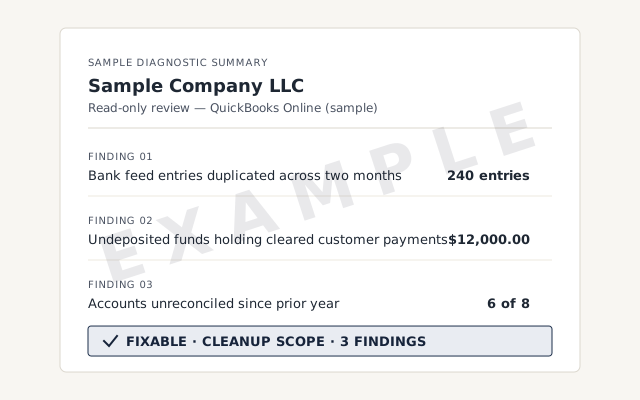
 Sample workflow — not a specific client’s data
A real diagnostic summary
The written read-out that tells you whether it is setup, damaged support files, or genuine file damage.
Error -6000, -83
Company file won't open? Usually setup, not damage — here's how to tell.
QuickBooks error -6000, -83 means the program tried to open your company file and was stopped — a general open failure. The usual causes are folder permissions, hosting or multi-user setup, damaged .ND or .TLG support files, or a network share QuickBooks cannot fully use. Correcting how the file is served clears most cases; occasionally it signals real damage.
Who this affects
You will usually see -6000, -83 when QuickBooks can locate the company file but is blocked from opening it. The -6000 series is the "cannot open the company file" family, and the -83 suffix is the general open failure within it — Intuit does not tie it to one single cause. In practice it lands on a short list: a folder locked down by Windows permissions, hosting set the wrong way in a multi-user setup, a network share that will not give QuickBooks full access, or damaged .ND and .TLG files sitting beside the .QBW. It also turns up when restoring a backup to a folder QuickBooks cannot fully write to. The data inside the file is usually fine — the problem is the door, not the room. Fix how and where the file is served, and the error typically disappears.
Start here
-6000, -83 — a setup fix, or a damaged file?
A setup fix
Correct folder permissions, hosting, and the .ND/.TLG support files — this clears most -6000, -83 messages.
Now suspect damage
If the file will not open even locally with full permissions and rebuilt support files, the file itself may be damaged.
See file repairFix it yourself
Start by proving where the fault is. Moving the file local separates a setup problem from a damaged file in a couple of minutes — everything after that follows from what the local test tells you.
Find the exact folder holding the .QBW company file. If it sits on an external USB drive, a mapped network drive, or a share, note that — those locations are where -6000, -83 most often starts.
Copy the .QBW to the local C: drive and open it from there. If it opens, the location or network was the problem, not the file, and you can fix the setup with confidence.
On the folder that holds the file, give the Windows user running QuickBooks full read and write permissions. Restricted folder rights are a common -6000, -83 cause, especially after a move or a new user.
In a shared setup, only the server hosts the file. Confirm hosting is on at the server and off on every workstation, so one machine controls access and the others reach it through it.
Rename the matching .ND and .TLG files next to the .QBW (add .OLD to each). QuickBooks rebuilds a fresh .ND when the folder is rescanned and a fresh .TLG on open — this clears damaged support files without touching your data.
From the QuickBooks Tool Hub, run File Doctor and the Database Server Manager on the host to scan the folder and repair network and permission problems, then reopen the file from its proper location.
The setup fix, in order
When to call us
If the file still throws -6000, -83 after you have moved it to a local drive, granted full folder permissions, and rebuilt the .ND and .TLG files, the setup is no longer the cause. A file that will not open even locally, with correct rights and fresh support files, is showing signs of damage. That is a file repair, and if data is already missing, a rescue. We diagnose on a copy, so your original file is never put at further risk — and where a Desktop repair needs admin-level access to the file, it runs over a screen-share or a hosted copy you control. And because -6000, -83 shares its family with error -6000, -77, working through both the same way — location, permissions, hosting, then the file itself — is often what separates a quick fix from a real repair. If the code you are actually seeing is -6189, -816 — the file held by another session or a stale transaction log — that guide walks its own fix path.
Some -6000, -83 cases are not a QuickBooks problem at all. When the block traces to your operating system, a firewall, server permissions, or failing network hardware, changing QuickBooks settings will not help — that is work for your IT or network support, not a bookkeeping fix. For Intuit's own documentation on the -6000 series and the Tool Hub, see QuickBooks official help. We will tell you plainly which side the cause sits on so you spend your time on the right one.
What the local test tells you
Sample workflow — not a specific client’s data
The written read-out that tells you whether it is setup, damaged support files, or genuine file damage.
We confirm the cause on a copy before changing your file. See what repair involves.
See QuickBooks file repairA written reply within one business day.
It means QuickBooks tried to open your company file and could not. In the -6000 family, the -83 suffix is a general open failure — most often folder or file permissions, a hosting or multi-user setup problem, damaged .ND or .TLG support files, or a network share QuickBooks cannot fully use. Sometimes it points to real damage in the file itself.
Copy the company file to your local C: drive and open it there. If it opens, the storage location or network was the problem, not the file. Then correct folder permissions, confirm hosting, and rename the .ND and .TLG files so QuickBooks rebuilds them. That local test resolves or narrows most -6000, -83 cases fast.
The .ND (network descriptor) and .TLG (transaction log) files sit beside your .QBW company file and help QuickBooks find and serve it. Renaming them is safe and reversible — QuickBooks rebuilds a fresh .ND when you rescan the folder, and a fresh .TLG when you open the file. You are not touching the data in the .QBW itself.
Yes, it can. If the file still fails after you move it to a local drive, grant full permissions, and rebuild the support files, the setup has been ruled out and damage is the likely cause. At that point it is a file repair — or a rescue if data is already missing — not another permissions change.
Restoring writes a brand-new company file, so it needs a folder QuickBooks can fully write to. Restoring onto a network drive or USB stick, into a protected folder, or with special characters in the file name can all trigger -6000, -83. Restore to the local C: drive with a plain file name first, then move the file where it belongs.
When it traces to your operating system, your network hardware, or server permissions beyond QuickBooks, it stops being a bookkeeping fix. A blocked share, a firewall, or a failing drive is IT territory. We will tell you honestly when the cause sits outside the file so you call the right person and do not keep changing QuickBooks settings that were never wrong.