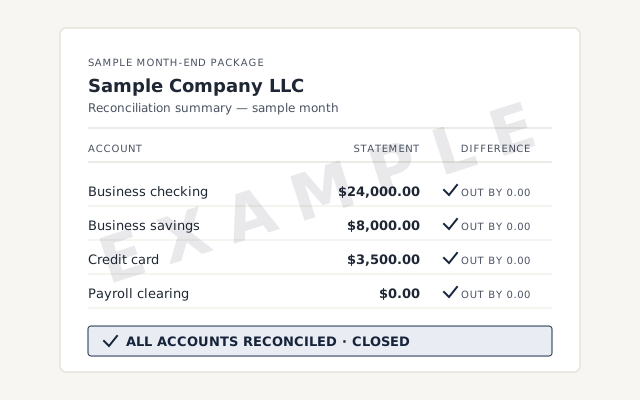
 Sample workflow — not a specific client’s data
A real monthly package
The reconciled reports and close summary you receive at the end of each period.
QuickBooks bookkeeping
Books that tie out, month after month.
QuickBooks bookkeeping is the ongoing work that keeps your file accurate: every transaction categorized consistently, every account reconciled to its statement, and reports that tie each period. One firm keeps the books, start to finish; we do not file your taxes — we hand your CPA a clean file to work from.
QuickBooks bookkeeping is the recurring work of recording every transaction in the right account, reconciling each account to its bank or card statement, and closing the period so your reports tell the truth — done the same way every month.
Three operations repeat each period. Every transaction is categorized to the account it belongs in, consistently, so your profit and loss reads the way the business actually runs. Every account — bank, card, loan, payroll liability — is reconciled to its statement, so the balance in QuickBooks matches the balance in the real world, out by zero. Then the period is closed, and the reports are checked to make sure they tie. This is one of the engagements that fans out from a full QuickBooks service, and it is deliberately distinct from filing: we keep the books accurate; your CPA files from them. The person matters as much as the routine — if you're weighing who should do this work, our guide to hiring a QuickBooks bookkeeper covers the role itself.
You need ongoing bookkeeping when keeping the file current has become a job you cannot get to, when accounts stop getting reconciled, or when you cannot trust the reports enough to make a decision from them.
The usual signs:
If you already reconcile every account each month and your reports tie, you may not need us on a monthly basis — a point we come back to below, and one we will tell you plainly at the review. Our bookkeeping workflow guide lays out the weekly and monthly routine that keeps a file in that state on your own.
Our monthly bookkeeping covers the same four steps every period: every transaction categorized, every account reconciled to its statement, the period reviewed for anything that looks off, and reports delivered that tie — with a note of anything that needs your CPA.
The monthly cycle
Categorizing is done to a chart of accounts that fits your business, so the same expense lands in the same place every time and your reports stay comparable month to month. Reconciling covers every account that carries a balance, not just the checking account — cards, loans, and payroll liabilities included — because a book that reconciles the bank but ignores the rest still hides drift. We review the closed period for the things that quietly go wrong: a duplicate that slipped through a feed, a transfer booked as income, a balance that stopped matching. And when something can only be settled by your preparer, it is named in the handoff, not buried. If you want the recurring engagement in detail — cadence, deliverables, and how a close is run — that lives on our monthly bookkeeping page.
If your file has already drifted, bookkeeping cannot start on top of the mess: a QuickBooks cleanup resets the file to a reconciled baseline first, and then the monthly cycle keeps it there.
Starting ongoing bookkeeping on a file that never reconciled is like painting over rot — the current month looks handled while last year's errors still distort every report. So when the review finds real drift, we scope the cleanup as its own fixed piece, tie every account back to its statement, and hand you a documented baseline. From that clean starting point the monthly work is straightforward, because it only ever has to keep pace with new activity, not chase old mistakes. If your file is already clean, we skip the cleanup and start bookkeeping directly — we do not sell a cleanup a clean file does not need. The free review is where we tell you which case you are in.
Why the order matters
Timeline
Most bookkeeping engagements move from a free review to a running monthly cycle within one to two weeks, because a clean file only needs a baseline check before the cycle starts — longer only if the file needs a catch-up or cleanup first, which we scope and quote separately before anything recurring begins.
Day 0
View-only look at your file; we scope the work and quote a fixed monthly fee.
Week 1
Reconcile to a clean starting point — a catch-up or cleanup first if the file needs it.
Month 1
Categorize, reconcile every account, and deliver reports that tie for the period.
Monthly
The same cycle every period, with anything for your CPA flagged in writing.
Which route?
Specialist bookkeeping keeps your file reconciled and hands off clean to your CPA; DIY works if you know the accounting and have the time; a general firm may file taxes but often will not do the monthly reconciling. Here is how the three compare.
| Specialist bookkeeping | DIY | General firm | |
|---|---|---|---|
| Reconciles every account each period | It depends | It depends | |
| Categorizes to a chart that fits you | It depends | It depends | |
| Delivers reports that tie | It depends | It depends | |
| Documented handoff to your CPA | — | It depends | |
| Files your taxes | — | — | |
| Best when | You want books you can trust | You know the accounting | You need filing, not books |
| Verdict | Books that tie, every month | If you have the time | Filing, not bookkeeping |
One firm keeps your books start to finish, reconciling every account to its statement and documenting the work so you or your CPA can audit it — never a rotating pool, and not an offshore desk that categorizes by guesswork. And when you do not need us, we say so.
Our method is verification, not assertion: every account ties to its statement, every close is checked, and access stays minimal — view-only for the free review, then QuickBooks' accountant access to make and log every correction — never your bank logins. We hold a bright line at filing; we keep the books, your preparer files from them. Read exactly how we work on our methodology page. But skip monthly bookkeeping if your file already reconciles cleanly and your reports already tie — there is no prize for paying to maintain books that are already right, and we will tell you that at the review. If you're keeping the books yourself, our QuickBooks for small business guide covers the fundamentals end to end, free. If you mostly want to know the number first, our bookkeeping cost page breaks down what drives the monthly fee before you ever talk to us.
You don't have to take our word for it. Here is the evidence you can check — the deliverable you receive each period, the method we use to prove your accounts tie, and our response commitment.
Sample workflow — not a specific client’s data
The reconciled reports and close summary you receive at the end of each period.
A written reply within one business day.
Remote-first, nationwide
Mon–Sat · 8am–6pm CT
We work entirely remote — view-only access for the free review, QuickBooks' accountant access for the monthly work itself, screen-share whenever you want to watch, and every period documented in writing.
A cleanup is a one-time engagement that fixes a file that has drifted — miscategorized transactions, un-reconciled accounts, a balance sheet that won't foot. Bookkeeping is the ongoing work that keeps a clean file clean: categorizing, reconciling, and closing each period so it never drifts again. If your file is already a mess, a cleanup comes first; bookkeeping keeps it right after.
Not necessarily, and we will tell you so. If you reconcile every account each month, categorize consistently, and your reports already tie, you may only need us for a periodic check or a year-end review. Ongoing bookkeeping earns its fee when the work is falling behind, drifting out of reconciliation, or eating time you would rather spend on the business.
No. We keep your QuickBooks accurate and reconciled so your CPA or tax preparer has clean books to file from, and we hand off cleanly to them at year end. We do not prepare or file tax returns, and we say so plainly so there is never confusion about where our work ends and your preparer's begins.
QuickBooks Online and QuickBooks Desktop. The free review runs on view-only access; the bookkeeping itself uses QuickBooks' accountant access to make and log every correction — never your bank logins — with Desktop handled by screen-share or a hosted file. If you are on Desktop and considering a move, we handle that separately as a migration; ongoing bookkeeping works the same either way once you land.
Yes. We catch the file up first — recording and reconciling the missing months — and then start the monthly cycle from a clean baseline. We scope the catch-up as its own fixed piece so you know exactly what it costs before ongoing bookkeeping begins.
It is a fixed monthly fee set by the size and activity of your file — the number of accounts, transaction volume, and whether payroll or inventory are involved — quoted after a free view-only review. We break down what drives the figure on our bookkeeping cost page, and the review sets a real number for your file, not a generic rate.
Ready to start? Get a free QuickBooks review and we will scope the work, or book a call to talk it through. If the file needs it, we handle a cleanup first, then keep it right with monthly bookkeeping.