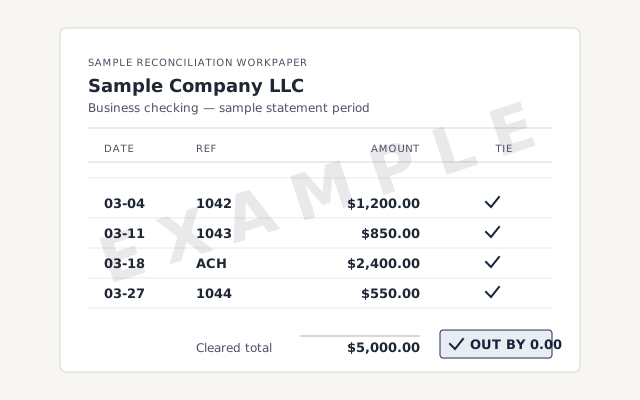
 Sample workflow — not a specific client’s data
A real payout reconciliation
The exact worksheet tying one Stripe payout — gross charges, fees, and refunds — to the deposit on the bank.
QuickBooks Stripe reconciliation
A Stripe payout is never your sales figure. Stripe takes its fee before it pays you, and one deposit batches many charges, minus the refunds and disputes in that window. We book the gross charge as revenue, the fee as an expense, and route every payout through a Stripe clearing account — so the deposit reconciles instead of floating.
QuickBooks Stripe reconciliation means turning what Stripe actually deposits into books that tell the truth: gross sales recognized in full, processing fees recorded as the expense they are, refunds and disputes accounted for, and each batched payout matched back to the bank. Stripe is a payment processor, and like every processor it settles a net number — so the money that lands is never the money you sold.
Most Stripe files we see are wrong in the same quiet way. Someone connected the bank feed, saw a Stripe deposit arrive, and booked it as "sales." It looks fine on the surface, but that single move understates revenue by every fee Stripe kept, makes the processing cost vanish, and leaves refunds and disputes floating with nothing to net against. Each of those is a specific, fixable mechanic rather than a matter of taste. This page walks through how the reconciliation actually works. It is one integration lens on a full QuickBooks cleanup — the same discipline, pointed at a Stripe account.
Your Stripe payout never matches your gross sales because two things happen between the charge and the deposit: Stripe subtracts its fee, and Stripe batches. A payout is not one sale arriving in your bank — it is a group of charges that settled in a window, reduced by the processing fees on those charges and by any refunds or disputes that occurred in the same window. What deposits is the leftover net figure.
That is the deposit-vs-payout gap, and it is the whole reason Stripe bookkeeping needs its own handling. Gross charges are what your customers paid and what your revenue should reflect. Processing fees are the cost Stripe charged to collect that money. Refunds return revenue to customers; disputes and chargebacks pull funds back and often add a dispute fee. Every one of those sits between the gross and the net. Book only the net deposit and all of it disappears into a single understated "sales" line that no report can unpick. The figure below shows the split we build instead.
Stripe payout reconciliation
Book the gross charge — the full amount the customer paid — as revenue, every time, rather than the net amount Stripe deposits. The fee Stripe keeps does not reduce what you sold; it is a separate cost you paid to collect the sale. Recognizing revenue at gross is the single decision that keeps a Stripe file honest.
The failure mode is booking the net deposit as "sales." A business doing real volume through Stripe can lose a meaningful slice of revenue this way — not to fraud, but to arithmetic, because every fee quietly shaves the top line and the processing cost never appears anywhere it can be seen or deducted. When revenue is recognized at gross and the fee is recorded on its own, both numbers are true: the income statement shows what you actually sold and what it actually cost you to accept card payments. That is also what lets a payout still reconcile to the penny — because the net deposit is simply gross minus the fees and refunds you have already booked.
Record Stripe's processing fees as an operating expense — typically a merchant-fees or payment-processing account — in the period the charge settled. The fee is money you paid Stripe to accept the payment, so it belongs on the profit-and-loss as a cost of doing business, sitting visibly on its own line rather than being netted invisibly out of revenue.
We do not assert what Stripe charges. Processing pricing varies by plan, product, card type, and region, and it changes over time, so any page quoting a fixed rate is guessing. What we do is take the actual fees Stripe reports on its payout and transaction records and post those exact amounts, so the expense in QuickBooks equals the expense Stripe charged. Recorded that way, the merchant-fees line becomes something you can actually manage — you can see what card acceptance costs you as a share of revenue, watch it as volume grows, and hand your CPA a real, deductible expense instead of a number buried inside understated sales. If you want the accounting underneath this, our doc on what merchant fees are and how to book them walks through the pattern in plain English.
A Stripe clearing account is the holding account that makes the whole reconciliation tie. It sits in QuickBooks between your sales and your bank: gross charges post into it as revenue is recognized, processing fees and refunds post out of it, and when a Stripe payout lands in the bank you move exactly that amount out of the clearing account and into the bank. Nothing hits "sales" directly, and nothing hits the bank without passing through the clearing account first.
The elegance is in what the balance means. When it is run correctly, the clearing account balance equals the money Stripe is holding on your behalf but has not yet paid out — your in-transit Stripe balance. If that balance matches what Stripe's dashboard says it owes you, the account is reconciled; if it drifts, you have found exactly where a charge, fee, or refund was mis-booked. This is the same mechanism behind every processor tie-out, which is why the discipline generalizes across a QuickBooks Square reconciliation and the broader account tie described in our bank reconciliation guide. The clearing account is what turns "the deposit doesn't match" into a number you can prove.
What the clearing balance means
Refunds, disputes, and chargebacks all reduce what Stripe pays you, so every one of them has to reduce the clearing account. A refund returns money to the customer and reverses the original revenue, posting as contra-revenue against the clearing account. A dispute or chargeback pulls the funds back and, on many plans, adds a separate dispute fee — which is a further expense — so a single disputed charge can touch revenue, the clearing account, and a fee line at once.
The reason these tangle a file is timing: a refund or dispute frequently lands in a different payout batch than the original sale. The charge settles and pays out one week; the refund reverses it the next, arriving in a later deposit. Unless both the sale and its reversal are booked against the same clearing account, they never find each other and the file slowly drifts out of tie. We match each refund and dispute back to the payout it actually affected, post the fee where a fee belongs, and keep the clearing account honest — so a busy refund month still reconciles instead of becoming a mystery balance.
Stripe pays out on a rolling schedule, not per sale, and that batching is what makes a bank deposit impossible to match against a single day's sales. Stripe accumulates the charges whose funds have become available and sends them to your bank as one payout — commonly on a set delay after the funds settle — so any given deposit is a mix of charges from an earlier window, minus the fees and refunds in that window.
Reconciliation solves this by working from Stripe's own payout report rather than guessing. Each payout Stripe issues comes with a breakdown of exactly which charges, fees, refunds, and adjustments it contains; that report is the bridge between the gross activity and the net deposit. We reconcile payout by payout — the report's total must equal the deposit on the bank statement, and its components must equal what we booked to revenue, fees, and refunds. When a payout ties on both sides, the deposit-vs-payout gap for that batch is fully explained. Do that consistently and a Stripe account that once looked unreconcilable becomes routine monthly work.
How it goes
Whether you need a one-time cleanup or ongoing monthly reconciliation, the shape is the same: a free review, a pass to set up the clearing account and correct how charges and fees post, reconciliation payout by payout to the bank, and a handback. Accounts that are months behind start with a catch-up; accounts that are current move straight to a clean monthly rhythm.
Day 0
View-only look at the file: how Stripe deposits are posting today, whether fees are visible, and how far behind the reconciliation is.
Week 1
A Stripe clearing account created, gross revenue and fee accounts set, refund and dispute handling defined.
Weeks 1–2
Each payout matched to its Stripe report, gross charges and fees restored, refunds tied, every deposit reconciled to the bank.
Ongoing
A file that ties, a written summary of what changed, and either a handback or ongoing monthly reconciliation.
What changes
A file built for Stripe recognizes revenue at gross, shows the fee, and ties every payout; a lump-deposit file hides all three. Here is the difference line by line.
| Reconciled for Stripe | Lump deposit | |
|---|---|---|
| Revenue recognized at gross | — | |
| Processing fees visible as an expense | — | |
| Refunds and disputes matched to payouts | — | |
| Clearing account equals in-transit balance | — | |
| Every payout tied to the bank | — | |
| Deposit-vs-payout gap fully explained | — | |
| Verdict | A file you and your CPA can trust | Understated sales nobody can unpick |
What it costs
Real ranges depend on your Stripe volume, transaction count, and how far behind the books are. The floors shown are published starting points; a free review sets your scope.
| Engagement | Typical range | Timeline | What's included |
|---|---|---|---|
| Stripe cleanup / catch-up | From $1,500 | 2–4 weeks | Build the clearing account, restore gross revenue, break out fees, match refunds and disputes, reconcile back payouts. |
| Monthly reconciliation | From $400/mo | Ongoing | Every payout tied to its Stripe report and the bank, fees and refunds kept current, monthly reconciled file. |
| Multi-processor | Custom fixed quote | Scoped | Stripe plus other processors consolidated, each with its own clearing account, one reconciled file. |
| Get your range after a free review | |||
Stripe cleanup / catch-up
Monthly reconciliation
Multi-processor
The same hands set up and reconcile your file from a documented plan — not an offshore pool learning what a payout report is on your books. Every Stripe account we take on gets the same mechanics applied deliberately: gross revenue recognized, fees broken out, refunds and disputes matched, and each payout tied through a clearing account.
Our discipline is verification, not assertion. We reconcile each payout to Stripe's own report and to the bank, and we show you the tie rather than telling you it balances. Access stays minimal — QuickBooks' accountant access to make and log every correction, or a screen-share you control, never your bank logins or your Stripe admin credentials. And we stay in our lane: we keep the books accurately and consistently, and we hand your CPA a file that already ties, but we do not file returns, set sales-tax positions on your Stripe sales, or give tax advice. That line is deliberate, and the honesty about where our job ends is part of doing it well. You can read the full method behind that on our methodology page.
Skip us when your file already works. If your Stripe charges already post at gross, your fees already sit on their own expense line, your refunds and disputes already match their payouts, and every deposit already reconciles to the bank, there is nothing here for us to fix — and no reason to pay someone to reconcile a file that already ties.
Skip us, too, when what you actually need is a different professional. If you need last year's return prepared or a position on how your Stripe sales are taxed, that is your CPA's work, not ours. If your volume is low and a single clearing account is all you need, you may set it up yourself in an afternoon with a cleanup checklist and no invoice from anyone. We will tell you which case you are in during the free review, even when the honest answer is that you do not need us. Not sure a payment processor is even your main problem? The wider industries hub points you to the right lens.
You don't have to take our word for it. Here is the evidence you can check — the deliverable you receive, the method we use to prove a payout ties, and our response commitment.
Sample workflow — not a specific client’s data
The exact worksheet tying one Stripe payout — gross charges, fees, and refunds — to the deposit on the bank.
Each payout reconciled to Stripe's report and to the bank. Read the discipline we apply.
Read the full methodA written reply within one business day.
Remote-first, nationwide
Mon–Sat · 8am–6pm CT
We work entirely remote — view-only for the free review, then QuickBooks' accountant access to make and log every correction — never your bank logins; screen-share whenever you want to watch, and every payout reconciliation documented in writing.
Because a Stripe payout is never the same number as what your customers were charged. Stripe deducts its processing fees before it sends money to your bank, and a payout is usually a batch of many charges from a period, reduced by any refunds and disputes in that same window. So the deposit that lands is a net figure, while your sales are the gross charges. When only the net deposit is booked, revenue is understated by every fee and the two never tie. Reconciliation splits the payout back into gross sales, fees, and refunds so both sides agree.
Gross. The full amount the customer was charged is your revenue; the fee Stripe keeps is a business expense you incurred to collect it. If you book only the net deposit, you silently understate both your income and your expenses by the amount of the fees, and your Stripe processing cost never appears anywhere you can see or deduct it. We book the gross charge as revenue and record the fee separately as an expense, so the payout that hits the bank still reconciles to the penny.
As an expense, typically a merchant-fees or processing-fees account, recorded in the period the charge settled. The fee is money you paid Stripe to accept the payment, so it belongs on the profit-and-loss as a cost of doing business rather than being netted invisibly out of revenue. We do not assert Stripe's fee rate — pricing varies by plan and product and changes over time — we take the actual fees Stripe reports and post them, so the number in QuickBooks is the number Stripe charged.
A Stripe clearing account is a holding account in QuickBooks that sits between your sales and your bank. Gross charges post into it as revenue is recognized, fees and refunds post out of it, and when Stripe's payout lands in the bank you move that exact amount out of the clearing account. Done right, the clearing account balance equals the money Stripe is holding but has not yet paid out — your in-transit Stripe balance — and every payout ties cleanly to the bank. It is the mechanism that makes the deposit-vs-payout gap reconcile instead of float.
Each one reduces what Stripe pays you, so each one has to reduce the clearing account too. A refund returns money to the customer and reverses the revenue; a dispute or chargeback pulls the funds back and, on many plans, adds a separate dispute fee. Because these often hit a different payout than the original sale, they are a common reason a file drifts — the refund lands in one batch, the sale in another, and nothing lines up unless both are booked against the same clearing account. We post refunds as contra-revenue and dispute fees as an expense so the payout still reconciles.
Stripe accumulates the charges that settle and pays them to your bank on a rolling schedule — commonly a set number of days after the funds are available — so one bank deposit represents many charges from an earlier window, minus the fees and refunds in that window. The batching and the delay are exactly why the deposit almost never equals a single day's sales. Reconciliation matches each payout back to the specific charges, fees, and refunds it contains, using the payout report Stripe provides.
No. Whether and how much sales tax applies to what you sell is a position for you and your CPA, and it varies by what you sell and where your customers are. What we do is make QuickBooks record the tax consistently with whatever you collect through Stripe and reconcile the liability to what you file. We keep the books accurate; we do not decide your tax positions or file your returns.
Yes — that is one of the most common Stripe cleanups we do. When months of payouts were booked as lump deposits, revenue is understated, fees are invisible, and refunds are tangled across batches. We rebuild it: a proper clearing account, gross charges restored as revenue, fees broken out, refunds and disputes matched to their payouts, and every deposit reconciled to the bank. The free review tells you how far the file has drifted before you commit to anything.
It depends on your monthly Stripe volume, how many charges and refunds run through it, and whether you need a one-time cleanup or ongoing monthly reconciliation. We set a fixed scope and a fixed fee after a free review rather than quoting a number that has to change later. The floors on this page are published starting points; the review sets your real range.
Stripe reconciliation is one processor lens on the same craft. See QuickBooks Square reconciliation for the same tie on a different processor, the bank reconciliation guide for the account-tie discipline underneath it, QuickBooks for short-term rentals where the pooled payout covers stays at several properties, and the full QuickBooks cleanup a Stripe catch-up is part of.