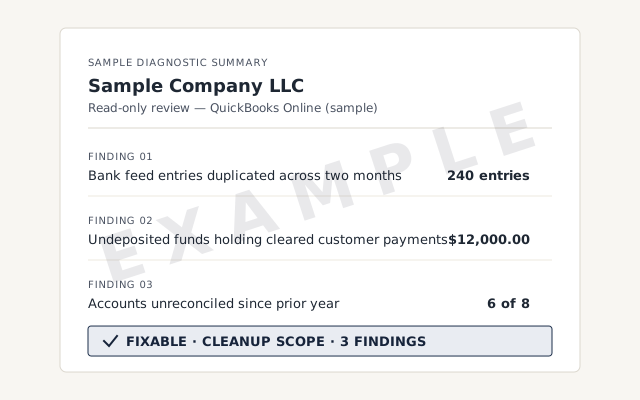
 Sample workflow — not a specific client’s data
A real findings report
The plain-English read you receive — what's reliable in your file, what isn't, and what it would take to fix.
QuickBooks second opinion
Numbers feel off? Get an independent read.
A QuickBooks second opinion is an independent review of books you suspect are wrong — when the numbers feel off, or you're not sure your bookkeeper has them right. We read the file cold and tell you what's solid and what isn't. Start with the free health score; if it's clean, you may not need us.
Which do you need?
Start here
Do you actually need one?
You may not need us
If your last three reconciliations tied and the statements agree, run the health score to confirm — a do-it-yourself check.
Run the health scoreIndependent review
A cold read of the file tells you what's solid and what needs work, with no obligation.
Get your free reviewReview, then cleanup
If the review confirms real errors, cleanup corrects them and gets the file back to reliable.
See QuickBooks cleanupHonest answer
Plenty of people who ask for an independent review don't need one, and we'll tell you so. If your bank and credit-card accounts reconcile every month, your balance sheet balances, and your profit-and-loss matches what you know about the business, your books are probably fine — a nagging feeling isn't the same as an error. In that case the honest answer is to run a quick self-check and get on with your day.
An independent review earns its keep when something concrete is off: reports that don't match your bank, a balance sheet that won't balance, numbers that jumped without explanation, or a handover from a bookkeeper you're no longer sure about. It's also worth it before a big decision — a loan application, a sale, a tax filing you'll sign — where being wrong is expensive. The point of an independent read is to replace the feeling with a fact, either way.
Do-it-yourself
Before you pay anyone, you can get most of the way to an answer yourself, and we'd rather you did. Start with our free bookkeeping health score — it walks through the checks that matter and flags the ones your file fails. Then look at three things: does each bank and credit-card account reconcile to the latest statement with a zero difference, does the balance sheet actually balance, and does Undeposited Funds or Opening Balance Equity carry a balance it shouldn't.
The three checks
If all three come back clean, you likely don't need an independent review — this is a do-it-yourself check, and passing it is the answer. If they don't — a reconciliation won't tie, the balance sheet is off, or a suspense account is holding money — that's your fact, and it's worth an independent read. Either way you'll know more than you did, and you won't be paying to confirm a hunch.
Sample workflow — not a specific client’s data
The plain-English read you receive — what's reliable in your file, what isn't, and what it would take to fix.
Every account checked against the statement before we call anything solid. Read the method.
Read the reconciliation referenceA written reply within one business day.
Remote-first, nationwide
Mon–Sat · 8am–6pm CT
We work entirely remote — view-only access for the review itself, QuickBooks' accountant access only if you hire us to fix what it finds, screen-share whenever you want to watch, and every finding documented in writing.
No. The review is about the file, not the person. We tell you what's reliable and what needs work in plain terms, with the evidence behind each finding. If the books are in good shape, we say that too — the goal is an honest read, not a sales pitch.
A second opinion diagnoses; a cleanup fixes. The review tells you what's wrong and what it would take to correct — no obligation. If you decide to fix it, cleanup is the separate engagement that does the work, scoped from what the review found.
The checks that reveal whether books can be trusted: bank and credit-card reconciliations, whether the balance sheet balances, suspense accounts like Undeposited Funds and Opening Balance Equity, and whether the reports agree with the statements. It's a read of the file, not a full audit.
The initial read is our free QuickBooks review — we look at the file, view-only, and tell you what it needs. If a deeper independent review or a cleanup is warranted, we scope and quote that up front, so you decide with the findings in hand.
No. The findings are yours, not a hook. Many owners hand the list to their current bookkeeper to fix, and that's a fine outcome — the review's job is to tell you the truth about the file. If you'd rather have the errors corrected independently, cleanup is a separate engagement, never a condition.
Run the free bookkeeping health score first. If your reconciliations tie, the balance sheet balances, and nothing looks off, you probably don't need one. If something fails, that's your signal that an independent review is worth it.