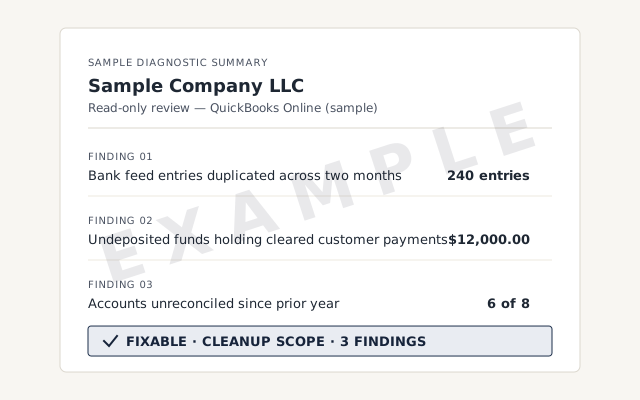
 Sample workflow — not a specific client’s data
A real diagnostic summary
The written read-out that confirms 1603 is an install issue and that your company file is untouched.
QuickBooks error 1603
“There was a problem installing” — start here.
An install or update that quits with “there was a problem installing” is QuickBooks error 1603 — a generic Windows Installer failure. The usual culprit is a damaged Microsoft component QuickBooks relies on: the .NET Framework, MSXML, or the C++ Redistributable. It is a Windows problem, not a problem with your company file, and repairing the affected component clears most cases.
Who this affects
Error 1603 appears while QuickBooks Desktop is being installed, reinstalled, or updated — never while you are working in your file, because it stops before QuickBooks ever opens one. The number itself is not specific to QuickBooks; 1603 is a general Windows Installer code that means "a fatal error occurred during installation." QuickBooks Desktop is built on top of several Microsoft components — chiefly the .NET Framework, MSXML, and the Visual C++ Redistributable — and its installer checks and updates them as it runs. When one of those components is damaged, out of date, or only partly installed, the installer cannot finish its job and stops with the generic 1603 message. Because all of this happens at install time, none of it involves your accounting data. Your transactions, reconciliations, and reports are untouched, and there is no risk to your books in working through the fix — the task is a Windows one, on the machine, not a task that opens or changes your company file.
Start here
Error 1603 — a component repair, or a deeper Windows problem?
A component repair
The tool repaired the .NET, MSXML, or C++ component the installer needs — that resolves the large majority of 1603 failures.
A Windows-level problem
A 1603 that will not clear points at a Microsoft component needing a manual reinstall or an operating system needing servicing — a Windows technician's job, not a bookkeeping one.
See file repairFix it yourself
Most error 1603 cases clear at the first step, and none of these steps touch your company file. Work them in order, stop as soon as the install completes, and take a backup of anything you value on the machine before you start, as a matter of habit.
Close QuickBooks and download the QuickBooks Tool Hub. On its Installation Issues tab, run the QuickBooks Install Diagnostic Tool. It checks and repairs the .NET Framework, MSXML, and C++ components that cause most 1603 failures, then lets you re-run the install.
Open Windows Update, install everything pending, and restart. The installer relies on Microsoft components that must be current; an out-of-date system is a common 1603 cause. Try the QuickBooks install again after the restart.
If 1603 persists, repair the affected Microsoft component manually — the .NET Framework through Windows features, and MSXML by re-registering or reinstalling it. These are Windows components, not QuickBooks ones, so this is where the task becomes an IT job.
A damaged or missing Visual C++ Redistributable can also stop the installer. Reinstall the current Microsoft C++ Redistributable, restart, and re-run the QuickBooks install.
If the install still fails, uninstall QuickBooks, use the Tool Hub's Clean Install Tool to rename the leftover install folders, restart, and install fresh from a downloaded copy. With the Windows components repaired, the clean install completes and 1603 clears.
The install fix, in order
QBSpecialist is an independent firm of QuickBooks specialists — not Intuit, and not affiliated with or endorsed by Intuit. "QuickBooks" is used here descriptively to name the software we work in. For official product support, billing, or account access, use Intuit's official channels.
When to call us
We will be honest with you about QuickBooks error 1603: it is largely an IT fix. If the Install Diagnostic Tool and Windows updates do not clear it, what is left is a manual repair or reinstall of a Microsoft component — the .NET Framework, MSXML, or the C++ Redistributable — or servicing of Windows itself. That is Windows-technician work, and a good IT person or Microsoft's own support may resolve it faster than a bookkeeping firm can; it sits outside our lane, so we will point you there rather than pretend the machine is ours to rebuild. What we can do is the part that is genuinely ours: confirm in writing that your company file and your accounting are entirely unaffected by the failed install, so you can hand the computer to IT knowing the books are safe and nothing was lost. We diagnose from a copy of your file — never the live one — and tell you plainly where the line falls between the Windows install fix and anything that would touch your data. Two related codes are worth bookmarking: error 3371, when a reinstall leaves QuickBooks unable to load its license data, and error 15271, when it is the update download that fails rather than the install.
Whose fix it is
Sample workflow — not a specific client’s data
The written read-out that confirms 1603 is an install issue and that your company file is untouched.
We confirm the cause on a copy before touching anything. See what our work involves.
See QuickBooks file repairA written reply within one business day.
Error 1603 is a generic Windows Installer failure that appears while QuickBooks Desktop is installing or updating — the wording is usually 'there was a problem installing.' It almost always traces to a damaged Microsoft component QuickBooks relies on: the .NET Framework, MSXML, or the C++ Redistributable. It is an installation and Windows problem, not a problem with your company file.
Download and run the QuickBooks Tool Hub, then use the QuickBooks Install Diagnostic Tool on its Installation Issues tab. It checks and repairs the .NET Framework, MSXML, and C++ components that cause most 1603 failures, then lets you re-run the install. That single tool clears a large share of 1603 cases.
No. Error 1603 happens during installation or an update, before QuickBooks opens any company file, so your books are not involved. If your data was fine before the install, it is still fine. The fix restores the Windows components the installer needs; your company file opens normally once QuickBooks installs successfully.
QuickBooks Desktop is built on Microsoft components — chiefly the .NET Framework, MSXML, and the C++ Redistributable. The installer checks and updates them as it runs. If one of those components is damaged, out of date, or partly installed, the installer cannot complete and stops with the generic 1603 code. Repairing or reinstalling the affected component is what clears it.
A 1603 that will not clear after the Install Diagnostic Tool usually means a Windows component needs a manual repair or reinstall, or the operating system itself needs updates or servicing. That is a Windows technician's job, not a bookkeeping one, and it is honest to say a good IT person may fix it faster than we can. We can confirm your company file and books are entirely unaffected while IT clears the machine.
If the error appeared during an update, your installed copy usually still opens and works — the failure stopped the new version from installing, not the current one from running. If it appeared during a first-time install or a reinstall, there is no working copy until the install completes, which makes the component repair the priority.