QBSpecialist

Hire a QuickBooks bookkeeper

Hire a QuickBooks bookkeeper who reconciles and documents.

Hiring a QuickBooks bookkeeper means choosing the person who keeps your file accurate month to month — reconciling accounts, categorizing consistently, and closing the period so your reports tie. Ours starts from $400/mo, fixed after a free review. We are a practice with one bookkeeper — the same person throughout — not a marketplace, and we reconcile the books while your CPA files.

Already know you want it done every month? The monthly bookkeeping service and its fixed fee.

Last reviewed October 2026 by a Certified QuickBooks ProAdvisor

What this page is based on: our reconciliation-first methodology and published floor, with Intuit’s own bookkeeper and pricing pages (checked October 2026)

How to verify the bookkeeper you hire
  • One bookkeeper throughout
  • Reconciled and documented monthly
  • We keep books, your CPA files

What a QuickBooks bookkeeper actually does

A QuickBooks bookkeeper keeps the file accurate as the business runs: reconciling bank and card accounts to the statements, categorizing every transaction to the right account, and closing each month so the profit and loss and balance sheet can be trusted.

The work is unglamorous and it is the difference between books you can use and books you merely hope are right. Each period, a bookkeeper matches what the bank actually cleared against what QuickBooks recorded, sorts transactions into consistent categories instead of a shifting pile of guesses, chases down the ones that do not have a home, and reconciles the accounts so nothing is double-counted or missing. When the month closes, the reports foot — revenue reads as revenue, expenses read where they belong, and the balance sheet ties. That is the raw material your CPA needs at tax time and the dashboard you need to make decisions the rest of the year. It is the same discipline behind QuickBooks bookkeeping and monthly bookkeeping, done by a person who owns the outcome.

When it's time to hire a bookkeeper

Hire a QuickBooks bookkeeper when keeping the books yourself has stopped being worth your time, when the file no longer reconciles cleanly, or when your CPA keeps sending back questions your records can't answer.

The usual signals:

  • You are doing the books at night and on weekends, and they are still behind.
  • Accounts have not been reconciled in months, so you no longer trust the reports.
  • Transactions are categorized inconsistently — the same vendor lands in three different accounts.
  • Your accountant charges to clean up the file every year before they can even start on taxes.
  • You are making decisions on a gut feel because the numbers in QuickBooks don't feel real.

Having QuickBooks is not the same as having a bookkeeper. Bank feeds bring transactions in and suggest a category, but the software does not reconcile the account to the statement, notice that a feed imported the same deposit twice, or close the month — someone has to. If you do that yourself every month and the reports tie, you may not need to hire anyone yet — and we will say so. But if any of the above sounds familiar, the cost of drifting books usually outruns the cost of a bookkeeper long before year end.
We're a practice — not a marketplace or Intuit

The engagement model

One bookkeeper on your account, with documented work YOUR ACCOUNT Your QuickBooks file One bookkeeper SAME PERSON, EVERY MONTH RECONCILED AND CATEGORIZED DOCUMENTED CHANGE LOG
Read this as text

Your QuickBooks file is handled by one bookkeeper who reconciles and categorizes each month and records the work in a change log you can audit. The continuity and the documentation are what distinguish a firm engagement from a rotating marketplace pool. Illustrative example, not a measured figure.

One bookkeeper stays on your account month to month, and every close is recorded in a change log you can audit. The example is illustrative.

When you hire us, you get one bookkeeper who stays on your account, backed by a firm's method and records — not a pool you get rematched out of, not a lone gig worker, and not Intuit's own service.

The distinction is practical, not marketing. A marketplace optimizes for matching volume, so the person on your books can change without warning and the continuity that makes bookkeeping accurate resets each time. A freelancer can give you continuity, but the record of your file often lives only in their head. And QuickBooks Live is Intuit's own offering: Intuit now sells it as Expert Full Service Bookkeeping, with "a dedicated QuickBooks-certified bookkeeper" for QuickBooks Online files, starting at $300/mo after initial cleanup fee (Intuit, checked October 2026), and it excludes invoicing, bill pay, inventory and receivables or payables management. We are independent, work in Online and Desktop, and our only stake is your file being right. Before you hire anyone, check the credential yourself — our ProAdvisor page shows how to verify one in Intuit's directory. We give you one accountable specialist and a documented method: every change goes into a written record, so the knowledge of your file is never only in one person's head. You can read more about how we practice on our about page.

How it works

How hiring a bookkeeper through us works

You start with a free review, we scope the work honestly, and if it is a fit, one bookkeeper takes the account and keeps it reconciled every month. No long onboarding maze, no rotating handoffs.

  1. Free review

    Day 0

    A view-only look at your file. We tell you what shape the books are in and whether you need a cleanup first, monthly bookkeeping, or nothing yet.

  2. Scope and quote

    Days 1–2

    A fixed scope and fixed fee, quoted from what the review actually found — no surprise hourly meter.

  3. Onboard your bookkeeper

    Week 1

    One bookkeeper takes the account, sets up secure access, and learns your accounts and vendors.

  4. Reconcile every month

    Ongoing

    Accounts reconciled, transactions categorized, the period closed, and a documented summary sent to you.

Illustrative day numbers. Your written scope sets the schedule.

See how it works

A bookkeeper isn't an accountant — and we say so

A QuickBooks bookkeeper keeps your books accurate; an accountant files your taxes and advises on tax strategy. We are a bookkeeping practice, so we do the first job well and hand the second to your CPA — we do not file, and we will not pretend otherwise.

The two roles work best in sequence. A bookkeeper reconciles the accounts, categorizes the year's activity, and closes the books so the numbers are real; the accountant then takes those clean books and prepares and files the returns. When the bookkeeping is neglected, the accountant either bills to fix it first or files from shaky numbers — neither is what you want. Our job is to make sure the books handed to your preparer already tie, so their work is filing, not archaeology. If what you actually need is tax filing or planning rather than day-to-day books, that is your accountant's lane, and we will point you there plainly rather than take work that isn't ours — if you arrived here searching for a QuickBooks accountant, we've set that boundary out in full on its own page. Still weighing the two roles from scratch? We've written a fuller answer on whether you need a bookkeeper or an accountant — for most businesses it's both, in sequence.

Two roles, in sequence

The bookkeeper closes books that tie; the accountant files from them BOOKKEEPER — US ACCOUNTANT — YOUR CPA Reconcile, categorize, close Books that tie CLEAN BOOKS Prepares and files the returns Tax planning and advice WE DO NOT FILE FILING, NOT ARCHAEOLOGY
Read this as text

Two roles in sequence. First the bookkeeper reconciles the accounts, categorizes the year, and closes the books so they tie — the verified tick marks that end state. The clean books are then handed to the accountant or CPA, who prepares and files the returns and advises on tax. We do the first job and hand off the second; we do not file. An illustrative diagram of the division of labor, not a measured figure.

A bookkeeper closes books that tie and hands them over; the accountant files from them — in that order, the preparer's work is filing, not archaeology. An illustrative diagram of the two roles.

What you get with a bookkeeper on your account

You get books you can trust every month: reconciled accounts, consistent categorization, a closed period whose reports tie, and a written summary of what was done — from one specialist who knows your file.

Nothing about the work is a black box. Each month's close comes with a plain-language summary of what was reconciled, what was categorized, and anything that needs your or your CPA's decision. Because the same person stays on the account, the categorization stays consistent instead of drifting, and small issues get caught before they become year-end cleanups. If your file needs to be brought current first, a bookkeeper naturally starts with that and then keeps it clean going forward through monthly bookkeeping. And because access stays scoped to the accountant role or a screen-share on your terms, you keep control of your file and your banking the entire time. The engagement is fully remote and works the same in every state — we've written up how it lands for a QuickBooks bookkeeper in California, Texas, Florida, and New York. When you are ready, the honest first step is a free review — it costs nothing and tells you exactly what, if anything, you need.

How to verify the bookkeeper you hire

You don't have to take our word for it. Here is what you can check before and during the engagement — the monthly deliverable, the method we use, and our response commitment.

  • Who’s responsible for your file

    A Certified QuickBooks ProAdvisor handles your file from the review through the corrections to the hand-back — the same person throughout, never a rotating pool.

    About QBSpecialist
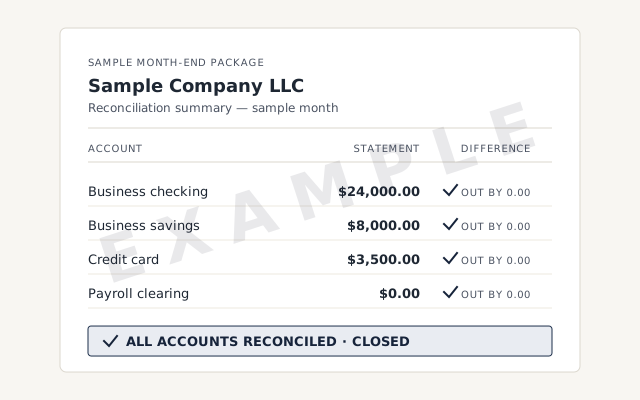
  • Sample month-end package — an illustrative reconciliation summary with every account at a zero difference for Sample Company LLC. Marked SPECIMEN, not a real client document. Columns: Account, Statement, Difference. Rows: Business checking, $24,000.00, ticked, out by 0.00; Business savings, $8,000.00, ticked, out by 0.00; Credit card, $3,500.00, ticked, out by 0.00; Line of credit, $15,000.00, ticked, out by 0.00. Result: All accounts reconciled, closed.Illustrative example — not a client file.

    Sample monthly close

    The reconciliation and documented summary you receive at the end of each period.

  • Our methodology

    How we reconcile, categorize, and close. Read it before you commit.

    Read the full method
  • Response commitment

    A written reply within one business day.

Remote-first, nationwide

Mon–Sat · 8am–6pm CT

We work entirely remote — view-only access for the free review, QuickBooks' accountant access for the monthly work, every change visible to you in the audit log, and every month's close documented in writing.

Questions about hiring a QuickBooks bookkeeper

Do I need a bookkeeper if I already have QuickBooks?

Not always. QuickBooks and its bank feeds bring transactions in and suggest categories, but they don't reconcile the accounts to the statements, catch a duplicate a feed created, fix a payment parked in Undeposited Funds, or close the month. If you do that work yourself every month and the reports tie, you may not need a bookkeeper yet. If the reconciliations are months behind or your CPA keeps sending the file back, the software alone isn't keeping the books.

How much does a QuickBooks bookkeeper cost?

Ours starts from $400 a month, fixed after a free review of your file and set by transaction volume, accounts and reporting. For comparison, NerdWallet puts typical small-business bookkeeping at around $300 a month (updated March 2026) and Intuit lists its own Full Service bookkeeping starting at $300/mo after initial cleanup fee; our bookkeeping cost page sets the options side by side with sources.

Are you a bookkeeping marketplace or a staffing pool?

No. We are one practice, and the same person stays on your account — not a rotating pool you get matched to and re-matched away from. The work is specialist-led and continuous month to month, and that continuity is the whole point: we learn your accounts, your vendors, and your quirks, so the books stay consistent instead of resetting every time a new contractor picks them up.

What's the difference between hiring you and hiring a freelancer?

A freelancer is one individual; if they get busy, sick, or move on, your books stop. The work is documented in a change log so you or your accountant can review it and pick it up, not locked in one person's head. The same hands still keep your books, but the method, the records, and the accountability sit with the practice, not a single gig worker.

Do you file my taxes?

No, and we are direct about that line. We are a QuickBooks bookkeeping practice: we reconcile, categorize, and close your books so they are accurate and ready. Filing your taxes is your CPA or preparer's role, and we hand them clean, reconciled books to work from. If you are unsure whether you need a bookkeeper or an accountant, we will tell you plainly during the free review.

Are you QuickBooks Live or part of Intuit?

No. We are an independent QuickBooks practice, not Intuit and not Intuit's QuickBooks Live service. Intuit's own service now sells a dedicated QuickBooks-certified bookkeeper for QuickBooks Online files, starting at $300/mo after initial cleanup fee (Intuit, checked October 2026). We work inside your QuickBooks Online or Desktop file the same way any outside bookkeeper does — with access you grant and can revoke — and our work is documented so you can verify it.

Can I start with a cleanup and then keep you monthly?

Yes, and that is the most common path. If your file is behind or out of tie, we reconcile it first so there is a clean starting point, then move into monthly bookkeeping to keep it that way. You can also start monthly straight away if the books are already current. The free review tells us — and you — which one you actually need.

How do I know the work is real and correct?

Every month you receive a documented close: what was reconciled, what was categorized, and what still needs your or your CPA's attention. Access stays minimal — QuickBooks' accountant role, or a screen-share you control, never your banking logins. You can audit any entry against the source, and our full method is written down for you to read before you commit.

Deciding who to bring on? Compare the whole range on hire a QuickBooks specialist, read how we deliver QuickBooks bookkeeping and monthly bookkeeping, or start with a free review.

Not sure how bad it is?

Talk to a QuickBooks specialist.

Describe the file and a specialist will tell you which of these you are dealing with — including when the answer is that you don't need us.

Or start with a free, view-only review