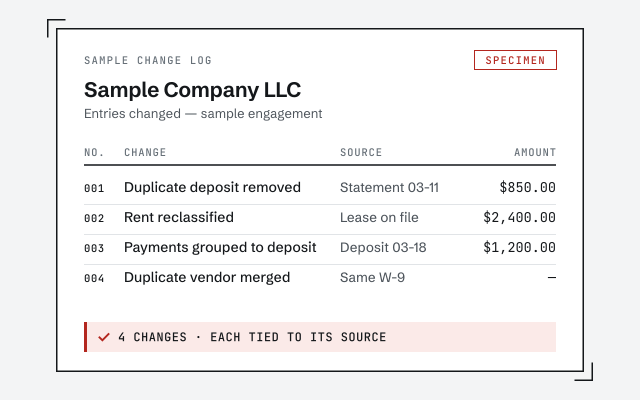
A QuickBooks specialist concentrates on your accounting file — reconciling each account, correcting how transactions were categorized and recorded, and proving the result ties to your bank statements and returns. It is narrower and deeper than general bookkeeping.
The word "specialist" gets used loosely, so here is the plain version. A general bookkeeper records the day-to-day. A CPA handles tax filing and attestation. A QuickBooks specialist works the layer in between: the state of the file. When accounts will not reconcile, when transactions sit in the wrong place, when a migration left balances that no longer foot, or when a year of entries needs to be caught up and made to tie, that is specialist work. We do it inside QuickBooks Online and Desktop, and we do it to a documented standard rather than by assertion — the same discipline set out in our methodology. And when the question turns from repairing the file to directing it — how the books should be structured, kept, and read going forward — that is the neighboring role of a QuickBooks advisor, which we cover under the same roof. It is the core of every QuickBooks service we run.
The layer a specialist works
Read this as text
Three layers of work stacked in order. At the top, the CPA handles tax filing and attestation. At the bottom, a general bookkeeper records the day-to-day entries. In between sits the QuickBooks specialist, working the state of the file itself — reconciling accounts, correcting how transactions were recorded, and making the books tie. An illustrative layer diagram, not a measured figure.