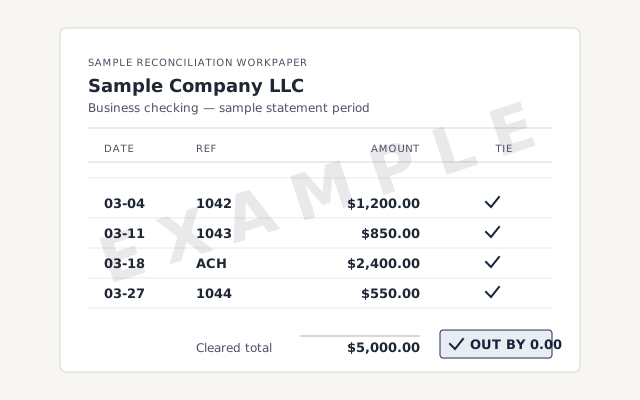
 Sample workflow — not a specific client’s data
A real payout reconciliation
The exact worksheet tying a Shopify payout's sales, fees, refunds, and tax to the deposit on the bank.
QuickBooks Shopify reconciliation
The deposit Shopify sends you is never your order total: Shopify Payments takes its fee first, refunds and chargebacks come off, and one payout covers many orders across a pay period. We book gross sales, fees, and sales tax through a clearing account, then match the net payout to the deposit — so every batch reconciles and your revenue is honest.
Shopify reconciliation means proving that the money Shopify deposited into your bank matches the sales your store actually made — after every fee, refund, and timing lag is accounted for. Shopify is an ecommerce platform where orders arrive all day at their full gross value, but the cash that reaches your bank has already been reduced by Shopify Payments' processing fee and by any refunds or disputes, and it arrives on a payout schedule that batches many orders together. The gap between those two numbers is where most Shopify books go wrong.
The usual failure is simple and quiet: the net Shopify deposit gets booked straight to a "sales" account. That single shortcut buries the processing fees, hides the sales tax you collected inside your revenue, makes refunds invisible, and guarantees the bank reconciliation never quite ties. None of it is the store owner's fault — it is what happens when a merchant payout is treated like an ordinary deposit. This page walks through the mechanics we actually apply to fix it. It is one channel-specific lens on the same discipline as a full QuickBooks cleanup, pointed at a Shopify store's books.
The core problem is the gap between the gross order total a customer paid and the net payout that lands in your bank — and that gap is two things stacked together: fees and timing. Fees are the amount Shopify Payments deducts before it deposits. Timing is the fact that a payout settles a day or more after the sale and usually bundles many orders from a pay period into one deposit.
Walk one order through it. A customer pays the gross total — the product price, any shipping you charged, and the sales tax you collected, less any discount. Shopify Payments then deducts its processing fee. If that order was refunded or disputed, that comes off too. What remains is grouped with every other order settling in the same pay period and sent as a single payout. So the deposit on your bank statement is the gross of a batch of orders, minus fees, minus refunds, arriving after the fact — which is why it can never match a single day's sales figure, and why matching it by eye is hopeless. Reconciliation exists precisely because that arithmetic is invisible from the bank line alone.
The technique that makes a Shopify payout reconcile is a clearing account — a holding account that sits between your sales and your bank. Orders post into it at gross, the fees and refunds reduce it, and when the real payout hits the bank you move that net amount out of clearing into the bank account. If every piece is recorded, the clearing account nets to zero once the payout arrives; whatever is left in it is money Shopify is still holding.
Shopify payout reconciliation
Read left to right, that is the whole method: gross sales, tax, and shipping post to their own accounts; the Shopify Payments fee posts as an expense; refunds and chargebacks reduce the total; and the net that remains is the payout, matched to the deposit on the bank statement. When one payout is built that way, every payout after it reconciles the same way. Getting the underlying accounts right is the foundation, which is why a QuickBooks cleanup is so often where a drifted Shopify file starts.
Processing fees are recorded as an expense, against gross sales — never by shrinking the sales figure down to the net deposit. Shopify Payments deducts its fee before it deposits, so the money never appears in your bank as a separate line; it is simply missing from the payout. If you book only what arrived, your revenue looks smaller than it was and your fee cost disappears entirely, which distorts both the top line and the margin.
The correct entry records the full order value as income and the fee Shopify took as a merchant-fee expense, so the profit-and-loss shows both what you sold and what the fee cost. We do not assert a fee percentage on this page — the rate depends on your Shopify plan and your agreement, and quoting one would be a guess. What matters mechanically is that the actual fee Shopify reports on each payout is the fee we record, every time, so the fee expense on your books matches reality rather than an assumed rate.
Refunds and chargebacks both pull money back out of a payout, so both have to be recorded — and when either is skipped, the payout won't tie and the clearing account won't clear. They are not the same event, though, and treating them identically hides useful information.
A refund is you returning money to a customer; it reverses part or all of a sale and reduces the payout it settles against. A chargeback is a customer disputing a charge through their card issuer, reversed through the card networks, and it can carry its own fee on top of the reversed amount. Booked properly, a refund reduces sales and a chargeback reduces sales while its fee posts as an expense — so your net revenue is honest and the deposit still reconciles. Left out, they are the classic reason a Shopify bank reconciliation is off by an amount nobody can find. This is the same in-transit and adjustment discipline described in our bank reconciliation guide.
Sales tax that Shopify collects on an order is not revenue — it is money you hold on behalf of a tax authority — so it posts to a sales-tax liability, never to income. When the net payout gets booked straight to sales, that collected tax is silently mixed into revenue, which overstates what you earned and leaves the liability you actually owe untracked.
What we do is keep the collected tax coded to its liability consistently, and reconcile that liability to what gets remitted, so the amount you owe is always visible and always ties. Whether a given sale is taxable, which jurisdictions you have to collect for, and the return itself are positions for you and your CPA to set — Shopify's tax settings and your CPA decide the treatment; we make QuickBooks reflect it accurately. We keep the books; we do not file the return or decide the tax position.
Payout timing is the second half of the gap, and it is the one that quietly breaks a month-end close. Shopify Payments settles on a payout schedule, so the cash for today's orders lands in your bank a day or more later, and one payout usually bundles orders from across a pay period. That means at any month-end, some sales have been earned but their cash is still in transit.
The clearing account is what keeps that honest. Orders recorded during the month sit in clearing until their payout arrives, so revenue lands in the period it was earned while the bank only ever shows cash that actually moved. The clearing balance at month-end is the in-transit amount — the money Shopify is holding but hasn't paid out — which is a real number you can point to, not a mystery discrepancy. When several processors are in play, each payout stream gets its own clearing account so a Shopify Payments deposit and a third-party gateway deposit never get tangled. It is the same in-transit discipline any clean bank reconciliation relies on. And if you also sell on a marketplace, the batching takes a different shape there — settlement reports, reserves, FBA fees — which is why decomposing Amazon settlements into QuickBooks gets a walkthrough of its own.
The month-end timing gap
How it goes
Whether you need a one-time catch-up or ongoing monthly work, the shape is the same: a free review, a pass to set up the clearing account and mapping, reconciliation of the payouts to the bank, and a handback. Stores months behind start with a catch-up; stores that are current move straight to a clean monthly rhythm.
Day 0
View-only look at the file: how payouts, fees, and tax are posting today, and how far behind the reconciliation is.
Week 1
A clearing account per payout stream, gross-sales mapping, and fee, refund, and sales-tax accounts set correctly.
Weeks 1–2
Each payout split into sales, fees, refunds, and tax and tied to the bank deposit; the sales-tax liability reconciled.
Ongoing
A file that ties, a written summary of what changed, and either a handback or ongoing monthly bookkeeping.
What changes
A file built for Shopify shows gross sales, breaks out fees and tax, and ties each payout to the bank; a file that books net deposits hides all of it. Here is the difference line by line.
| Reconciled properly | Booked as net deposits | |
|---|---|---|
| Gross sales recorded at full order value | — | |
| Shopify Payments fees shown as expense | — | |
| Refunds and chargebacks recorded | — | |
| Sales tax coded to a liability | — | |
| Payout matched through a clearing account | — | |
| In-transit balance visible at month-end | — | |
| Bank deposit ties to the penny | — | |
| Verdict | A file you and your CPA can trust | Revenue and fees nobody can see |
What it costs
Real ranges depend on order volume, payout streams, and how far behind the books are. The floors shown are published starting points; a free review sets your scope.
| Engagement | Typical range | Timeline | What's included |
|---|---|---|---|
| Shopify cleanup / catch-up | From $1,500 | 2–4 weeks | Rebuild gross sales, break out fees and refunds, restore the sales-tax liability, reconcile back payouts. |
| Monthly bookkeeping | From $400/mo | Ongoing | Each payout reconciled through clearing, fees and sales tax kept current, monthly P&L, one payout stream. |
| Multi-channel / multi-processor | Custom fixed quote | Scoped | Several payout streams, a clearing account each, consolidated into one reconciled file. |
| Get your range after a free review | |||
Shopify cleanup / catch-up
Monthly bookkeeping
Multi-channel / multi-processor
The same hands set up and reconcile your file from a documented plan — not an offshore pool learning what a payout schedule is on your books. Every store we take on gets the same mechanics applied deliberately: gross sales booked, fees and refunds broken out, sales tax to its liability, each payout tied through a clearing account.
Our discipline is verification, not assertion. We reconcile each payout to the deposit and show you the tie, rather than telling you it balances. Access stays minimal — QuickBooks' accountant access to make and log every correction, or a screen-share you control, never your bank logins or your Shopify admin credentials. And we stay in our lane: we keep the books accurately and consistently, and we hand your CPA a file that already ties, but we do not file sales-tax returns, decide whether a sale is taxable, or give tax advice. That line is deliberate, and the honesty about where our job ends is part of doing it well. You can read the full method on our methodology page.
Skip us when your file already works. If your Shopify payouts already reconcile to the bank, your gross sales and fees are already broken out, and your sales-tax liability already ties to what you remit, there is nothing here for us to fix — and no reason to pay someone to reconcile a file that already ties.
Skip us, too, when what you need is a different professional. If you need a return prepared, a ruling on whether a product is taxable in a given state, or nexus advice, that is your CPA's work, not ours. And if your store volume is low enough that one payout a week reconciles in a few minutes and you are comfortable in QuickBooks, you may be able to set the clearing account up yourself with a cleanup checklist and no invoice from anyone. We will tell you which case you are in during the free review, even when the honest answer is that you do not need us. See the full range of industries and integrations we reconcile to find the closest fit.
You don't have to take our word for it. Here is the evidence you can check — the deliverable you receive, the method we use to prove a payout ties, and our response commitment.
Sample workflow — not a specific client’s data
The exact worksheet tying a Shopify payout's sales, fees, refunds, and tax to the deposit on the bank.
Each payout reconciled to the deposit, each fee and refund tied out. Read the discipline we apply.
Read the full methodA written reply within one business day.
Remote-first, nationwide
Mon–Sat · 8am–6pm CT
We work entirely remote — view-only for the free review, then QuickBooks' accountant access to make and log every correction — never your bank logins; screen-share whenever you want to watch, and every reconciliation and correction documented in writing.
Because a payout is never the same number as the orders that produced it. Shopify Payments takes its processing fee before it deposits, refunds and chargebacks are netted out, and a single payout usually covers several orders across a pay period rather than one order at a time. So the deposit that lands in your bank is the gross of many orders, minus fees, minus refunds — and it settles a day or more after the sales happened. Reconciliation splits that deposit back into its parts so it ties to the bank.
As an expense, not as lost sales. The mistake we see most often is booking only the net deposit as income, which quietly understates both revenue and expenses. Instead we record gross sales at the full order value, then record the processing fee Shopify deducted as a merchant-fee expense. That way your profit-and-loss shows what you actually sold and what the fee actually cost, and both numbers are there when your CPA needs them. We do not assert a fee percentage on this page — the rate is set by your Shopify plan and agreement, and we use the actual fee Shopify reports on your payout.
A clearing account is a holding account that sits between your Shopify sales and your bank. Orders post into it at gross, fees and refunds reduce it, and when the real payout hits the bank you move that net amount out of clearing and into the bank account. Done right, the clearing balance at any moment equals the money Shopify is holding but hasn't paid out yet — the in-transit amount — and it nets to zero once every payout has arrived. It is the single technique that makes a multi-order payout reconcile cleanly.
Both reduce a payout, so both have to be recorded, and they behave a little differently. A refund reverses part or all of a sale and reduces the payout it settles against. A chargeback is a customer dispute reversed through the card networks, and it can carry its own fee. If either is simply left out, the payout won't tie and the clearing account won't clear. We record refunds against sales and chargebacks with their fee so the deposit reconciles and your net revenue is honest.
We record it correctly; we do not file it. When Shopify collects sales tax on an order, that money is not revenue — it is money you owe to a tax authority, so it posts to a sales-tax liability, not to income. We keep that coding consistent and reconcile the liability to what gets remitted. Whether a sale is taxable, which jurisdictions you owe, and the return itself are positions for you and your CPA to set. We make QuickBooks reflect them accurately.
Shopify lets merchants take payment through third-party gateways as well as Shopify Payments, and each settles on its own schedule with its own fees. The reconciliation method is the same — gross sales in, fees out, payout matched — but each payout stream gets its own clearing account so a PayPal deposit and a Shopify Payments deposit never get tangled. If several processors are involved, we set one clearing account per stream and reconcile each to its own report.
Payouts settle a day or more after the orders happen and often batch across a pay period, so at month-end some sales have been earned but the cash is still in transit. The clearing account captures exactly that: orders recorded in the month sit in clearing until their payout arrives, so your revenue lands in the right period and the timing gap is visible instead of silently throwing off the bank reconciliation. It is the same in-transit discipline we apply in any bank reconciliation.
Yes, and it is a common starting point. When months of payouts have been booked as plain deposits with fees, refunds, and tax all buried inside the net number, the fix is a catch-up: rebuilding gross sales, breaking out fees and refunds, restoring the sales-tax liability, and reconciling each payout to the bank. Once the file is current and the clearing account is set, keeping it current each month is light work. The free review tells you how far off the books actually are.
The fee depends on your order volume, how many payout streams you run, how far behind the books are, and whether you need a one-time cleanup or ongoing monthly work. We set a fixed scope and a fixed fee after a free review rather than quoting a number that has to change later. The floors on this page are published starting points; the review sets your real range.
Shopify reconciliation is one channel lens on the same craft. See the bank reconciliation guide for the in-transit method underneath it, the full QuickBooks cleanup a Shopify catch-up is part of, and every industry and integration we reconcile.