QBSpecialist

Hire a QuickBooks advisor

A QuickBooks advisor who guides the books and can prove they tie.

QuickBooks advisory work is about decisions and the written record behind them: how the file is structured, how transactions are recorded, and what the reports are telling you — and then the file corrected to match. We are an independent practice, not a marketplace, a freelancer, or Intuit.

Checking a credential instead? What a ProAdvisor certification proves, and how to check one.

Last reviewed October 2026 by a Certified QuickBooks ProAdvisor

What this page is based on: our reconciliation-first methodology, Intuit’s Find an accountant directory and the SBA’s resource-partner page (checked October 2026)

How to verify a QuickBooks advisor's work
  • Independent firm, not Intuit
  • Specialist-led and remote
  • Documented, auditable work

What a QuickBooks advisor does

A QuickBooks advisor guides the decisions behind your books — how the chart of accounts is structured, how transactions get categorized, and how to read what the reports are telling you — so the accounting supports the business instead of confusing it.

Most people who search for a QuickBooks advisor mean one of two things: a credentialed QuickBooks professional — usually an Intuit ProAdvisor, whom you can look up in Intuit's Find an accountant directory and whose credential our ProAdvisor page explains — or someone to decide how their books should run. This page is about the second: advisory as an engagement. (A third label you may meet, QuickBooks Certified User, is a separate user-level exam, not the ProAdvisor certification.)

That is broader than data entry and narrower than tax. A bookkeeper records what happened; an advisor shapes how it should be recorded and then makes sure the file reflects it. In practice the two run together: the advice about how your QuickBooks should be run is worth little until the file actually matches it, so we do both — review the structure, recommend the fix, and carry it out with a written change log you can trace. When we advise on our full QuickBooks specialist engagements, the deliverable is never just an opinion; it is books that tie.

Advisor, ProAdvisor, or Intuit — what we do and don't claim

"QuickBooks advisor" is a role, not a credential. "ProAdvisor" is a specific Intuit program with its own membership and badge, and we are careful not to blur the two: the specialist who does our work holds Intuit's ProAdvisor certification, which is that person's credential rather than the firm's, and the advisory role described on this page is the work, not the badge.

We are an independent QuickBooks specialist firm — not Intuit, not owned by Intuit, and not speaking for Intuit. We work inside the QuickBooks products your business already uses, but we are the people who keep your file honest, not the company that sells the software. That independence is the point: our advice is about your books and what they need, never about moving you onto a plan. If you are trying to understand the ProAdvisor program itself — what it is, who it is for, and how it compares to hiring a firm like ours — we explain it plainly on our QuickBooks ProAdvisor page rather than dressing ourselves in a label.

Advisor, bookkeeper, or consultant — which one you need

Three questions, three roles

Advisor, bookkeeper, or consultant — the question names the role ADVISOR BOOKKEEPER CONSULTANT How should this file be run? Keep it current every month Fix this specific project DIRECTION DOING A DEFINED FIX MOST OWNERS NEED A BLEND — ONE ENGAGEMENT USUALLY COVERS IT
Read this as text

Three roles matched to three questions. An advisor answers how the file should be run — direction. A bookkeeper keeps it current every month — doing. A consultant fixes a specific, defined project. Most owners need some blend, and one engagement usually covers it. An illustrative role map, not a ranking.

The dividing line is direction versus doing: an advisor decides how the file should be run, a bookkeeper keeps it current every month, and a consultant fixes a defined project — most owners need a blend that one engagement can cover. An illustrative role map, not a ranking.

You need an advisor when the question is "how should this file be run," a bookkeeper when the question is "keep it current every month," and a consultant when the question is "fix this specific project." Most owners need some blend, and one engagement usually covers it.

The dividing line is direction versus doing. If your books are recorded but you can't trust the reports, or nobody has decided how categories and accounts should work, that is advisory. If the transactions simply need to be entered and reconciled on a schedule, that is bookkeeping. If you have a defined problem — a migration, a cleanup, a payroll snarl — that is closer to consulting, the role our page on hiring a QuickBooks consultant walks through in full. Because we run all three under one roof, the free review sorts your situation into the right one instead of selling you the most expensive label. For the practice behind that judgment, our about page describes who actually does the work.

What a QuickBooks advisory engagement delivers

Advice you cannot hold in your hand tends to fade by the next quarter, so an advisory engagement here ends in written decisions and a file that already follows them:

  • A chart of accounts built for your business. The accounts you actually need, grouped the way your lender and CPA read them, with a written old-to-new mapping so merged accounts keep their history. (The mechanics are on our chart of accounts cleanup page.)
  • A one-page file policy. How each recurring transaction is recorded — customer payments and deposits, card payments, loan payments, owner draws, refunds — and which bank rules do what, so everyone who touches the file records it the same way.
  • The structure your reports need. Classes or locations if you report by department or site (class tracking setup), jobs if you price by project (job costing setup), and inventory settings if you hold stock.
  • A monthly read-out. Your profit and loss, balance sheet and receivables and payables aging, read with you: what moved, why, and what needs a decision.
  • Product decisions made on evidence. Online or Desktop, which plan, which apps to connect — with the trade-offs written down (see QuickBooks Online vs. Desktop and integration setup).

If what you need is general business guidance rather than work inside your file, the SBA's Small Business Development Centers offer counseling and training, including financial management, and the SBA lists SCORE mentors as a no-cost option (checked October 2026). We will say so in the free review if that is the better fit.

Who you're hiring

A practice, not a marketplace

Hiring a QuickBooks advisor usually means choosing among three things: a gig marketplace that matches you to whoever is available, a lone freelancer, or a specialist practice like ours. They are genuinely different, and the honest trade-offs matter.

Hiring a QuickBooks advisor: practice vs. marketplace vs. freelancer
Our practiceGig marketplaceLone freelancer
Specialist-led work throughoutIt dependsIt depends
Documented, auditable change logIt dependsIt depends
One person owns the file end to end
Fixed scope quoted before workIt dependsIt depends
Independent of Intuit sales
Best whenYou want accountable, repeatable workYou want the lowest hourly rateYou've vetted the individual
VerdictAccountable and documentedCheap, unevenDepends on the person

How to start with a QuickBooks advisor here

You start with a free, view-only review. We look at your actual file, tell you what it needs and what it doesn't, and quote a fixed scope before any work begins — so you are never buying advice by the hour into an open-ended bill.

From there the work is remote and documented: the free review runs on view-only access, then the work itself uses QuickBooks' accountant access to make and log every correction — never your bank logins — with corrections carried out against your real records, and a written log of every change so you — or your CPA — can audit it. We hold a bright line at tax: we advise on the books and keep them readable, but we are not a CPA or tax firm, and where something is a tax or legal judgment we flag it for your preparer rather than decide it. Our full method, step by step, lives on the methodology page. And if the review shows you don't actually need an advisor — your file is clean and your reports already tie — we tell you that plainly, because there is no honest reason to sell you work you don't need. When you're ready, the free QuickBooks review is the front door.

The engagement, in order

How an advisor engagement runs — review to auditable change log Free, view-only review NO CHANGES YET Fixed scope, in writing BEFORE WORK BEGINS Corrections carried out EVERY CHANGE LOGGED Change log YOURS TO AUDIT
Read this as text

Four stages in order: a free, view-only review of the actual file, a fixed scope quoted in writing before any work begins, corrections carried out against the real records, and a written change log handed over at the end. The verified tick marks that auditable end state.
Every advisory engagement runs the same way — a free, view-only review, a fixed scope in writing before work begins, and corrections logged as they are made — ending in a written change log you or your CPA can audit; the tick marks that end state. An illustrative diagram of the method.

How to verify a QuickBooks advisor's work

You don't have to take our word for it. Here is what you can check before and after you hire — the deliverable you receive, the method we follow, and our response commitment.

  • Who’s responsible for your file

    A Certified QuickBooks ProAdvisor handles your file from the review through the corrections to the hand-back — the same person throughout, never a rotating pool.

    About QBSpecialist
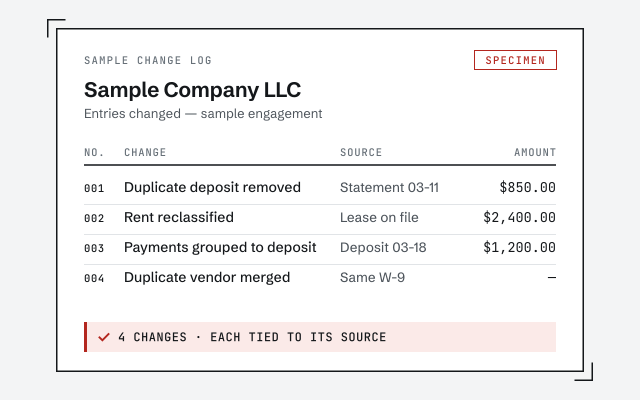
  • Sample change log — an illustrative record of four corrections for Sample Company LLC, each with its reason and source. Marked SPECIMEN, not a real client document. Columns: No., Change, Source, Amount. Rows: 001, Duplicate deposit removed, Statement 03-11, $850.00; 002, Rent reclassified, Lease on file, $2,400.00; 003, Payments grouped to deposit, Deposit 03-18, $1,200.00; 004, Duplicate vendor merged, Same W-9, —. Result: 4 changes, each tied to its source.Illustrative example — not a client file.

    Sample change log

    The documented log of corrections you receive, so every advisory decision is traceable in the file.

  • Our methodology

    How we tie the books to reality, written out in full.

    Read the full method
  • Response commitment

    A written reply within one business day.

Remote-first, nationwide

Mon–Sat · 8am–6pm CT

We work entirely remote — view-only access for the free review, QuickBooks' accountant access for the work itself, every change visible to you in the audit log, and every advisory correction documented in writing.

Questions about QuickBooks advisor

Is a QuickBooks advisor the same as an Intuit ProAdvisor?

Not the same thing. "QuickBooks advisor" describes the role — someone who guides how your file is set up, kept, and read. "ProAdvisor" is a specific Intuit program with its own membership and badge. The specialist who does our work is a Certified QuickBooks ProAdvisor — Intuit awards that to individuals, so it is the specialist's credential, not the firm's — and we are an independent firm, not Intuit. If you want to understand what the ProAdvisor program is and how it fits your search, we explain it plainly on our ProAdvisor page.

Are you Intuit, or affiliated with Intuit?

No. We are an independent QuickBooks specialist firm, not Intuit and not owned by Intuit. We work inside the QuickBooks products your business already uses, but we are not the software maker and we do not speak for Intuit. That independence is why our advice is about your books, not about selling you a plan.

Do I need a QuickBooks advisor or a bookkeeper?

A bookkeeper records the transactions; an advisor guides the decisions behind them — the chart of accounts, how items get categorized, what the reports are actually telling you. Many owners need both, and often the same engagement covers both. If you mainly need the monthly work done, start with bookkeeping; if you need direction on how the file should be run, start with an advisor. The free review tells you which you actually need.

Can an advisor fix my existing QuickBooks file, or only give advice?

Both. Advising on how a file should be run and correcting the file so it matches that are the same discipline done twice. We can review your existing QuickBooks, tell you where it drifted, and do the reconciling and recategorizing to bring it back — with a written log of every change so you can audit the work.

What does a QuickBooks advisory engagement actually deliver?

Written decisions you can keep, and a file that matches them: a redesigned chart of accounts with the old-to-new mapping, a one-page file policy saying how each recurring transaction is recorded, the structure for classes, locations, jobs or inventory if you need them, and a monthly read-out of your reports that explains what moved and why. Each change is logged so your CPA can trace it.

Where can I find a QuickBooks advisor for free?

Two places worth knowing. The SBA's Small Business Development Centers offer counseling and training, including on financial management, and the SBA lists SCORE mentors as a no-cost option — good for general business questions, though not hands-on work in your file. For someone who works inside QuickBooks, Intuit's Find an accountant directory lets you search ProAdvisors by location, services and software.

Do you give tax advice?

No. We are a bookkeeping and QuickBooks practice, not a CPA or tax firm. We keep the books right and readable so your accountant can file from numbers that tie — and where something is a tax or legal judgment, we flag it for your preparer rather than decide it ourselves. We advise on the books; your CPA advises on the tax.

How do I start with a QuickBooks advisor here?

Start with a free, view-only review. We look at your file, tell you what it needs and what it doesn't, and quote a fixed scope before any work begins. There is no obligation, and if the honest answer is that you don't need us, we say so.

Still narrowing the role? See what an Intuit ProAdvisor actually is, meet the practice behind the work on our about page, or start every engagement the same way — with a free QuickBooks review.

  • Bookkeeper— the person who keeps the records the advice is based on
  • Accountant— where the advice stops and a CPA's signature starts

Not sure how bad it is?

Talk to a QuickBooks specialist.

Describe the file and a specialist will tell you which of these you are dealing with — including when the answer is that you don't need us.

Or start with a free, view-only review